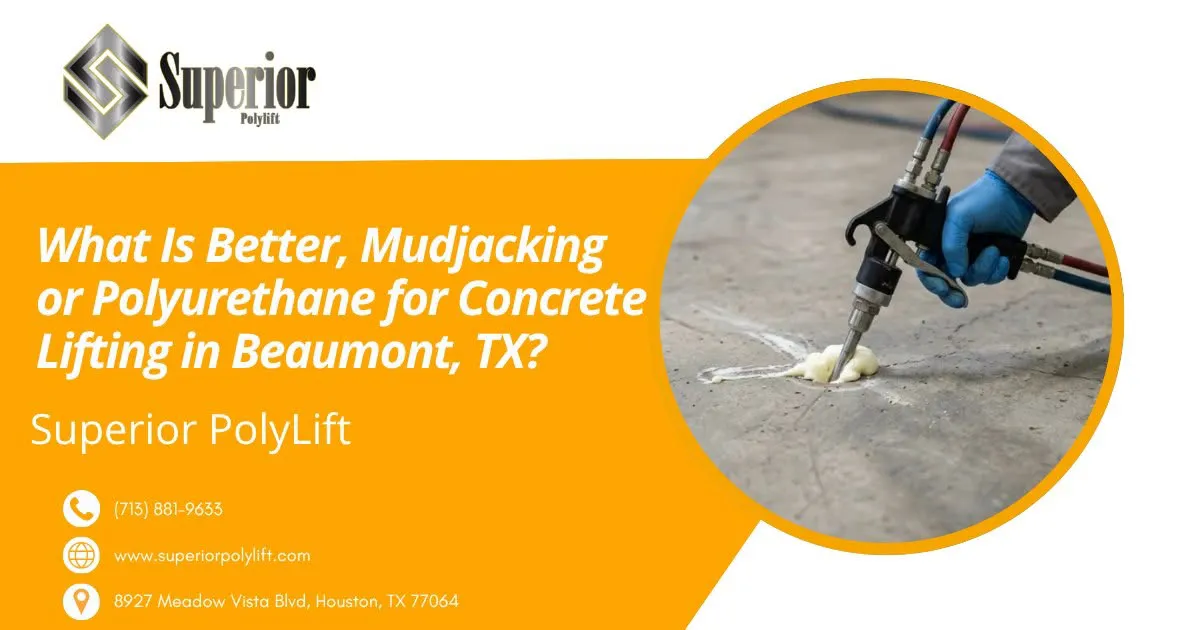
Polyurethane foam outperforms mudjacking in Beaumont's expansive clay and high-moisture conditions. Foam weighs 2-4 lbs/cubic foot vs mudjacking's 100-150 lbs/cubic foot, cures in 15 minutes to 1 hour vs 24-48 hours, lasts 20+ years vs 2-5 years, and resists water rather than absorbing it. Mudjacking remains a budget option only for stable, well-drained sites where long-term durability is secondary.
When concrete slabs sink or become uneven on commercial properties around Beaumont, you face a critical choice: traditional mudjacking or modern polyurethane foam injection. Beaumont's expansive clay soils create unique challenges. Repeated wet-dry cycles cause soil movement that can quickly undermine repairs not designed for high-moisture environments.
This article compares the two concrete lifting methods on durability, weight impact on unstable soils, cure time, and long-term performance under Gulf Coast conditions. The decision affects warehouse floors, refinery infrastructure, loading docks, dock aprons, sidewalks, and machinery pads. For industrial sites where downtime carries material costs, choosing the right method matters even more than upfront price.
Superior PolyLift offers polyurethane concrete lifting and foundation services engineered for industrial and commercial sites across Southeast Texas, with workflows tuned for refinery, logistics, public works, and chemical-plant operating environments.
Mudjacking, also called slabjacking or concrete leveling, has been used since the 1930s to lift settled concrete slabs by pumping a cement-soil slurry beneath them. It is the older of the two methods and remains in use across the United States, particularly where budget concerns dominate decision-making. Process basics:
This weight adds significant load to already unstable soil, potentially causing additional settling over time, particularly in saturated clay environments. The slurry also takes time to fully cure, during which traffic loads can cause initial compression and partial settling before the final position is locked in.
When done correctly in well-drained soils, mudjacking lasts 2-5 years, though some report up to 10 years in optimal conditions. In Beaumont's environment with poor drainage and saturated clay soils, lifespan is significantly shorter. Several factors limit longevity:
Cost typically ranges from $3-$6 per square foot, with most jobs running $500-$1,500 total. Warranties typically cover 1-3 years, reflecting contractor confidence in the material's limited durability. Lifecycle cost analysis often favors polyurethane despite the higher upfront price.
Polyurethane concrete lifting injects dual-component foam beneath concrete to fill voids, compact loose soil, and lift slabs. The technology emerged in the late 1970s and has been refined extensively for infrastructure use over the past two decades. Process basics:
The International Concrete Repair Institute (ICRI) technical guidelines cover the standards and best practices that govern polyurethane concrete repair work, including substrate preparation, injection patterns, and post-installation verification.
Quality polyurethane lifting uses precision instrumentation:
This level of precision far exceeds what is possible with mudjacking, where high-pressure hydraulics create greater risk of over-lifting or uneven results. Modern injection equipment is computer-monitored, and trained crews follow standardized lift sequences that produce repeatable outcomes.
Polyurethane foam ranges from 50-100 PSI depending on density, with high-density formulations reaching 120-150 PSI. The Illinois Tollway requires approximately 47 PSI for highway pavement carrying semi-truck loads, proving this strength is sufficient for demanding infrastructure applications. Working strength is achieved within 15-30 minutes, with full load-bearing capacity within one hour.
Surfaces can be used the same day. Polyurethane foam solutions last 20 years or more, often matching the remaining lifespan of the concrete itself. Once cured, foam resists moisture, erosion, and temperature extremes without shrinking or decomposing. Closed-cell structure is the key to this durability: water cannot penetrate the foam matrix, so it cannot leach material or cause progressive degradation.
Cost typically ranges from $5-$25 per square foot, with typical jobs costing $800-$2,500. Labor represents 70-80 percent of costs because precision injection and elevation monitoring require skilled crews. Polyurethane companies commonly offer 5-10 year guarantees, reflecting confidence in long-term performance. When evaluating bids, the lifecycle cost ratio (cost divided by expected service years) typically favors polyurethane by a wide margin.
Table 1: Mudjacking vs Polyurethane Foam Quick Comparison
| Attribute | Mudjacking | Polyurethane Foam |
| Material weight | 100-150 lbs/cubic foot | 2-4 lbs/cubic foot |
| Drill hole size | 1-2 inches | 5/8 inch |
| Cure time | 24-48 hours | 15 min to 1 hour |
| Compressive strength | Up to 2,400 PSI | 50-150 PSI |
| Water resistance | Absorbs water | Hydrophobic, closed-cell |
| Typical lifespan | 2-5 years | 20+ years |
| Typical cost | $3-$6 per sq ft | $5-$25 per sq ft |
| Warranty | 1-3 years | 5-10 years |
The weight difference is dramatic: mudjacking weighs 100-150 lbs/cubic foot, while polyurethane foam weighs 2-4 lbs/cubic foot, a 25-to-50-fold difference. Polyurethane is far less likely to overburden unstable soil.
Mudjacking uses 1-2 inch holes; polyurethane uses 5/8-inch holes, making repairs less obtrusive and easier to patch. Polyurethane foam is closed-cell and hydrophobic, resisting water infiltration. Mudjacking's cement-soil mixture is porous and susceptible to water degradation, a critical disadvantage in wet climates.
Beaumont experiences triple-threat conditions: expansive clay soils, extreme Gulf Coast moisture, and punishing industrial traffic. The region features Vertisols, clay-rich soils with 40-75 percent clay content that form large cracks when dry and become saturated quickly during rain.
These conditions create unique challenges for concrete stabilization. Heavy materials like mudjacking slurry add weight to soil that is already prone to movement and saturation. The Beaumont area also experiences:
Closed-cell polyurethane seals sub-grade soils, guarding against frequent rain events and storm surges. Mudjacking grout, by contrast, absorbs water and can erode within months in saturated environments. The cement-soil mixture is also prone to washout where storm-surge or sheet-flow water passes through the slab interface.
Table 2: Method Performance in Beaumont Conditions
| Beaumont Condition | Mudjacking Performance | Polyurethane Performance |
| Expansive clay (Vertisols) | Adds weight to unstable soil | Lightweight, no added load |
| Heavy rainfall | Erodes and degrades over time | Hydrophobic, water-resistant |
| Wet-dry cycles | Cracks form with soil movement | Maintains integrity |
| Industrial traffic | Adequate compressive strength | Sufficient for most applications |
| Storm surge exposure | Material breaks down | Resists infiltration |
| Tight schedules | 24-48 hour cure delays operations | Same-day return to service |
Different applications favor different methods. Match the method to the site:
Table 3: Application-Specific Method Recommendations
| Application | Recommended Method | Key Reason |
| Refinery slab lifting | Polyurethane | Same-day return to service |
| Warehouse floor leveling | Polyurethane | Heavy load tolerance, fast cure |
| Loading dock repair | Polyurethane | Minimal downtime for logistics |
| Sidewalk and apron lifting | Polyurethane | Clean cosmetic finish |
| Highway pavement lift | Polyurethane | DOT-preferred, lightweight |
| Bridge approach repair | Polyurethane | Lightweight, no added load |
| Public works infrastructure | Polyurethane | Long warranty, low lifecycle cost |
| Stable-soil parking lots | Mudjacking acceptable | Budget primary constraint |
| Sites near wells | Polyurethane only | Safety profile |
| Storm-surge zones | Polyurethane | Hydrophobic resistance |
Mudjacking remains viable for budget-conscious repairs on large areas with stable, well-drained soils. When cost per square foot is the primary constraint and long-term durability concerns are secondary, it can be an acceptable choice. In Beaumont's expansive clay environment, however, those conditions are rare. Sites in interior Texas with sandy or loamy soils may meet the criteria, but Gulf Coast sites typically do not.
Polyurethane foam has constraints worth understanding before committing to a project:
Each of these constraints is manageable when identified during the pre-job site evaluation. A qualified contractor walks the site, reviews drainage patterns, examines existing cracks, probes for void locations, and may take core samples if conditions warrant. The result is an engineered injection plan rather than a generic price-per-foot quote.
Working with an experienced Beaumont commercial concrete lifting contractor ensures proper assessment, engineered solutions, and precision application for long-term structural stability. Look for contractors who provide written scope documents detailing injection point locations, expected lift volumes, and verification methods before work begins.
Before selecting a concrete lifting method, work through these questions with your contractor:
Honest answers to these questions point most Beaumont commercial sites toward polyurethane. Mudjacking should be considered only when the site genuinely fits its narrow performance window. A site walk with a qualified contractor typically resolves the decision within an hour, including measurement of slab tilt, void detection, and drainage observation.
For multi-slab projects (large warehouses, refinery aprons, multi-bay loading docks), most operators prefer a single method across the whole site to simplify warranty terms and future maintenance. Splitting methods across adjacent slabs creates uneven service-life expectations and complicates re-lifting decisions years later.
If you are dealing with sunken concrete in Beaumont, Superior PolyLift can help you choose the right solution for your property's unique conditions. Our team specializes in polyurethane lifting designed for Gulf Coast soils and provides detailed quotes within 48 hours.
Call 281-894-4175 today to request a free estimate and discover how we can restore your concrete quickly and permanently.
Discuss your concrete lifting options.
Plan a long-lasting Gulf Coast solution.

Explore how our expertise can benefit your project. Reach out to our team for a consultation and discover the best solutions for your needs.

At Superior PolyLift™, integrity and reliability are the core of our ethos. Our expert team crafts custom solutions that guarantee quality and durability for every project. Choose us for geotechnical excellence that endures.
Copyright © All rights reserved. 2024 • Terms of Use and Privacy Policy • Internet Marketing by Authority Solutions®