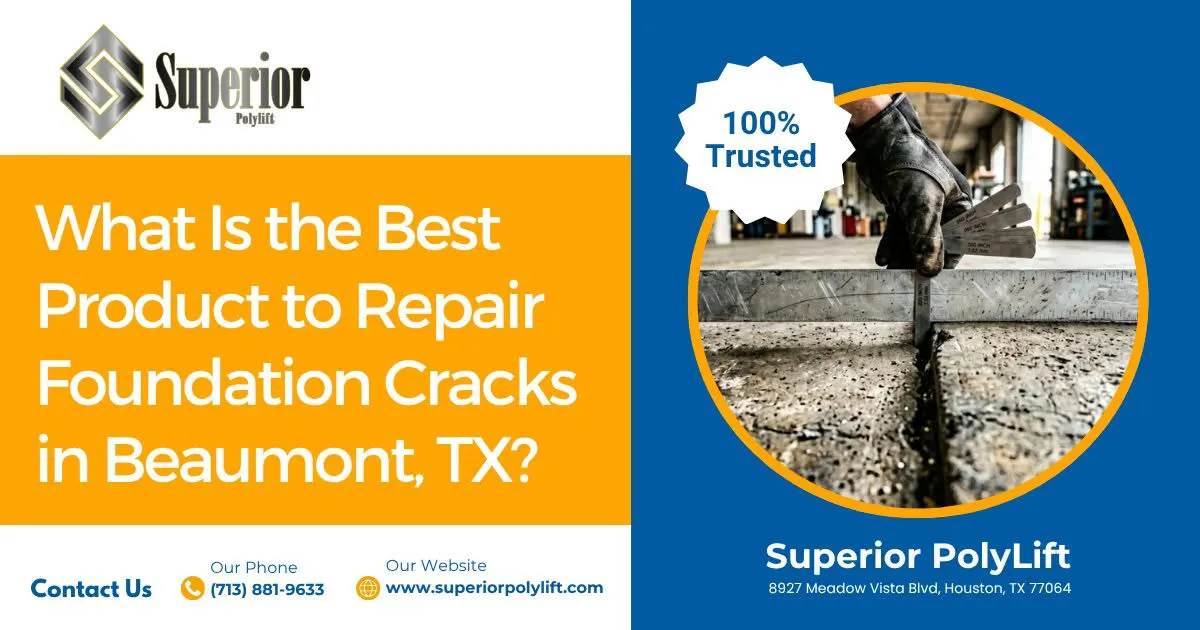
There is no single best product. The right choice depends on whether the crack is structural and whether it is leaking. Polyurethane foam injection is the best product for non-structural, actively leaking cracks because it cures in wet conditions and stays flexible. Epoxy injection is best for structural cracks in dry concrete because it restores load-carrying capacity. Hydraulic cement should be avoided entirely in Beaumont's expansive clay.
When cracks appear in a Beaumont foundation, choosing the right repair product isn't as simple as picking up a tube of sealant. The region's expansive clay soils and heavy rainfall create unique challenges that cause foundations to shift, crack, and leak, and surface patches rarely hold up over time.
The best solution depends on whether the crack is structural or simply allowing water intrusion, which is why understanding the difference between polyurethane foam injection, epoxy systems, and other repair methods matters. In this guide, you'll learn how to match the right product to a specific crack type, soil conditions, and long-term performance needs.
Beaumont sits in Southeast Texas near the Neches River delta and the Gulf of Mexico, where clay-rich soils, shallow water tables, and frequent heavy rainfall create challenging conditions for foundations. The expansive clay soils in this region swell when saturated and shrink when dry, producing cyclical movement that promotes cracking, tilting, and misalignment of structural elements.
This seasonal expansion and contraction places continuous stress on concrete foundations, making cracks almost inevitable over time. Understanding the local soil conditions is the first step in choosing the right repair product and the right approach to foundation repair.
Non-structural cracks are often associated with concrete shrinkage during curing and typically appear as vertical or diagonal hairline cracks less than 1/4 inch in width. While these cracks don't threaten the structural integrity of a foundation, they can still admit water, soil gases such as radon, and insects.
Even minor cracks deserve attention in Beaumont's wet climate, where water intrusion can lead to larger problems over time.
Structural cracks are linked to foundation movement, load redistribution, or material deterioration such as corrosion-induced splitting. These cracks may be wider than 1/4 inch and often appear horizontal or in stepped patterns along mortar joints.
A horizontal crack in a foundation wall can indicate that lateral soil pressure has exceeded the wall's capacity, requiring immediate professional evaluation and structural repair.
The presence or absence of water in a crack dramatically affects which repair product will work best. Epoxy injection resins are typically designed for use on dry substrates and do not perform well when injected into cracks with flowing water.
In contrast, polyurethane injection systems are often water-activated and deliberately formulated to react with moisture, expanding to create seals in actively leaking cracks. The table below matches crack conditions to the appropriate product.
| Crack condition | Best product | Why |
| Non-structural, leaking | Polyurethane foam injection | Cures in wet conditions, stays flexible |
| Structural, dry | Epoxy injection | Restores tensile and compressive strength |
| Structural, leaking | Staged: polyurethane, then epoxy | Stop water first, then restore capacity |
| Lateral pressure, bowing | Carbon fiber reinforcement | Adds bending and shear capacity |
| Slab crack with voids beneath | Polyurethane slab lifting | Addresses the support failure causing it |
Hydraulic cement is rarely the right solution for long-term crack repair, particularly in foundations. When hydraulic cement cures, it forms a rigid, inflexible material that does not accommodate the natural expansion and contraction of concrete.
Rigid hydraulic cement patches are prone to re-cracking, separation, or debonding even under minor movement. In Beaumont, where expansive clay soils and high moisture levels cause ongoing foundation movement, hydraulic cement's inability to flex makes it a poor choice for durable crack repair.
While hydraulic cement may seem like an inexpensive quick fix, it typically fails within months or a few years, requiring repeated repairs. On a facility where access is disruptive or costly, that repeat cycle often exceeds the price of doing it correctly once.
Epoxy is a two-component resin system that cures into a hard, rigid polymer with high compressive and tensile strength, often exceeding that of the surrounding concrete. High-quality structural epoxies are considered excellent adhesives for structural crack repair in foundation walls and beams.
Epoxy injection excels in specific scenarios:
Epoxy is generally performed on dry substrates, since moisture can interfere with proper curing. Its rigid nature means it does not accommodate significant future movement, making it less suitable for foundations still experiencing active settlement or seasonal movement.
In Beaumont's environment, epoxy works best when combined with other solutions that stabilize the soil and eliminate the root cause of movement.
Polyurethane injection for cracks is typically a dual-component system where resin and activator are mixed immediately before injection. Many crack injection polyurethanes are water-activated: when the mixed liquid encounters moisture, it reacts to form a foam that expands significantly, often two to forty times its original volume.
Polyurethane foam injection offers several advantages in Southeast Texas conditions:
It's important to recognize that polyurethane is not a structural repair product for cracks. It does not provide the tensile and compressive strength needed to restore load-carrying capacity. Instead, it functions as a flexible or semi-rigid sealant rather than a structural adhesive.
For non-structural, leaking cracks, polyurethane foam injection is generally the material of choice, particularly for below-grade applications that experience active leaks.
Carbon fiber straps, staples, or laminates are applied to walls using specialized adhesives and serve to provide additional support and stability to cracked sections. Contractors may recommend carbon fiber straps to repair structural cracks by bonding the strap across the crack to the wall surface, thereby increasing bending and shear capacity.
Carbon fiber is typically used for structural reinforcement rather than crack filling itself, complementing injection materials where walls are subject to ongoing lateral pressure from expansive soils.
Polyurethane concrete lifting, often termed polyjacking, involves injecting a dual-liquid polyurethane material underneath a concrete slab through small holes drilled through or adjacent to the slab. Once injected, the mixed liquid reacts to expand and fill voids, compacting the surrounding earth and creating a denser, more stable base.
In Beaumont, where expansive clay soils shrink during dry periods and leave voids under slabs, polyurethane void filling and slab lifting directly tackle one of the root causes of cracking in pavements, loading areas, and interior floor slabs.
Repairing cracks without addressing underlying voids treats the symptom rather than the cause, and the cracking generally returns.
Polyurethane slab lifting is quick and cost-effective compared to traditional mudjacking or slab replacement, with several practical advantages:
That fast return to service matters on sites where a closed loading area, warehouse aisle, or drive lane carries a real operational cost per day.
Polyurethane slab lifting has limitations. It's not appropriate for severe settlement due to deep soil issues or widespread structural failure, and it is not designed to replace structural piles in heavily loaded or deeply compromised foundations.
The method works best for small to moderate slab settlement and void filling, which covers a large share of commercial and light industrial applications.
Start by documenting the crack's location, orientation, width, and whether it's leaking. Vertical or diagonal wall cracks less than 1/4 inch wide are likely non-structural shrinkage cracks, while horizontal cracks or cracks greater than 1/4 inch wide raise structural concerns.
The presence or absence of water leakage determines product compatibility and should be noted during any inspection.
Determine whether the crack resulted from concrete shrinkage, soil movement, reinforcement corrosion, or overloading. Soil movement due to expansive clays produces cracks that evolve and widen as seasons change, requiring flexible repair materials.
Corrosion-induced cracks may appear near reinforcement lines with rust staining or spalling, indicating a different repair approach may be needed.
Clarify whether the primary goal is waterproofing, structural restoration, soil stabilization, or a combination. For non-structural shrinkage cracks, the primary objective is waterproofing and durability under minor movement.
For structural cracks, restoring load-carrying capacity and limiting further movement are paramount, often requiring more comprehensive solutions.
For non-structural, leaking cracks: Polyurethane foam injection is generally the best product. It expands to fill the crack, adheres to concrete, remains flexible, and accommodates minor ongoing movement while providing water and airtight sealing.
For structural cracks in dry walls: High-quality epoxy injection is the best product for fusing the crack and restoring structural capacity, often supplemented by carbon fiber straps if lateral loads or bending are significant.
For structural cracks that are also leaking: Use a staged approach, applying polyurethane injection to stop leaks followed by epoxy and carbon fiber reinforcement once the crack is dry.
For slab cracks with voids and settlement: Polyurethane slab lifting foam addresses the underlying support issue, while crack repair materials handle the surface symptom.
Regional cost data indicate that polyurethane injection projects to fill gaps, strengthen weak soils, and lift concrete slabs often fall in the range of about $1,000 to $3,000, depending on the extent of settlement.
Simple crack repairs may cost $300 to $800, while comprehensive foundation solutions using piers or other methods can exceed $30,000. The wide range reflects the variety of foundation problems and repair approaches available.
Investing in the right repair product the first time typically costs less than repeated attempts with inadequate materials. Working with a Beaumont polyurethane grouting specialist who uses advanced injection technology ensures engineered, long-term structural solutions rather than temporary fixes. Because the correct product depends on a diagnosis rather than a guess, it is worth arranging a professional evaluation before committing to any repair method.
There is no universal best product for foundation cracks, and that is the most useful thing to understand before buying anything. The decision comes down to two questions: is the crack structural, and is it wet? Polyurethane foam injection answers the wet, non-structural case because it cures in the presence of water and stays flexible through seasonal movement. Epoxy answers the dry, structural case because it bonds the concrete back into a load-carrying whole. Carbon fiber adds capacity where lateral soil pressure is bending a wall.
What ties it together in Beaumont is the clay. Expansive soils swell, shrink, and leave voids, which is why rigid hydraulic cement patches fail so reliably and why sealing a slab crack without filling the void beneath it just delays the next one. Diagnose the crack, address the cause, and match the material to both, and the repair holds instead of becoming an annual expense.
Match the right repair product to your crack type and soil conditions.
Schedule a professional evaluation with the Superior PolyLift team.

Explore how our expertise can benefit your project. Reach out to our team for a consultation and discover the best solutions for your needs.

At Superior PolyLift™, integrity and reliability are the core of our ethos. Our expert team crafts custom solutions that guarantee quality and durability for every project. Choose us for geotechnical excellence that endures.
Copyright © All rights reserved. 2024 • Terms of Use and Privacy Policy • Internet Marketing by Authority Solutions®