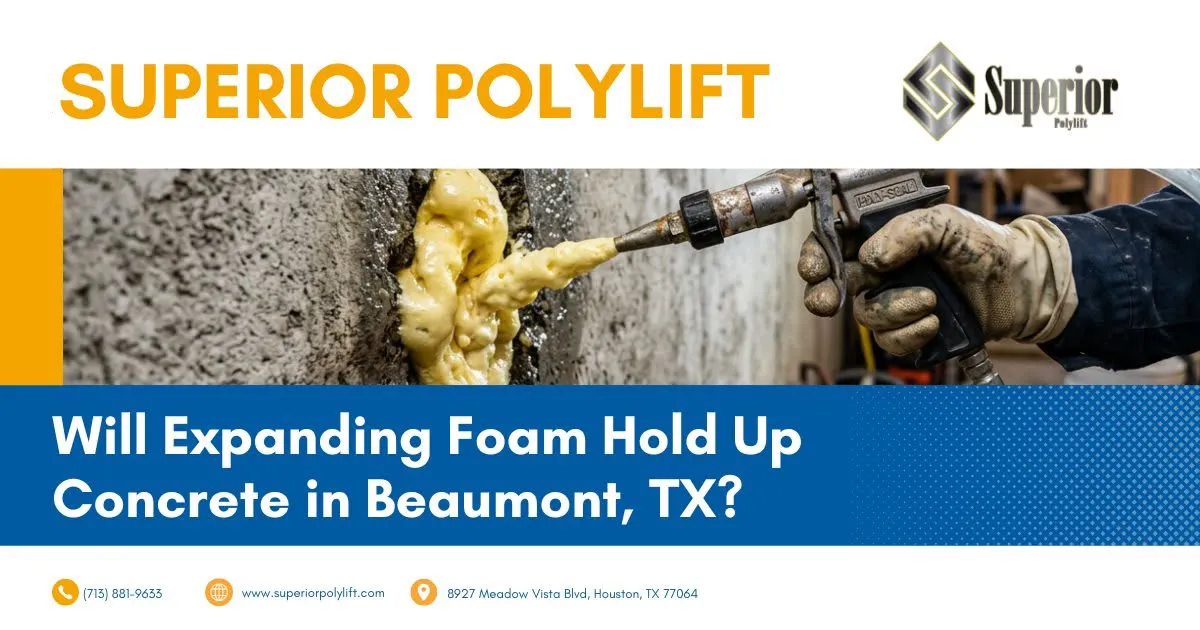
Yes, for 20 years or more when properly specified and installed. High-density polyurethane runs 3.8 to 4.2 pounds per cubic foot with 60 to 100 psi compressive strength, and its closed-cell structure resists the groundwater that defines Beaumont's subsurface. The weight is what matters most here: at a fraction of slurry's density, it supports slabs without overloading the weak Gulf Coast soils that caused the settlement.
If you are dealing with settled concrete at a Beaumont facility, you have probably heard about polyurethane foam lifting and wondered whether it holds up long term in Gulf Coast soils.
High water tables, saturated subgrades, and unstable clay are common across the region, which makes the durability question a fair one rather than a skeptical one. This guide covers how the material actually supports concrete, how it performs in local conditions, and where its limits sit relative to heavier alternatives.
Polyurethane used for concrete lifting is a two-part chemical system that expands rapidly after injection. High-density formulations typically run 3.8 to 4.2 pounds per cubic foot with compressive strengths of 60 to 100 psi.
Those properties make it strong enough to support commercial slabs while remaining light enough not to compound the problem underneath. That balance is the entire engineering argument for the material.
The closed-cell structure is central to its performance. TxDOT specifications require at least 85 percent closed cell content, which is what delivers water resistance and prevents groundwater from penetrating and degrading strength over time.
Chemical durability follows from the same structure. Properly formulated polyurethane resists breakdown from soil chemicals, moisture, and biological activity, which is why service life is measured in decades rather than years.
Beaumont's proximity to the Gulf means many sites contend with high water tables and persistently saturated soils. The closed-cell structure creates a waterproof barrier resistant to groundwater infiltration.
TxDOT specifications call for water-insoluble diluents that permit foam formation even in saturated soils. In practical terms, the injection works when the ground is wet, which is frequently the condition it needs to work in here.
Hydro-insensitive formulations are used for seawalls and bulkheads in tidal conditions, which demonstrates the material's performance at the demanding end of the moisture spectrum. A slab in saturated clay is a less severe application than a bulkhead in tidal exposure.
Work begins with laser survey equipment documenting existing elevations and mapping cracks. That baseline is what makes lift measurable rather than estimated.
Small ports, typically 5/8 inch, are drilled through the concrete at strategic locations. These are considerably smaller than the holes traditional slurry methods require, which matters on visible surfaces.
Two-part material is injected under pressure, expanding to fill voids and densify loose soils beneath the slab. Technicians monitor lift in real time with laser equipment, which is what allows precise control and prevents over-lifting.
After lifting completes, ports are patched with rapid-set grout and the surface returns to service immediately. There is no extended cure period comparable to concrete replacement.
The material does more than occupy empty space beneath a slab:
That last point is the one most often missed. The result is not a foam block under a slab but a modified soil mass, which is why the support persists rather than depending on the material alone.
Where soil problems extend well below the slab, surface-level injection may be insufficient. Deep injection treats weak soils in gridded patterns at multiple depths, typically ranging from the surface to about 14 feet.
This stabilizes the full soil column rather than the immediate subgrade, which prevents future settlement rather than only correcting current elevation. Facilities planning to add heavy equipment can pretreat soils this way rather than waiting for problems to develop.
Many local soils are weak, compressible, or poorly consolidated, particularly fill placed beneath industrial slabs and waterfront structures decades ago without adequate compaction. Those materials continue settling under load.
This is precisely where added weight becomes counterproductive. Introducing heavy slurry into soil that is already failing under load accelerates settlement rather than correcting it, which is the central argument for lightweight material in this market.
Substantial annual rainfall drives variable soil moisture, void formation beneath slabs, and erosion behind retaining structures. Material that absorbs water or washes out compounds these problems over time.
Impermeability significantly reduces erosion relative to materials that degrade with moisture exposure. Once cured, the material stays in place through flooding and heavy rain events that would displace conventional fill.
Expansive clays produce shrink-swell cycles as moisture content changes seasonally. Wet periods bring expansion that can lift concrete, and drought brings shrinkage that opens voids beneath it.
Foam addresses the voids that cycle creates, but it does not stop the cycle. Pairing injection with drainage correction and moisture management is what makes the repair durable rather than repeated.
| Factor | Polyurethane foam | Cement slurry |
| Weight | 2 to 4 lb per cubic foot | 100 to 150 lb per cubic foot |
| Compressive strength | 60 to 100 psi | Potentially higher on paper |
| Water behavior | Waterproof, will not wash out | May absorb and soften over time |
| Hole size | 5/8 inch | 1 to 2 inches |
| Cure time | Minutes | 24 to 72 hours |
| Typical service life | 20+ years | Frequently a few years |
The strength comparison is where the numbers mislead. Slurry can test higher in compression, but that figure is irrelevant if the weight of the material causes the soil beneath it to fail.
A roughly fortyfold weight difference on soils that are already inadequate is the deciding factor. Support without added dead load is what the situation actually requires.
Cure time carries operational weight too. Minutes versus days determines whether a facility loses a shift or most of a week, and for concrete leveling in an operating environment that difference frequently exceeds the material cost gap.
Polyurethane injection serves a broad range of commercial, industrial, and municipal concrete:
Bridge approaches deserve specific mention because settlement there creates transitions that damage vehicles and create liability. Restoring smooth grade quickly with minimal traffic disruption is exactly what the method is suited to.
TxDOT's detailed specifications for foam use demonstrate acceptance for critical infrastructure, which is a meaningful endorsement given the loading and service life those applications demand.
Significant structural damage from expansive clay may require steel piers or pressed pilings to transfer loads to competent strata. Foam works within the upper soil profile and cannot reach bearing soils 20 to 30 feet down.
Structures showing foundation cracking, binding doors, or separation at wall junctions warrant structural engineering evaluation. Those symptoms can indicate movement beyond what any injection method addresses.
Improper drainage continues degrading soils after treatment, producing renewed settlement. The material provides excellent support but does not resolve the water that caused the loss of support in the first place.
Grading, functioning drainage, and controlled discharge are what make the repair permanent. Without them, even correct installation eventually requires touch-up.
Adding load beyond a slab's original design causes cracking or settlement regardless of what supports it from below. A slab engineered for light traffic will not carry concentrated equipment loads simply because it has been stabilized.
Facilities planning equipment additions should establish whether the existing slab can accept the increase before assuming stabilization solves it.
Injection lifts and stabilizes slabs but cannot rebuild concrete that is severely cracked, spalled, or deteriorated. Where the concrete itself has failed, replacement is the honest answer.
A working threshold: where more than roughly 30 percent of the surface shows significant cracking or reinforcement is exposed, replacement generally makes better economic sense than salvaging.
Foam leveling runs approximately $4 to $8 per square foot in Beaumont, roughly 50 to 70 percent below slab replacement. Actual pricing depends on slab thickness, settlement severity, soil conditions, and access.
The scale difference is substantial on larger areas. Replacing a 10,000 square foot warehouse floor might approach $200,000, while leveling the same floor could come in under $60,000.
Polyurethane injection also runs several times less than compaction grouting, which uses thick cement-based grout at high pressure and requires specialized equipment and longer installation windows.
Service life of 20 years or more means the cost is not repeated. Slurry methods frequently require retreatment every few years, which changes the comparison considerably over a facility's planning horizon.
Seal expansion joints and correct slopes so water drains away from slabs. Standing water accelerates deterioration and creates new voids as soil erodes beneath.
Maintain consistent soil moisture where expansive clays are present, since stable moisture prevents the shrink-swell cycling that drives movement. This matters most during extended dry periods.
Annual laser elevation checks confirm slab position and detect early movement before it becomes significant. Distribute stacked material and equipment to avoid concentrated point loads that exceed design capacity.
A Gulf Coast concrete lifting contractor working across Beaumont can establish whether your conditions suit injection, and facilities with settled slabs can schedule an assessment that includes elevation survey and void mapping before scoping the work.
Polyurethane holds up concrete in Beaumont, and the reason has less to do with how strong the material is than with how little it weighs. Slurry tests higher in compression, but placing 100 to 150 pounds per cubic foot beneath a slab that settled because the soil could not carry load is a solution working against itself. At a fortieth of that weight, foam supports the slab while leaving the subgrade alone, and its closed-cell structure means saturated ground and a high water table do not degrade it.
The limits are worth knowing as clearly as the capabilities. Foam works within the upper soil profile, so genuine structural failure requiring transfer to competent strata is a different job. It cannot outrun uncontrolled drainage, cannot make a slab carry loads it was never designed for, and cannot rebuild concrete that has already deteriorated. Within those boundaries, matched to the right density and paired with drainage correction, it delivers two decades or more of support at roughly half to a third the cost of replacement.
Stabilize Beaumont concrete without adding weight to failing soil.
Schedule an assessment with the Superior PolyLift team.

Explore how our expertise can benefit your project. Reach out to our team for a consultation and discover the best solutions for your needs.

At Superior PolyLift™, integrity and reliability are the core of our ethos. Our expert team crafts custom solutions that guarantee quality and durability for every project. Choose us for geotechnical excellence that endures.
Copyright © All rights reserved. 2024 • Terms of Use and Privacy Policy • Internet Marketing by Authority Solutions®