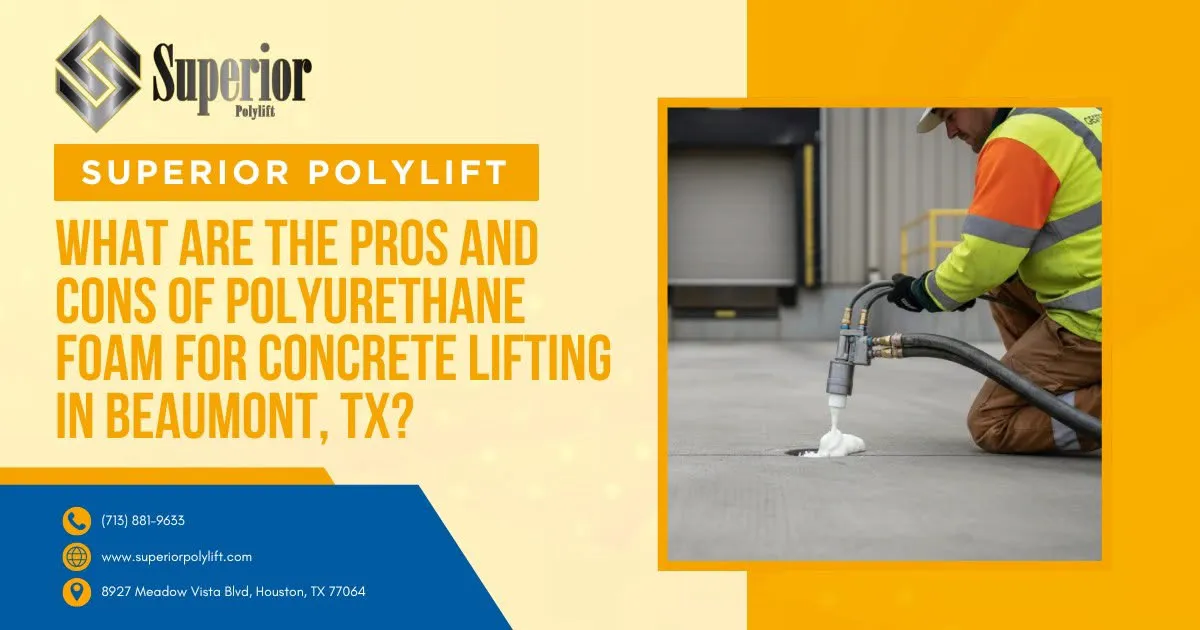
Polyurethane foam concrete lifting offers fast, water-resistant, lightweight slab repair ideal for Beaumont's expansive clay soils, with same-day return to service and a 20-50+ year lifespan. The method costs $5-25 per square foot, requires professional installation due to chemical and equipment complexity, and is not suitable for severely cracked slabs requiring full replacement. For most industrial and commercial sunken concrete in Southeast Texas, foam lifting outperforms mudjacking on durability and moisture resistance.
If you have noticed sunken concrete slabs around your Beaumont commercial or industrial site, you are dealing with a problem that only gets worse with time. Beaumont's expansive clay soils shift dramatically between wet and dry seasons, creating voids beneath concrete that lead to settling, cracking, and operational hazards at warehouses, refineries, and distribution centers.
Polyurethane foam concrete lifting offers a fast, minimally invasive solution, but it is not perfect for every situation. This article walks through the specific pros and cons of using polyurethane foam in Beaumont's challenging soil conditions, so you can make an informed decision about the right repair approach for your facility. Superior PolyLift specializes in Beaumont commercial polyurethane concrete lifting for industrial and commercial properties.
Polyurethane lifting begins with a professional assessment using laser levels or digital sensors to map elevations and calculate the required lift at multiple injection points. This precision planning ensures accurate restoration of concrete surfaces. Process steps:
The dual-component foam mixes inside the injection gun and reacts immediately, generating internal temperatures of 250-300°F. Throughout the process, technicians monitor the lift to ensure precise restoration to design elevation.
Polyurethane foam has displaced older slab-lifting methods at most industrial and commercial sites for several practical reasons. Understanding the advantages helps facility managers decide whether this approach fits their site conditions and operational constraints.
Polyurethane foam's predictable expansion allows technicians to make millimeter-increment adjustments for uniform surfaces. This level of control is particularly valuable for commercial and industrial applications where exact tolerances matter.
Speed advantages of polyurethane foam:
For warehouses, refineries, and distribution centers in Beaumont, this means minimal operational downtime and faster return to revenue-generating activity.
The closed-cell structure of polyurethane foam prevents water infiltration and maintains integrity under high-pressure groundwater conditions. This characteristic is critical for Southeast Texas locations where high water tables and seasonal flooding are common concerns.
Unlike traditional mudjacking materials that can wash out or erode, polyurethane foam resists moisture damage throughout its lifespan. This makes it ideal for Beaumont's hurricane season rainfall, spring moisture cycles, and storm-surge exposure at facilities near waterways. Superior PolyLift offers polyurethane lifting for Gulf Coast industrial sites facing these moisture challenges.
Polyurethane foam weighs only 2-4 pounds per cubic foot compared to 100 pounds per cubic foot for mudjacking materials. Lightweight benefits include:
This long-term durability makes polyurethane foam particularly well-suited to Beaumont's expansive clay soils, which experience seasonal swelling and shrinking from the wet-dry cycles characteristic of the Gulf Coast.
Polyurethane foam is non-toxic when cured, produces zero leaching, and helps divert concrete waste from landfills by extending the life of existing slabs. Choosing foam injection over replacement reduces the environmental impact of demolition and new concrete production. For industrial facilities under sustainability mandates, this matters increasingly to procurement and ESG reporting teams.
Table 1: Polyurethane Foam vs. Traditional Methods
| Factor | Polyurethane Foam | Mudjacking | Concrete Replacement |
| Cure time | 15 min - 1 hour | 24-48 hours | 7-28 days |
| Material weight | 2-4 lbs/cu ft | 100 lbs/cu ft | Heavy slab |
| Hole size | 5/8" - 1.5" | 1.5" - 2" | Full demolition |
| Water resistance | Excellent (closed-cell) | Poor (washes out) | Good |
| Lifespan | 20-50+ years | 5-7 years | 25+ years |
| Cost per sq ft | $5-25 | $3-6 | $8-35 |
| Same-day service | Yes | No | No |
Despite the advantages, polyurethane foam is not a universal solution. Recognizing the limitations protects facility managers from misapplying the method to projects where it will underperform or fail.
The rapid expansion that makes polyurethane foam effective can also create complications. Pancaking occurs when foam spreads horizontally without filling vertical space, potentially leaving unsupported areas beneath the concrete slab. This requires experienced technicians who understand foam behavior and injection patterns.
Foam continues expanding after injection, making the exact final volume difficult to predict. Over-lifting can cause cracking or structural damage to the concrete slab. Professional monitoring throughout the process helps minimize this risk, but it remains a real consideration that demands trained operators with calibrated equipment.
Polyurethane foam typically provides 40-60 PSI of compressive strength compared to 200-300 PSI for mudjacking materials initially. However, foam maintains its strength over time while mudjacking materials degrade, making the long-term performance superior despite lower initial numbers.
For most commercial and industrial applications, the foam's compressive strength is more than adequate. Industrial-grade foam can support forklifts, pallet racks, and heavy machinery without shrinking or compressing under sustained load.
The chemical reaction generates excessive heat in large injections, requiring careful management by trained professionals. Isocyanates pose respiratory risks during application, necessitating proper protective equipment, ventilation protocols, and containment procedures that exceed what untrained personnel can safely manage.
Polyurethane foam may not perform optimally in certain conditions:
In these scenarios, alternative methods like full slab replacement or specialized chemical grouting may be more appropriate. A qualified contractor will evaluate each situation rather than apply foam to every project.
Cost analysis for slab repair extends beyond the upfront price per square foot. Long-term durability, downtime cost, and re-repair frequency matter for industrial budgets.
In the Beaumont area, polyurethane foam injection typically costs $5-25 per square foot, with an average commercial project running approximately $4,500 for 300 square feet. Labor accounts for 70-80 percent of these costs, reflecting the specialized expertise required.
Application type significantly impacts pricing:
Site accessibility, severity of settlement, and required lift volume also factor into the final quote.
Mudjacking costs $3-6 per square foot, offering a cheaper upfront option. However, mudjacking typically requires re-lifting within a few years due to material degradation and additional soil compression from the heavier material.
Complete concrete replacement costs $8-35 per square foot including demolition and disposal. When you factor in the extended downtime and disruption, polyurethane foam often provides the best long-term value for facilities that cannot tolerate weeks of operational shutdown.
Generic foam-lifting information applies broadly, but Beaumont's geology and climate create site-specific considerations that affect both method selection and contractor specification.
Beaumont's expansive clay soils present unique challenges for concrete structures. These soils swell when wet and shrink during dry periods, creating ongoing stress on foundations and slabs throughout Jefferson County and the surrounding Gulf Coast region.
The lightweight nature of polyurethane foam makes it ideally suited to these weak seasonal soil conditions. Unlike heavier materials that add stress to compromised soil, foam provides lift and stabilization without additional weight that could trigger secondary settlement.
Southeast Texas experiences high water tables throughout much of the year. The water resistance of polyurethane foam becomes critical in these conditions, preventing the washout and erosion common with traditional materials.
The closed-cell structure maintains integrity even under high-pressure groundwater conditions, providing reliable long-term performance despite Beaumont's challenging moisture environment. This resistance to hydrostatic pressure is particularly important at facilities near the Neches River, Sabine River, or coastal industrial zones. Properties with documented settlement may benefit from a polyurethane site evaluation before selecting a repair method.
Beaumont's economy runs on heavy industry, port logistics, and chemical processing. The slab-lifting requirements at these facilities differ significantly from typical light commercial projects.
Table 2: Industrial Application Performance Profile
| Facility Type | Typical Lift Need | Foam Fit | Special Considerations |
| Warehouse floor | 1/2" - 2" | Excellent | Same-day return to service |
| Loading dock apron | 1/2" - 1.5" | Excellent | Trailer-level precision required |
| Forklift travel lane | 1/2" - 1" | Excellent | Compressive load tolerance |
| Refinery process pad | 1" - 3" | Good | Chemical-resistant formulation |
| Pipeline support pad | 1/2" - 2" | Good | Vibration tolerance verified |
| Outdoor storage yard | 1" - 3" | Excellent | Drainage assessment first |
| Equipment foundation | Variable | Variable | Engineered analysis required |
Industrial-grade polyurethane foam supports heavy equipment, forklifts, and loaded pallet racks without shrinking or settling. Warehouse-specific benefits:
Same-day curing means warehouses can resume normal operations quickly, minimizing costly downtime and maintaining productivity. Distribution centers operating on tight delivery schedules cannot afford week-long shutdowns from traditional repair methods.
Precise restoration ensures trailers dock securely and safely. Even small elevation differences at loading docks create safety hazards and operational inefficiencies, including:
Polyurethane foam's millimeter-level precision addresses these concerns effectively, restoring safe and efficient dock operations.
Beaumont's industrial sector requires solutions that withstand extreme conditions. Polyurethane foam demonstrates chemical resistance and durability under heavy loads, vibration, thermal stress, and exposure to corrosive chemicals common at refineries and petrochemical plants.
Experienced geotechnical specialists understand the operational and safety constraints of these facilities, providing engineered, long-term structural solutions designed for demanding industrial environments. Specialized foam formulations exist for chemical-exposure zones at refineries and petrochemical plants.
Foam lifting solves the immediate settlement problem, but preserving the result requires attention to the conditions that caused settlement in the first place. Maintenance after repair determines whether the lift lasts five years or fifty.
Proper drainage is the most critical factor for maintaining lifted concrete. Gutters, swales, and grading must direct water away from concrete surfaces to prevent soil erosion and settlement beneath the slab.
Even the best foam injection cannot compensate for ongoing water infiltration that undermines the soil support structure. For Beaumont facilities, hurricane season preparation and storm drainage maintenance are particularly important.
Table 3: Recommended Inspection and Maintenance Schedule
| Interval | Activity | Owner Action |
| Quarterly | Visual crack and settlement check | In-house facilities team |
| Quarterly | Drainage and gutter clearance | In-house facilities team |
| Annually | Professional slab inspection | Certified contractor |
| Every 2-3 years | Concrete sealer application | Approved sealer product |
| Pre-hurricane season | Storm drainage verification | Facilities + emergency team |
| Post-major storm | Settlement and water-pooling check | In-house facilities team |
| Per warranty terms | Warranty claim documentation | Property manager |
Regular maintenance extends the life of your investment:
Industrial facilities benefit from formal asset-management programs that track slab condition over time and trigger preventive interventions before settlement returns.
Typical warranties range from 5-10 years for commercial applications, with some contractors offering lifetime guarantees on the foam material itself. Review warranty terms carefully and understand what conditions might void coverage, especially clauses related to drainage maintenance, additional settlement from soil events, and structural overload.
Beaumont requires permits for public and structural work, and contractors must follow all utility location procedures before drilling. Per Texas811 excavation safety requirements, excavators must request line locates at least two business days before any drilling project, even small-diameter access holes used in foam injection. This requirement protects underground gas lines, electric service, fiber optic cables, and other utilities common at industrial sites.
Qualified contractors should provide:
Experienced geotechnical specialists understand local soil conditions and can engineer solutions for Beaumont's unique challenges, providing fast, minimally invasive concrete lifting with long-term structural integrity.
If you are dealing with sunken concrete at your Beaumont commercial or industrial property, Superior PolyLift can help you find the right solution for your specific soil conditions and budget. The team specializes in polyurethane foam lifting designed to handle Southeast Texas's expansive clay and high water tables, with minimal downtime and long-lasting results.
Call 281-894-4175 to request a project estimate and discover whether foam injection is the best fit for your concrete lifting needs.
Discuss your industrial slab lifting options.
Plan a long-lasting Beaumont concrete repair.

Explore how our expertise can benefit your project. Reach out to our team for a consultation and discover the best solutions for your needs.

At Superior PolyLift™, integrity and reliability are the core of our ethos. Our expert team crafts custom solutions that guarantee quality and durability for every project. Choose us for geotechnical excellence that endures.
Copyright © All rights reserved. 2024 • Terms of Use and Privacy Policy • Internet Marketing by Authority Solutions®