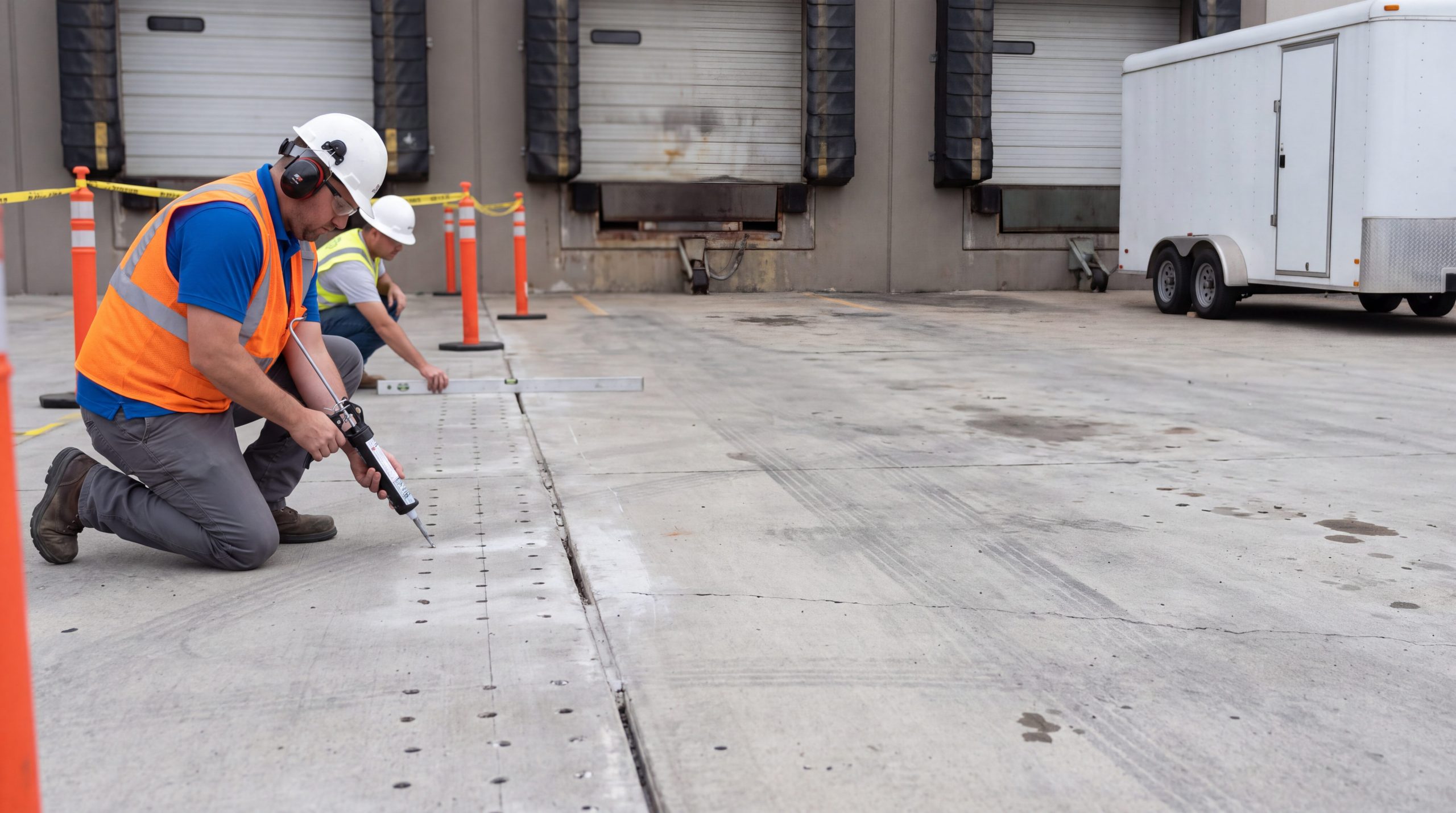
Polyurethane foam concrete lifting raises a settled slab by injecting expanding foam into the void beneath it through small ports while the lift is monitored. For specifiers and asset managers, the real questions are which slabs fit the method, what monitoring and documentation must record, and what the scope should state before work starts.
Polyurethane foam concrete lifting is a slab repair method that injects expanding foam beneath settled concrete to fill voids and raise the slab.
The material is a two-component polyurethane system. The two liquids are mixed at the injection gun, travel through a small port in the slab, and react in the space below to form a rigid, closed-cell foam. Closed-cell foam is a foam whose cells are sealed from one another, which limits how much water the cured material takes on. The space it fills is the void, meaning any gap between the underside of the slab and the soil that should be supporting it.
That soil layer is the subgrade: the compacted native soil or fill that carries the slab. When the subgrade consolidates, washes out or shrinks, the slab loses support and settles. Polyurethane injection addresses that lost support directly, which is why the method is described as lifting rather than resurfacing.
Several search terms describe the same family of work. Polyurethane concrete lifting, polyurethane concrete leveling, concrete lifting foam and concrete leveling foam all refer to raising concrete with an injected polymer. Slab jacking is the older umbrella term, and mudjacking is the traditional version of it, which pumps a cement-based slurry instead of foam. Retail foam kits sold for small do-it-yourself jobs sit outside this discussion; commercial and municipal slabs carry loads, joints and liability exposure that call for monitored work.
It is also worth being clear about what the method is not. Lifting does not repair concrete that has failed structurally, and it is not a substitute for pouring new concrete where a slab is broken through. It restores support and elevation to sound concrete that has sunk, which is a narrower and more useful definition for anyone writing a scope.
Polyurethane injection lifts a settled slab by filling the void first and then using controlled foam expansion to raise the panel while elevations are watched.

The sequence matters as much as the material. A typical project follows the steps below, and each one leaves something that can be recorded and checked later.
The table below sets out the general injection sequence for polyurethane foam concrete lifting and what each step should leave on record.
| Step | What happens | What gets recorded |
|---|---|---|
| 1. Pre-lift survey | Elevations are taken across the settled panel and the adjacent reference slabs; joints and cracks are mapped. | Baseline elevations and a marked-up plan |
| 2. Port layout | Small ports, typically 5/8 inch, are drilled in a pattern set by panel size, joint location and void extent. | Port locations on the plan |
| 3. Void fill | Foam is placed to fill open space beneath the slab before any lift is attempted. | Injection log by port |
| 4. Controlled lift | Further injection raises the panel in small increments while a laser level and receivers track movement. | Lift readings during injection |
| 5. Patch and clean | Ports are patched and the surface is cleaned. | Patch completion |
| 6. Verify and release | Post-lift elevations are checked against the targets before the area returns to service. | Post-lift elevation verification |
Each row maps to a document the owner can hold, which is what turns a repair into a verifiable scope.
The foam reacts within the void, so the order of injection controls where it goes. Ports near the lowest point and along the voided zone are usually worked first, and the lift is brought up gradually across the panel so the slab is not bent or rocked. Lift monitoring is the continuous measurement of slab movement during injection, usually with a rotating laser level and receivers on grade rods placed at the panel and at the adjacent reference slab.
As general method facts for polyurethane injection, the foam typically reaches working strength in about 15 to 30 minutes and reaches full cure in about 1 hour. Treated areas typically return to service about 30 minutes after the last injection. Those figures describe the method in general; the plan for a particular dock, aisle or sidewalk comes out of a site assessment.
Lift monitoring and documentation record where foam went, how much was placed, how far the slab moved and where it finished relative to its targets.
For an asset manager or procurement officer, this record is the difference between a repair and a defensible repair. At Superior PolyLift, every injection is documented with field logs, material batch traceability and post-lift elevation verification. Whoever does the work, the closeout package should let the owner, the engineer of record and a future contractor see exactly what was done to each panel.

Documentation is not paperwork for its own sake. It is the only practical way to compare a slab's elevation a year after the work with the elevation the day it closed, and it gives the specifying engineer evidence instead of a verbal assurance.
Polyurethane lifting fits intact concrete that settled after losing support beneath it, not slabs with structural failure or deep foundation movement.
Most commercial settlement shows up as uneven concrete: a faulted sidewalk joint, a dock apron that has dropped at the building line, an aisle panel that rocks under forklift traffic, or a step at an entrance slab. Those are the conditions the method was built for. The harder cases are the ones that look similar on the surface but have a different cause underneath.
The table below compares common commercial slab conditions against the scope of polyurethane foam concrete lifting.
| Slab condition | Lifting candidate? | Reason |
|---|---|---|
| Intact slab settled over a void | Yes | The method fills the void and restores support and elevation. |
| Faulted joint creating trip hazards on a sidewalk or entrance | Yes | The low panel can be raised to meet its neighbor under monitoring. |
| Dock apron dropped at the building line | Usually | Depends on void extent, loading and drainage at the apron edge. |
| Settlement with an active leak or poor drainage | Only with correction | The leak or drainage problem must be corrected alongside the repair. |
| Slab cracked through and structurally failed | No | Lifting does not repair failed concrete; replacement or structural repair is a separate scope. |
| Movement traced to piles, caissons or deep foundations | No | Deep foundation failure below the slab zone is outside the method. |
| Active sinkhole or ongoing soil loss | No | Injection does not stop an active sinkhole; the cause needs geotechnical investigation. |
Where a condition sits between two rows, the answer comes from a site assessment rather than from the surface symptoms.
Settlement that reaches the building itself, such as a floor slab pulling away from a wall base or interior slab movement near columns, belongs to a different conversation. Our page on foam foundation repair covers how slab settlement inside commercial and industrial buildings is scoped, and where its limits sit.
Polyurethane injection and mudjacking both raise settled slabs but differ in material, subgrade weight, port size and how soon the area reopens.
The comparison below sets polyurethane injection beside mudjacking on the factors a facility or public works team usually weighs.
| Factor | Polyurethane injection | Mudjacking |
|---|---|---|
| Material | Two-part expanding closed-cell foam | Cement-based slurry |
| Weight added to the subgrade | Low; lifting foams are typically 4 to 8 lb/ft³ | Higher; the slurry itself adds load |
| Injection ports | Typically 5/8 inch, patched afterward | Typically larger holes |
| Return to service | Typically about 30 minutes after the last injection | Depends on slurry curing |
| Material cost | Higher | Lower |
| Lift control | About 1/8 inch (3 mm) under monitored conditions, operator dependent | Depends on operator and monitoring |
Neither column wins on every row, which is why the method choice belongs in the site assessment rather than in a sales conversation.
Mudjacking is lower in material cost, so material cost alone does not favor polyurethane. The decision usually turns on other factors: how much extra weight a soft subgrade can take, how many ports a finished surface can tolerate, and how long the area can be closed. A dock that runs two shifts or a sidewalk on a busy route weighs the return-to-service window heavily. A remote yard slab with a generous closure may weigh it less.
Superior PolyLift does not perform mudjacking, so the comparison here is offered as context for specifiers writing a method requirement, not as a sales argument.
A polyurethane lifting specification should state the areas, targets, tolerances, monitoring, phasing, related drainage work and closeout records, so every bidder prices the same job.
Most disputes on lifting projects come from scopes that say little more than "raise settled slabs." The checklist below is a starting point for a civil engineer, public works director or facility manager drafting a scope. It does not replace the engineer of record's judgment on any specific site.
Actionable Tip
Before the site assessment, walk the affected area and record each settled panel on a plan: the measured step at its joint, the loads it carries, any leak or downspout discharge nearby, and the hours it can be closed. Hand that sheet to the specifying engineer and the contractor so tolerances, phasing and related drainage work start from the same field data.
A scope written this way protects the owner in two directions. It stops a low bid from quietly dropping monitoring or records, and it gives the contractor a clear stopping point if the site assessment finds a condition that is not a lifting candidate.
Site assessment and engineering review come first because the surface symptom rarely explains the cause, and the cause decides whether lifting is appropriate at all.
A site assessment for polyurethane foam concrete lifting looks below the slab as well as across it. It typically reviews the extent of settlement, the joint and crack pattern, the loading the slab carries, drainage and water sources at the slab edge, and the access and shut-down constraints. Where void extent is uncertain, ground-penetrating radar (GPR) or cores can confirm what the surface cannot show.
On Houston sites, the subgrade often explains the settlement. Expansive clay soils, including the Houston Black clay series, shrink and swell with moisture, and high water tables and coastal subsidence add their own movement. A slab can settle because clay dried and shrank, because water carried fines out from under an edge, or because poorly compacted fill consolidated. Each cause points to different related work.
Outcomes on any specific slab depend on that assessment and on engineering review. Superior PolyLift does not provide design or engineering services, so load capacity, structural adequacy and the cause of building distress remain questions for the owner's engineer of record. What the assessment does provide is the field data that engineer needs: measured settlement, observed voids, drainage findings and a clear statement of whether the slab is a lifting candidate.
That division of roles is also what keeps the method honest. When the cause is a leak, the leak is corrected with the lift. When the cause sits below the slab zone, the answer is a different repair, and the assessment should say so before anyone drills a port.
As a general method fact, polyurethane lifting foam typically reaches working strength in about 15 to 30 minutes and full cure in about 1 hour. Treated areas typically return to service about 30 minutes after the last injection. The release plan for a specific dock, aisle or sidewalk depends on the zone sequence, the patching and the traffic it carries, and it should be written into the phasing section of the scope.
Polyurethane injection restores support beneath a slab, but load performance depends on the slab thickness, the subgrade, the void extent and the loading itself. Lifting foams are typically 4 to 8 lb/ft³, which keeps added weight on the subgrade low. Whether a particular warehouse aisle or dock apron suits the method under its forklift or truck traffic is a question for site assessment and the owner's engineering review.
No. Mudjacking is lower in material cost than polyurethane injection, so material cost alone does not favor foam. Owners and specifiers usually weigh other factors: the extra weight a slurry places on a soft subgrade, the number and size of holes a finished surface can accept, and how long the area can be closed. Those factors come out of a site assessment rather than a price comparison.
Not by itself. Polyurethane injection fills the void and restores support and elevation, but the reason the support was lost may still be present. An active leak, poor drainage or downspout discharge must be corrected alongside the repair. Expansive clay and other subgrade conditions should be identified in the site assessment, so the related work is scoped and assigned before injection starts rather than discovered afterward.
A complete closeout package for polyurethane foam concrete lifting typically includes pre-lift elevations, a port layout plan, a port by port injection log, lift readings taken during injection, material batch identifiers and post-lift elevation verification against the scope targets. Those records let the owner, the engineer of record and future contractors see what was done to each panel, and they support procurement and audit review.
Polyurethane injection is the wrong repair when concrete has failed structurally, when movement traces to piles, caissons or other deep foundations below the slab zone, or when an active sinkhole or ongoing soil loss is present. It is also premature while an active leak or drainage problem remains uncorrected. In those cases the site assessment should name the condition and point the owner toward the appropriate investigation or repair.
Polyurethane foam concrete lifting performs best on paper first. A scope that names the panels, the targets, the monitoring, the phasing, the drainage work and the closeout records gives every bidder the same job and gives the owner a record worth keeping. Superior PolyLift works only on commercial, industrial, municipal and federal infrastructure, and our team reviews each slab against those scope items before injection is proposed. For background on the service itself, see our polyurethane foam concrete lifting page. When you send a message through our contact page, include the plan references, loading and shut-down windows so our team can judge whether each panel is a lifting candidate.
Call (866) 912-3281 to talk through your lifting specification, or Request a site assessment for the affected slabs.
Explore how our expertise can benefit your project. Reach out to our team for a consultation and discover the best solutions for your needs.

At Superior PolyLift™, integrity and reliability are the core of our ethos. Our expert team crafts custom solutions that guarantee quality and durability for every project. Choose us for geotechnical excellence that endures.
Copyright © All rights reserved. 2024 • Terms of Use and Privacy Policy • Internet Marketing by Authority Solutions®