Yes, PolyLevel and similar polyurethane injection systems are usually worth pricing for a structurally sound commercial slab in Beaumont, TX that has settled over voids or soft subgrade, especially when downtime matters. Lifting is not worth it when the concrete has failed, the cause of settlement is still active, or flowing water sits beneath the slab.
A settled slab on a loading dock, plant floor or public works yard creates trip hazards, equipment damage and drainage trouble long before a replacement order is signed. The practical question for facility managers is whether lifting the existing slab gives better value than tearing it out and pouring new concrete.
PolyLevel is a branded polyurethane foam lifting system, but the brand name on the foam does not decide whether a lift is worth paying for on your site. That decision rests on the cause of the settlement, the condition of the concrete, the water in the ground and the verification you receive afterward.
In this guide, you'll learn what a foam lift actually does to a settled slab and which conditions make it worth pricing or a poor spend. You'll also see how to compare lifting with replacement and how the wet upper Gulf Coast region around Beaumont shapes the decision.
A polyurethane foam lift fills the voids under a settled slab and raises the concrete back toward its intended elevation without removing it. Concrete leveling corrects uneven slabs by changing the support beneath them, using cement slurry, limestone grout or expanding structural foam.
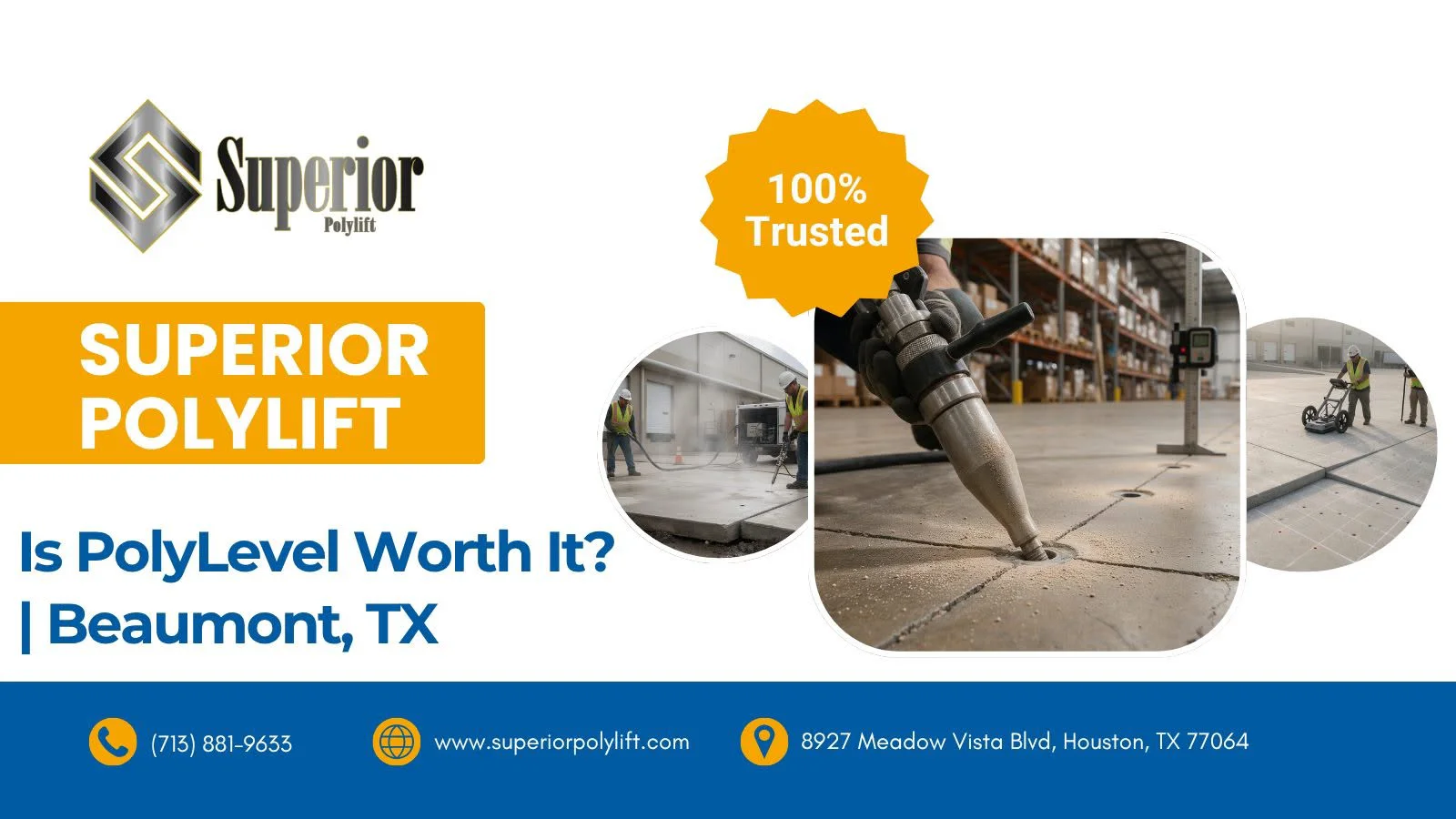
With polyurethane injection, crews drill 5/8-inch ports through the slab and inject expanding foam into the voids and soft soil below. The ports are patched once the lift is complete, so the existing concrete stays in place and keeps working.
Polyurethane is about 96 percent lighter than cement slurry, which weighs 100 or more pounds per cubic foot. That difference means the repair material adds far less weight to a subgrade that has already struggled to carry the slab.
The foam typically reaches working strength in about 15 to 30 minutes and fully cures in about an hour. Slabs usually return to service about 30 minutes after the last injection, and the work can be phased around operating hours at plants, distribution yards and municipal facilities.
Those speed and weight points appear in almost every description of foam lifting, so treat them as the baseline rather than the deciding factor. The deciding factors are the site conditions in the next two sections, because a fast repair on the wrong slab still wastes the budget.
Polyurethane lifting is worth pricing when the slab is intact, the cause of settlement is under control, and a long replacement closure would hurt your operation. The table below sets out the factors an owner can check or measure before comparing any quotes.
| Decision factor | What to check | Why it matters |
|---|---|---|
| Cause of settlement | Erosion or washout, consolidation, clay desiccation, decomposing organic material, utility leaks, water infiltration | Injection does not stop an active cause, so the cause has to be corrected alongside the lift |
| Slab condition | Spalling, delamination, exposed or corroded rebar, crack pattern | The slab must be intact enough to take lifting force |
| Soil bearing capacity | Strength of the subgrade under the slab | Bearing capacity often governs what a lift can achieve |
| Operating constraints | Shift patterns, loading schedules, equipment access | Phased work and a return to service about 30 minutes after the last injection limit disruption |
| Ground water | Saturated soil or water moving beneath the slab | Standard foam that reacts with groundwater expands without control and ends up weaker |
| Documentation | Field logs, batch traceability, post-lift elevation verification | Records let your engineers confirm the slab reached its target elevation |
When most of those rows check out, a lift is usually a sensible option to price against replacement. The site assessment is where each factor gets measured instead of assumed, and owners comparing concrete lifting contractors should expect every bidder to ask about all six.
The strongest case for lifting is a sound slab that settled because of a past problem that has since been fixed, such as a repaired utility leak. In that situation the lift restores support and elevation while the operation keeps running, which is usually the outcome an owner is paying for.
Lifting is a poor spend when the concrete has already failed, when the ground below is still washing out, or when water is flowing under the slab. Each of these conditions either stops the foam from doing its job or leaves the original cause in place to undo the lift.
| Condition | Worth pricing a lift | Not a fit for lifting |
|---|---|---|
| Slab concrete | Intact slab with settlement cracking that can take lifting force | Spalling, delamination or rebar corrosion |
| Cause of settlement | Past erosion, consolidation or clay desiccation that has been corrected | Active leak, failed drainage or erosion still under way |
| Depth of the problem | Voids and soft soil within the subgrade | Deep foundation failure below the subgrade |
| Water under the slab | Damp or saturated soil treated with a hydro-insensitive foam | Flowing water that prevents the foam from curing |
| Ground stability | Stable subgrade with known voids | Active sinkhole processes |
In any of the right-hand cases, paying for a lift first can mean paying twice for the same slab. The concrete either fails under lifting force or settles again once the untreated cause carries on beneath it.
Over-lift and foam migration are also real risks on any injection job, even on a slab that passes every row above. Both are managed through monitored, incremental injection, so ask each bidder how those two risks will be controlled on your slab.
The general reference on concrete leveling also notes environmental and toxicity concerns around foam materials. Public and industrial owners with environmental reporting duties can reasonably ask for the product data and handling details before work starts.
Replacement is the right comparison for every lift quote, because slab raising can be significantly less expensive than new concrete according to the general reference. No dollar figure applies until your site is assessed, and no dated price source supports a figure for Beaumont, so the table below compares what each bidder should price.
| Factor | Polyurethane lifting | Slab replacement |
|---|---|---|
| Downtime | Return to service about 30 minutes after the last injection | Demolition, forming, pouring and curing of new concrete |
| Disruption | 5/8-inch ports drilled and patched, work phased around operating hours | Removal of the existing slab and excavation of the area |
| Added weight on the subgrade | Foam about 96 percent lighter than 100-plus pounds per cubic foot cement slurry | A new slab bearing on the same subgrade that allowed the settlement |
| Cause of settlement | Must be corrected alongside the lift | Must also be corrected, or the new slab can settle the same way |
| What to ask the bidder to price | Injection, cause correction, post-lift elevation verification | Demolition, disposal, subgrade work, new concrete and closure time |
Replacement usually makes more sense when the slab is structurally failed or the problem sits below the subgrade. Those cases fall outside what injection can fix, and a lift there would only delay the larger repair.
If the slab passes the conditions in the earlier tables, polyurethane concrete lifting in Beaumont is usually worth quoting beside replacement. That way the downtime difference is on paper before anyone commits the budget to one option.
Beaumont sits in the upper Gulf Coast region, where highly plastic expansive clay and regional rainfall above 50 inches a year keep subsoils wet. High water tables and tropical storm seasons add repeated stress to those saturated subsoils, which is why water sits at the center of the worth-it question here.
Water is both a common cause of voids and the main condition that changes how foam behaves during injection. Standard polyurethane that reacts with groundwater expands without control and ends up with lower strength, so saturated ground calls for a hydro-insensitive formulation.
Owners dealing with settled industrial slabs in Beaumont should also ask how the drainage fault or leak that fed the void will be corrected. Injection does not stop water that keeps arriving, so the lift only holds its value once that source is managed.
After heavy rain or a tropical system, a lift may need to wait until water is no longer flowing under the slab. Flowing water prevents the foam from curing properly, so scheduling around the wet season becomes part of the value calculation for every Beaumont site.
Before approving any lift, ask for the evidence that shows the slab reached its target elevation, because a brand name is not a performance measure. These five questions give you a fair way to compare bids from different contractors on the same slab:
At Superior PolyLift™, every injection is documented with field logs, material batch traceability and post-lift elevation verification. That record gives your engineers something concrete to review against the target elevation once the slab is back in service.
We inject in monitored increments toward that target, with 1/8-inch precision achievable under monitored conditions and dependent on operator skill. We also phase the work around operating hours where the site allows, so bays and lanes can stay in use for as much of the job as possible.
Superior PolyLift™ works exclusively on commercial, industrial, municipal and federal infrastructure, and the out-of-scope list in this guide applies to our own work as well. Failed concrete, deep foundation failure below the subgrade and active sinkhole processes are not treated as lifting jobs, because a lift there would not deliver the value this guide describes.
A polyurethane foam lift is usually worth pricing for an intact commercial slab in the Beaumont region that settled over voids or soft subgrade. The cause has to be corrected and the ground water planned for, and the same lift is a poor spend on failed concrete or ground that is still washing out.
The fairest test is a side-by-side comparison with replacement, built on measured site conditions and backed by field logs and elevation verification. When you are ready to test your own slab against those conditions, request a site assessment to compare lifting with replacement and get the answer on paper.
Call Superior PolyLift™ at (713) 881-9633.
Book a Beaumont slab lift assessment today.

Explore how our expertise can benefit your project. Reach out to our team for a consultation and discover the best solutions for your needs.

At Superior PolyLift™, integrity and reliability are the core of our ethos. Our expert team crafts custom solutions that guarantee quality and durability for every project. Choose us for geotechnical excellence that endures.
Copyright © All rights reserved. 2024 • Terms of Use and Privacy Policy • Internet Marketing by Authority Solutions®