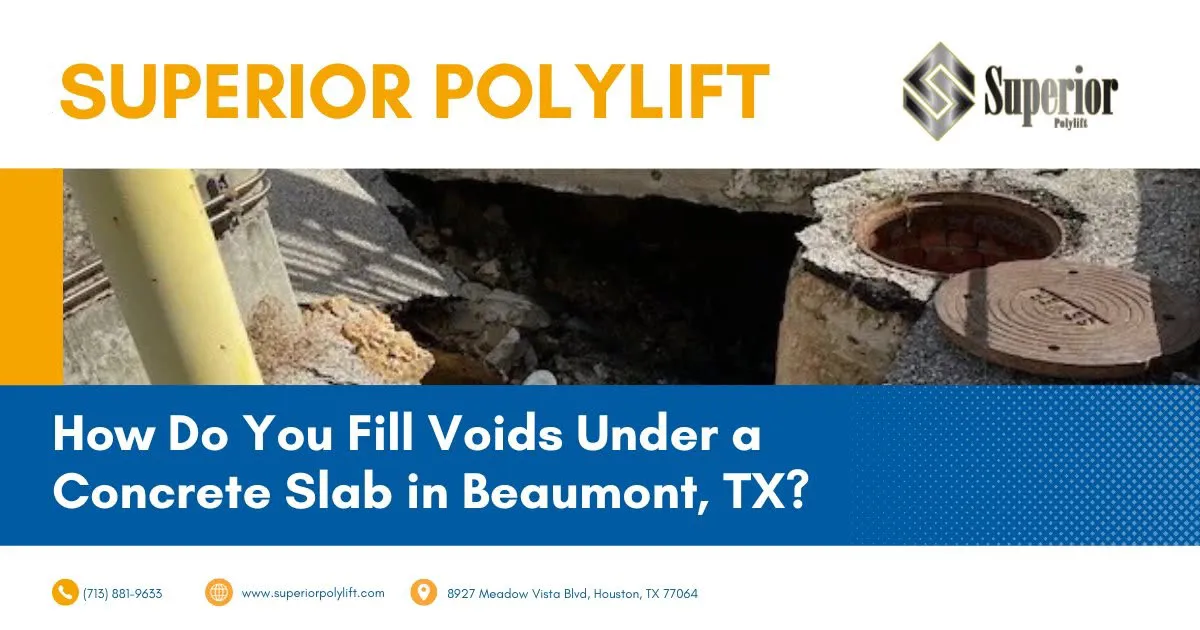
Polyurethane foam injection is the preferred method for filling voids beneath concrete slabs in Beaumont, TX. The two-component foam expands to fill sub-base cavities, compacts loose soil, and restores slab elevation while adding minimal weight to the sub-base. In Beaumont's expansive clay and high-moisture environment, foam's waterproof closed-cell structure prevents the erosion that causes mudjacking slurry to fail within 2 to 7 years.
If you manage a commercial or industrial facility in Beaumont and have noticed cracking slabs, uneven floors, or gaps at wall-slab interfaces, sub-base voids may be developing beneath your concrete. These empty spaces form when expansive clay soils shift with seasonal moisture changes and water erosion removes supporting material from beneath the slab.
Left unaddressed, voids lead to progressive structural damage and costly facility downtime. This guide covers what causes voids under concrete slabs in Beaumont's climate, how to identify them early, and which concrete leveling foam injection solutions restore sub-base stability before minor settlement becomes a major structural failure.
Voids beneath concrete slabs develop when water infiltrates the sub-base and gradually erodes soil particles, leaving empty cavities that compromise slab support. In Beaumont, where annual precipitation significantly exceeds the national average and humidity remains consistently elevated, water infiltration is a persistent threat to commercial and industrial floor systems.
Poor site drainage allows rainwater to accumulate at facility perimeters, creating pathways for water to migrate beneath concrete surfaces. Once below the slab, water erodes the supporting soil progressively, leaving empty spaces that grow with each rainfall event and worsen under traffic loading.
Natural soil compaction beneath concrete continues for years after construction, particularly where fill material was placed to establish grade. Disturbed soil typically requires five to ten years to fully settle under the weight of the concrete slab and operational loads.
Beaumont's expansive clay sub-base creates additional complications. Clay deposits expand when wet and contract when dry, causing cyclical volume changes that stress the concrete-soil interface and create contact gaps beneath slabs. This constant expansion and contraction accelerates void formation, particularly at slab perimeters and joint locations where water infiltration is most active.
Early detection of voids reduces repair scope and cost significantly. Several visible indicators suggest void formation beneath commercial and industrial concrete floors.
Cracking at concrete slabs often signals underlying voids. These may appear as hairline fractures, larger fissures, or distinctive step-cracks at wall-slab junctions. Uneven or sloping floor surfaces become apparent during forklift operations when load transfer across settled slab edges produces handling instability.
Gaps developing between floor slabs and wall bases or column bases indicate foundation movement. These gaps typically widen over time as the void beneath grows larger and the slab settles further into the cavity.
Ground Penetrating Radar (GPR) transmits radio waves into the concrete and measures reflections from interfaces between materials of different densities. This non-destructive method maps subsurface voids across large commercial floor areas without drilling or excavation.
Ultrasonic Pulse Echo testing uses acoustic stress waves to identify subsurface anomalies and accurately map void locations and sizes. For maximum confidence before a major injection program, professionals validate scanning results through borescope inspection and core sampling to provide definitive confirmation of void presence and extent.
| Method | Surface Penetration | Area Coverage | Confirmation Level |
| Ground Penetrating Radar | None | Large areas | High |
| Ultrasonic Pulse Echo | None | Moderate | High |
| Borescope camera | Single small hole | Localized | Definitive |
| Core sampling | Multiple holes | Targeted | Definitive |
Polyurethane foam injection, also called polyjacking or polyurethane concrete lifting, has become the standard method for filling voids beneath commercial and industrial concrete slabs in Southeast Texas. This approach offers decisive advantages over traditional cement-based alternatives in Beaumont's operating environment.
Small holes, typically measuring three-eighths to five-eighths inch in diameter, are drilled through the concrete surface at strategic injection points. These minimal holes preserve the appearance of the floor and require only simple patching after completion.
Once ports are inserted, the two-part polyurethane liquid is pumped beneath the slab. The foam begins expanding immediately upon injection, filling voids, compacting loose soil, and lifting the concrete slab to the target elevation. Professional-grade foam formulations are engineered as closed-cell, hydro-insensitive, high-density polyurethane systems with minimum free-rise density of 3.0 pounds per cubic foot and minimum compressive strength of 50 PSI, matching the requirements set out in Texas highway undersealing specifications.
The foam reaches initial set within approximately one minute. Treated areas are ready for foot traffic within 15 to 45 minutes, and most industrial equipment loads can return within one to four hours. This rapid return to operations is a primary advantage over mudjacking's 24 to 72-hour cure requirement for commercial and industrial facilities where floor downtime creates direct revenue impact.
Polyurethane foam is chemically inert and waterproof, resisting erosion and degradation from soil moisture, industrial chemicals, and repeated wet-dry cycles. This durability is particularly valuable in Beaumont's high-moisture environment where cement-based alternatives progressively break down under sustained water exposure.
When properly installed on stabilized sub-grade with drainage corrections addressed, foam repairs can last the lifetime of the concrete itself, potentially 20 to 50 years or longer. The lightweight expanded foam at 2 to 4 pounds per cubic foot adds minimal load to the sub-base, avoiding the settlement acceleration that heavy mudjacking slurry causes in soft Beaumont clay.
Mudjacking has been used for decades to address foundation voids and settling concrete but carries significant limitations in Southeast Texas conditions that make it a poor long-term choice for commercial and industrial applications.
Mudjacking slurry weighs up to 100 pounds per cubic foot compared to 2 to 4 pounds for polyurethane foam. In Beaumont's clay sub-base, this weight addition applies new load to already-compromised soil, potentially accelerating future settlement in the repaired area and adjacent slab panels.
The cement-based slurry absorbs water over time, becoming subject to erosion and material breakdown in Beaumont's high-moisture environment. This progressive water absorption leads to material shrinkage and void redevelopment, typically requiring retreatment within 2 to 7 years.
| Factor | Polyurethane Foam | Mudjacking |
| Material weight | 2 to 4 lbs per cubic foot | Up to 100 lbs per cubic foot |
| Waterproof | Yes | No |
| Beaumont service life | 20 to 50+ years | 2 to 7 years |
| Return to service | 15 to 45 min | 24 to 72 hours |
| Injection hole size | 3/8 to 5/8 inch | 1 to 2 inches |
| Cost per sq ft | $5 to $25 | $3 to $8 |
Polyurethane foam injection projects typically begin around $900 for small localized repairs, average around $2,500 for mid-sized commercial work, and reach $7,500 or more for extensive industrial floor programs. The higher material cost relative to mudjacking is consistently offset by the elimination of repeat mobilizations over any 10-year period.
Mudjacking projects range from approximately $1,600 for basic repairs to $7,000 or more for extensive work, with typical unit pricing of $3 to $8 per square foot. In Beaumont's conditions, the 2 to 7 year service life means cumulative costs exceed polyurethane within the first 10 years for most commercial projects.
Full slab replacement costs significantly more, ranging from $4,500 for small sections to $18,000 or more for large commercial floor areas, not including the extended facility downtime during demolition, re-pour, and cure. Concrete leveling methods cost up to 70 percent less than replacement while preserving the existing slab and eliminating demolition-related disruption.
| Method | Typical Range | Beaumont Lifespan | Return to Service |
| Polyurethane foam | $900 to $7,500+ | 20 to 50+ years | 15 to 45 min |
| Mudjacking | $1,600 to $7,000+ | 2 to 7 years | 24 to 72 hours |
| Slab replacement | $4,500 to $18,000+ | 20 to 30 years | 7 to 28 days |
Proper drainage management is the single most important preventive measure for commercial and industrial facilities in Beaumont. Gutters and downspouts must direct roof drainage at least five to ten feet away from building perimeters. Site grading must maintain positive slope directing surface water away from facility concrete areas. Sprinkler and irrigation systems adjacent to facility concrete should be positioned and scheduled to avoid saturating sub-base soils near slab perimeters.
Caulking cracks and control joints prevents water from infiltrating beneath slabs at the highest-risk locations. Joint sealant at commercial and industrial facilities should be inspected regularly and replaced when it begins pulling away from the concrete surface. Expansion joints, control joints, and perimeter edges are the priority locations for scheduled inspection and maintenance programs. As a floor leveling company serving Southeast Texas, Superior PolyLift recommends combining joint sealing with void filling programs for maximum long-term performance.
Underground utility and process line leaks create rapid soil washout beneath facility floors and can produce significant voids in a short period. Any suspected underground leak should be investigated and repaired immediately. Watch for unexplained increases in water consumption, persistently damp soil areas adjacent to facility concrete, or the presence of water in below-grade utility spaces as indicators of active subsurface leaks requiring immediate attention.
For facilities experiencing void formation from multiple causes, a comprehensive assessment identifies all void locations and root causes before any injection program begins.
Void formation beneath commercial and industrial concrete slabs in Beaumont is a predictable consequence of the region's expansive clay sub-base and persistent moisture environment. Polyurethane foam injection is the correct intervention: it fills existing cavities, stabilizes loose sub-base soil, and restores slab elevation with a service life of 20 to 50 years when drainage conditions are addressed alongside the repair.
The factors that determine whether void fill produces lasting results are pre-injection assessment thoroughness, foam formulation selection for Beaumont's conditions, drainage correction, and joint sealing after the injection program. Facilities that address all four consistently see repairs that last decades rather than years.
Schedule your Beaumont concrete slab void assessment today.
Get foam injection solutions engineered for Southeast Texas conditions.

Explore how our expertise can benefit your project. Reach out to our team for a consultation and discover the best solutions for your needs.

At Superior PolyLift™, integrity and reliability are the core of our ethos. Our expert team crafts custom solutions that guarantee quality and durability for every project. Choose us for geotechnical excellence that endures.
Copyright © All rights reserved. 2024 • Terms of Use and Privacy Policy • Internet Marketing by Authority Solutions®