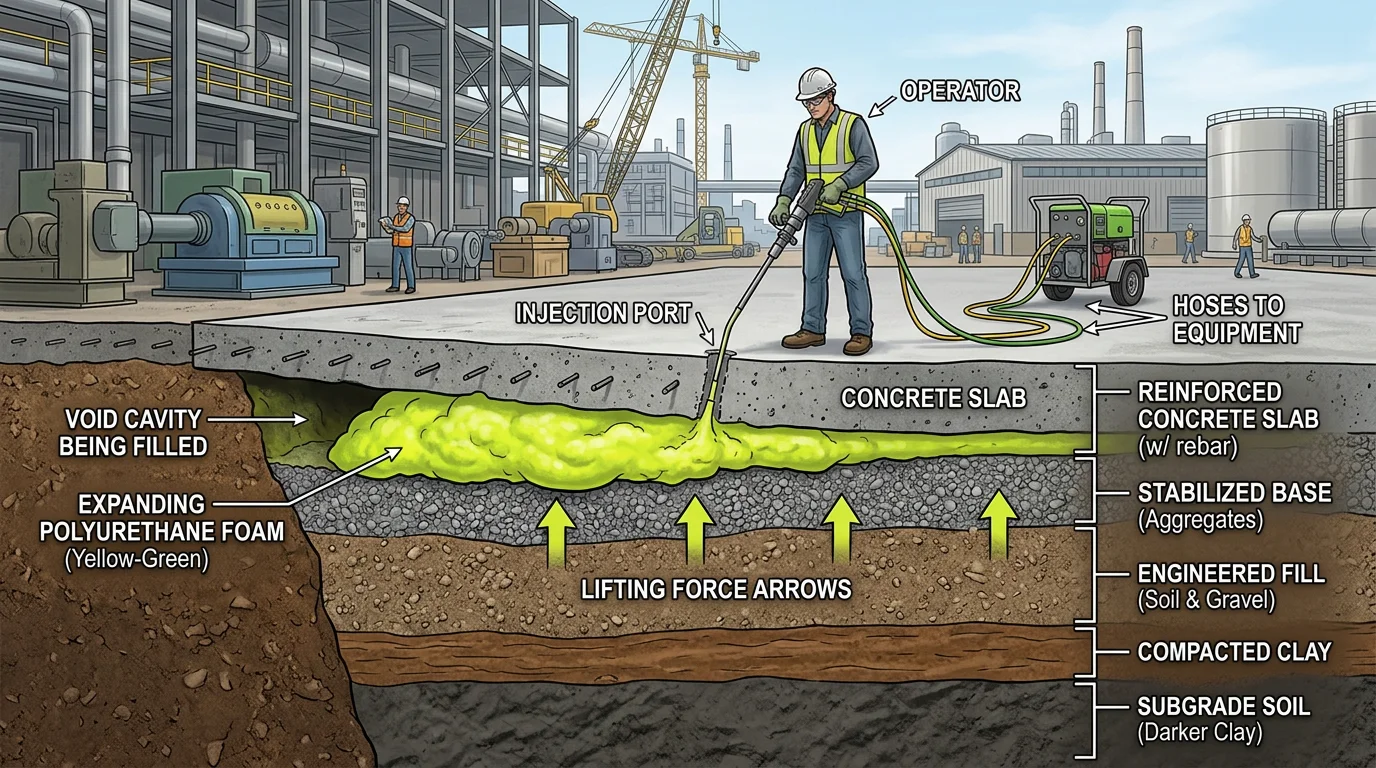
Polyurethane void filling injects expanding closed-cell foam beneath concrete slabs to fill subsurface cavities that have formed from soil erosion, clay shrinkage, washout, or organic decomposition. The foam flows into void space, expands to fill the cavity completely, densifies surrounding soil, and provides structural support that prevents the concrete above from settling into the gap. In Houston's clay soil environment, void filling is both a repair for existing damage and a preventive measure against future settlement.
Voids beneath concrete are invisible problems with visible consequences. A warehouse floor that deflects under forklift traffic. A parking lot panel that rocks when vehicles drive over it. A foundation slab that's settled two inches in one corner. In every case, the surface damage traces back to empty space beneath the concrete — space that formed over months or years as Houston's clay soil shrank, eroded, or washed away. Polyurethane void filling addresses the root cause by replacing that empty space with structural foam that supports the slab above and stabilizes the soil around it. Superior PolyLift's void filling services have filled subsurface voids across Greater Houston's commercial and industrial infrastructure — warehouses, ports, highways, parking structures, and foundations — using high-density polyurethane foam engineered for the Gulf Coast's aggressive soil and moisture conditions.
This guide covers how voids form beneath Houston concrete, how they're detected, how polyurethane foam filling works, what factors determine the right approach, and why void filling is one of the most cost-effective infrastructure maintenance investments a property owner can make.
Voids form through five primary mechanisms in Houston: clay soil shrinkage during drought cycles, soil erosion from water flow beneath the slab, washout from plumbing leaks or flooding, inadequate soil compaction during original construction, and organic material decomposition beneath the concrete. Houston's Beaumont clay makes void formation more aggressive here than in most U.S. cities because the soil's extreme shrink-swell behavior creates and recreates void space with every seasonal moisture change.
Understanding how voids form explains why they keep coming back — and why the repair method matters as much as the repair itself.
The most common cause in Houston. When Beaumont clay loses moisture during drought, it contracts — pulling away from the underside of the concrete slab above. The gap between the shrunken soil surface and the slab underside is a void. When rain returns, the clay may partially re-swell to close the gap — but not always completely, and not always uniformly. Over multiple wet-dry cycles, the cumulative effect produces permanent void space that the soil's natural movement can't close.
Water flowing beneath a concrete slab — from rain infiltration through joints, broken downspouts discharging against the foundation, or subsurface water movement — erodes soil particles and carries them away from beneath the slab. Over time, this erosion creates channels and cavities. Houston's 50+ inches of annual rainfall, combined with the region's flat topography and high water table, makes erosion-driven void formation particularly aggressive.
Under-slab plumbing leaks are a major void-formation mechanism in Houston. A leaking supply line or drain pipe introduces a sustained stream of water into the soil beneath the slab. That water erodes a cavity around the leak point, carrying soil particles downstream through the plumbing trench backfill. The result is a void that can grow for months or years before the surface concrete shows symptoms.
When the site was originally prepared for construction, the soil beneath the slab should have been compacted to engineering specifications. If the compaction was inadequate — common in Houston's rapid development cycles where schedule pressure overrides quality control — the loosely placed soil settles under the slab's weight over time, creating void space.
Tree roots, organic fill material, or vegetation buried during site preparation decompose over years, leaving void space where solid material once existed. This is more common on sites with mature tree removal before construction or in areas where organic topsoil wasn't fully stripped before slab placement.
| Void Formation Cause | How It Works | Detection Clue | Houston Prevalence |
| Clay shrinkage | Soil contracts during drought | Seasonal crack patterns | Very high (primary cause) |
| Water erosion | Rain/runoff carries soil away | Settlement near drainage paths | High |
| Plumbing leaks | Sustained water erodes soil | Localized heave + wet spots | High |
| Poor compaction | Loose fill settles under load | Early-life settlement (< 5 years) | Moderate |
| Organic decomposition | Buried material decomposes | Random localized settlement | Low–Moderate |
Voids are detected through a combination of visual surface assessment (settlement patterns, slab deflection, cracking), ground-penetrating radar (GPR) scanning that maps subsurface conditions without excavation, core sampling that provides direct physical access to the void, and probe testing that measures void depth and extent through small drilled holes. The detection method depends on the site type, void suspected size, and the precision required for the injection plan.
You can't fill what you can't find. Effective void filling starts with accurate void detection and mapping — knowing where the voids are, how deep they extend, and how they connect to the soil conditions around them.
The starting point for every project. Surface settlement patterns, slab deflection under load (a slab that moves when you walk on it or drive over it has a void beneath it), crack patterns that radiate from a settlement zone, and standing water that pools in settled areas all indicate subsurface void space. An experienced assessment team can map probable void locations from surface symptoms alone — but confirmation requires subsurface investigation.
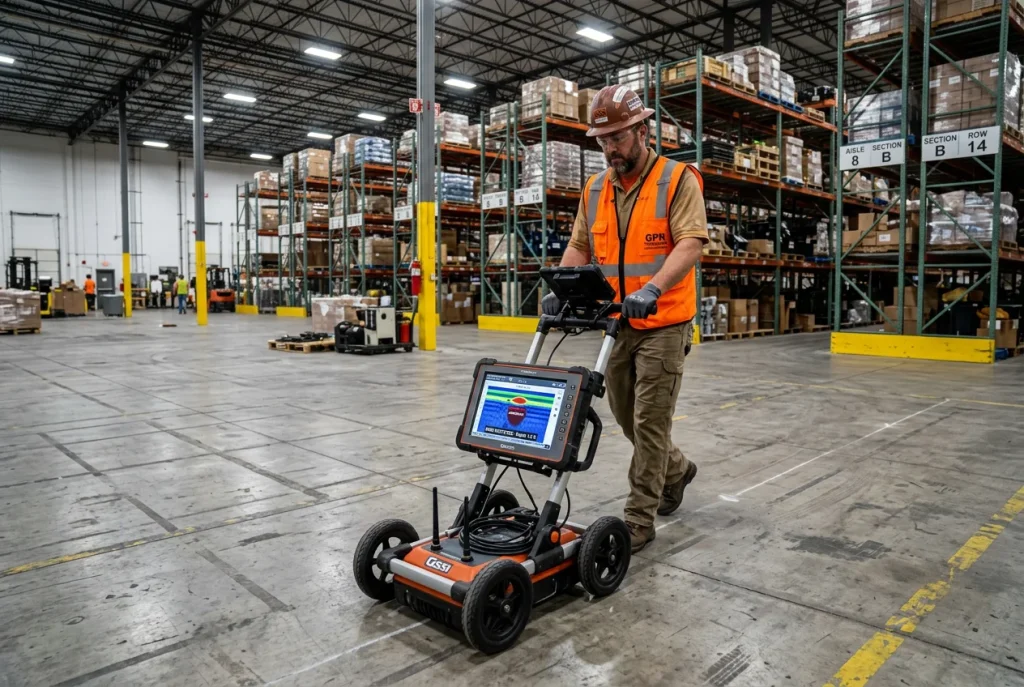
The primary non-destructive detection method for commercial void mapping. GPR sends electromagnetic pulses into the ground and reads the reflections. Changes in subsurface density — specifically the air-filled space of a void versus the solid mass of intact soil — produce distinct reflection signatures. A GPR technician pushes a cart-mounted antenna across the concrete surface, building a subsurface profile that shows void location, approximate depth, and lateral extent. GPR is fast (a 10,000-square-foot slab can be scanned in a few hours), non-destructive, and provides data that directly informs the injection plan.
When GPR data needs physical confirmation, a small core is drilled through the concrete to provide direct access to the subsurface. The core reveals the actual void depth, soil condition, and the presence of water or debris in the void space. Core samples also provide material for soil testing if geotechnical analysis is needed.
After injection ports are drilled, a probe rod can be pushed through the port to physically measure void depth beneath the slab. This ground-truth data confirms the GPR findings and helps calibrate foam volume estimates for each injection point.
| Detection Method | What It Reveals | Speed | Destructive? | Best For |
| Visual assessment | Surface symptoms, probable void zones | Fast | No | Initial screening |
| GPR scanning | Void location, depth, lateral extent | Moderate | No | Commercial mapping |
| Core sampling | Actual void depth, soil condition | Slow | Minimally (small core) | Confirmation of GPR data |
| Probe testing | Void depth at each injection point | Fast (per port) | Minimally (through existing port) | Injection calibration |
Two-part polyurethane resin is injected through small 5/8-inch ports drilled into the concrete on a calculated grid. The liquid resin flows into the void space beneath the slab and expands — typically 15 to 30 times its liquid volume — to fill the cavity completely. The expanding foam compresses against the soil walls of the void, densifying loose material and creating a structural bond between the foam mass and the surrounding soil. The foam reaches full compressive strength in 15 to 30 minutes.
The injection process for void filling follows the same fundamental approach as concrete lifting, but with different objectives and parameters. In concrete lifting, the goal is upward movement — raising the slab back to grade. In void filling, the primary goal is cavity elimination — filling the empty space to restore slab support and prevent future settlement. Sometimes both goals are addressed in the same project; sometimes void filling alone is sufficient.
Ports are drilled on a grid pattern determined by the void map. The grid spacing depends on the foam's expansion ratio and the void's geometry — tighter spacing for shallow voids that the foam must spread laterally to fill, wider spacing for deep voids where vertical expansion fills the cavity. Injection starts at the perimeter of the void zone and works inward, ensuring the foam fills from the edges toward the center rather than pooling in the deepest section and leaving perimeter gaps.
Not all polyurethane foam is the same density or expansion ratio. Void fill foam is typically a lower-density formulation (2 to 4 lbs/ft³) than the structural foam used for heavy-load concrete lifting (6 to 10+ lbs/ft³). The lower density fills more volume per pound of material, making it cost-effective for large voids where structural load transfer isn't the primary requirement. For voids beneath loaded slabs — warehouse floors, highway panels — higher-density foam may be specified to provide both void filling and load-bearing support.
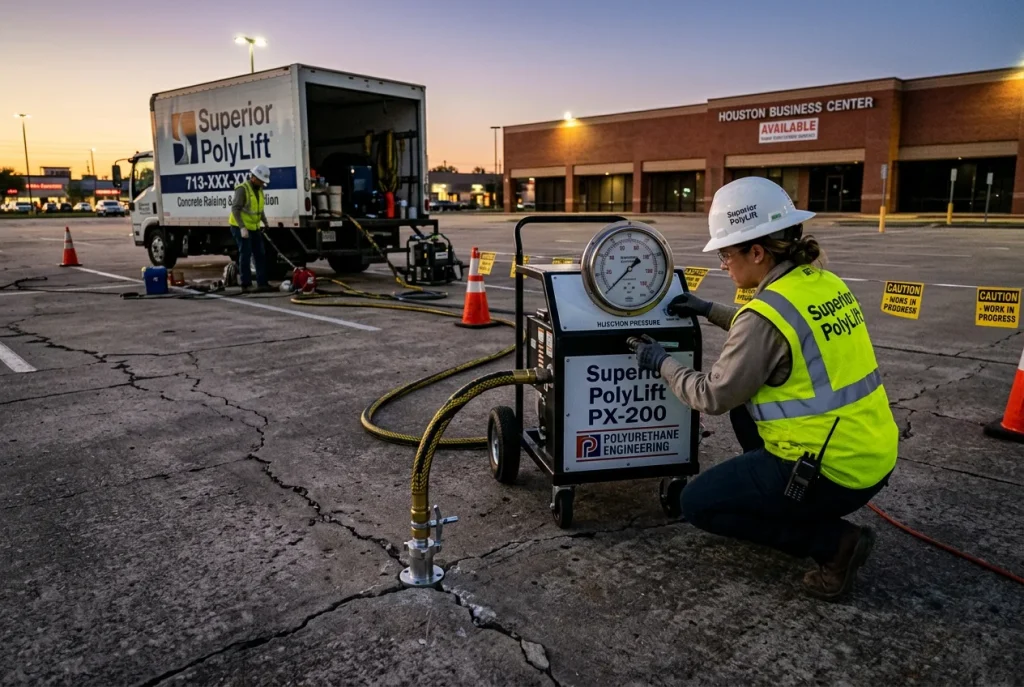
After injection, the crew verifies that the void has been filled through a combination of injection pressure monitoring (pressure increases when the foam encounters resistance, indicating the void is full), slab deflection testing (the slab no longer moves under load), and in some cases follow-up GPR scanning to confirm subsurface conditions have improved.
Polyurethane foam is closed-cell — meaning each cell in the foam structure is independently sealed. Water can't penetrate the cell walls, which means the foam doesn't absorb moisture, erode, or degrade in Houston's wet environment. The foam maintains its structural properties for decades. It doesn't compress under sustained load (it's engineered for specific compressive strength ratings), and it doesn't decompose biologically. Once the void is filled, it stays filled.
Void filling costs a fraction of concrete replacement, prevents the settlement and cracking that leads to far more expensive structural repair, maintains operational continuity with same-day return to service, and addresses the root cause (subsurface void space) rather than just the surface symptom (settled concrete). For Houston facility managers managing concrete on Beaumont clay, proactive void filling before settlement occurs is significantly cheaper than reactive repair after the damage is done.
The economics are straightforward. Filling a void beneath a 5,000-square-foot warehouse zone costs substantially less than replacing the settled concrete above it — and the void filling takes hours, not weeks. But the real value isn't just in the repair savings. It's in the damage prevention.
A void that goes unfilled eventually causes the concrete above to settle. That settlement cracks the slab, displaces joints, creates trip hazards, and damages equipment that operates on the surface. The repair scope expands from void filling alone to void filling plus concrete lifting plus joint repair plus surface refinishing. Catching voids early — before they produce surface damage — keeps the repair scope small and the cost proportional.
Superior PolyLift offers void detection assessments as a standalone service — GPR scanning and evaluation without committing to repair. For Houston facility managers, periodic void assessment is a maintenance practice that pays for itself many times over by catching subsurface problems before they reach the surface.Ready to assess your subsurface conditions? Contact Superior PolyLift™ for a free void assessment at your Houston facility. Their team maps subsurface conditions, identifies void zones, and provides a clear scope for addressing them — before they become surface-level problems.
Explore how our expertise can benefit your project. Reach out to our team for a consultation and discover the best solutions for your needs.

At Superior PolyLift™, integrity and reliability are the core of our ethos. Our expert team crafts custom solutions that guarantee quality and durability for every project. Choose us for geotechnical excellence that endures.
Copyright © All rights reserved. 2024 • Terms of Use and Privacy Policy • Internet Marketing by Authority Solutions®