Commercial concrete lifting restores sunken warehouse floors, settled port aprons, damaged parking structures, and failing industrial slabs to their original grade — without demolition, without extended shutdowns, and without the months-long timeline of full concrete replacement. For Houston's commercial and industrial sector, where every hour of downtime costs thousands in lost productivity, polyurethane foam injection delivers same-day return to service that no other repair method can match.
Houston's commercial infrastructure never stops moving. Freight trucks roll through distribution centers at all hours. Forklifts cross warehouse floors carrying full pallets across every shift. Container handlers work port terminals around the clock. When the concrete beneath that traffic settles, cracks, or develops trip hazards, the damage compounds fast — equipment damage, worker injuries, regulatory violations, and operational bottlenecks that grow more expensive the longer they're ignored. Superior PolyLift's concrete lifting services have restored commercial concrete surfaces across every major facility type in Greater Houston — ports, distribution centers, manufacturing plants, airports, retail complexes, and municipal infrastructure — using polyurethane foam injection engineered for heavy-load commercial environments.
This guide covers what makes commercial concrete lifting different from residential work, which Houston facility types benefit most, how projects are managed around active operations, and what facility managers should evaluate when selecting a commercial lifting contractor.
Commercial projects involve heavier traffic loads, larger slab areas, stricter tolerance requirements, active operational environments that can't shut down, and regulatory compliance standards that residential work never encounters. A residential driveway lift is a half-day project for a two-person crew. A 50,000-square-foot warehouse floor with differential settlement across multiple zones is a multi-day engineering project requiring phased execution, load-specific foam density, and coordination with facility operations.
The gap between lifting a homeowner's patio and lifting a container terminal's concrete apron is enormous. Here's what changes at commercial scale:
Residential concrete handles foot traffic, passenger vehicles, and the occasional heavy appliance delivery. Commercial concrete handles forklift axle loads of 10,000+ pounds, loaded semi-trailers at 80,000 pounds, container handlers, and industrial machinery that imposes concentrated point loads. The polyurethane foam density must be engineered for these loads — standard-density foam that works on a residential sidewalk won't support a loaded reach truck making 200 passes per day across the same floor section.
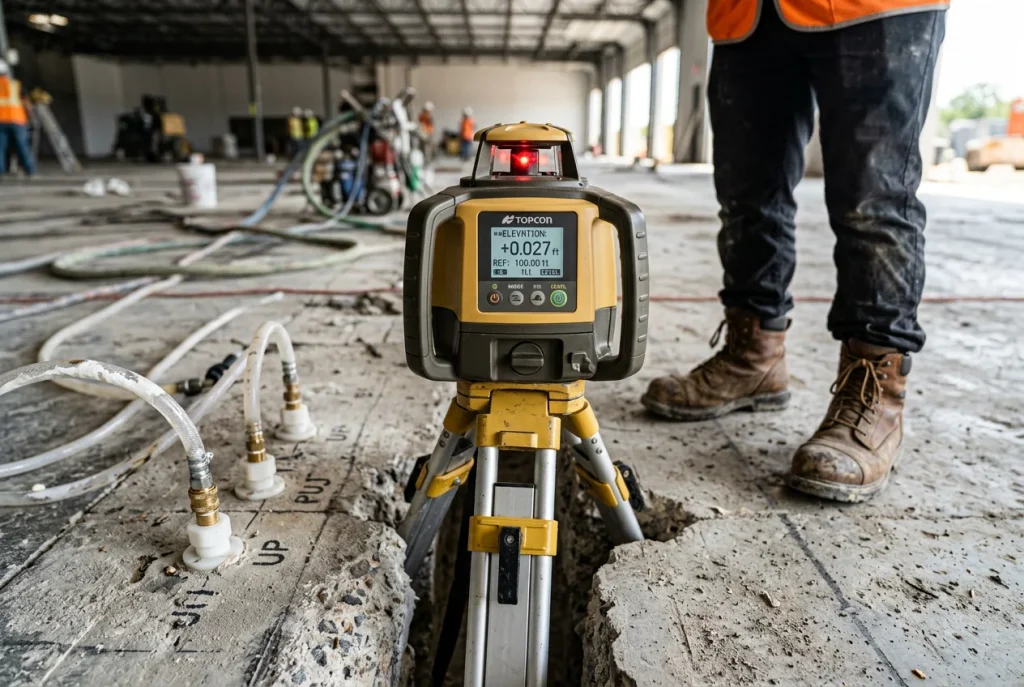
A residential driveway can be "close enough" — homeowners accept minor imperfections. Commercial facilities operate to tighter standards. Warehouse floors supporting racking systems need level surfaces within 1/8 inch across rack lines. Manufacturing facilities with CNC equipment need vibration-free, flat surfaces. Airport aprons must meet FAA surface tolerance specifications. The lifting process must achieve and verify these tolerances with monitoring equipment, not visual approximation.
Residential projects don't face downtime costs. Commercial projects do — and those costs can exceed the repair itself. A distribution center that shuts down a picking zone for three days loses far more in disrupted operations than the lifting project costs. Superior PolyLift structures commercial projects around operational schedules — night shifts, weekend windows, phased zones — so the facility keeps running while the concrete is being restored.
OSHA trip hazard standards, ADA accessibility requirements, DOT pavement specifications, and facility-specific safety protocols all apply to commercial concrete. A slab that's been lifted must meet these standards, and the lifting contractor must document compliance. That documentation becomes part of the facility's safety records.
| Factor | Residential Lifting | Commercial Lifting |
| Typical slab area | 100–500 sq ft | 5,000–100,000+ sq ft |
| Traffic load | Pedestrian + passenger vehicle | Forklifts, semis, heavy equipment |
| Tolerance requirement | Visual level | 1/8" across critical zones |
| Downtime tolerance | Flexible | Hours, not days |
| Foam density | Standard | Load-specific, engineered |
| Regulatory compliance | Minimal | OSHA, ADA, DOT, facility-specific |
| Project coordination | Homeowner | Facility manager + operations team |
Warehouses and distribution centers, port and marine terminals, airports, parking structures, manufacturing plants, retail and office complexes, and municipal infrastructure all benefit from polyurethane concrete lifting — each with specific challenges tied to their traffic patterns, load profiles, and operational constraints.
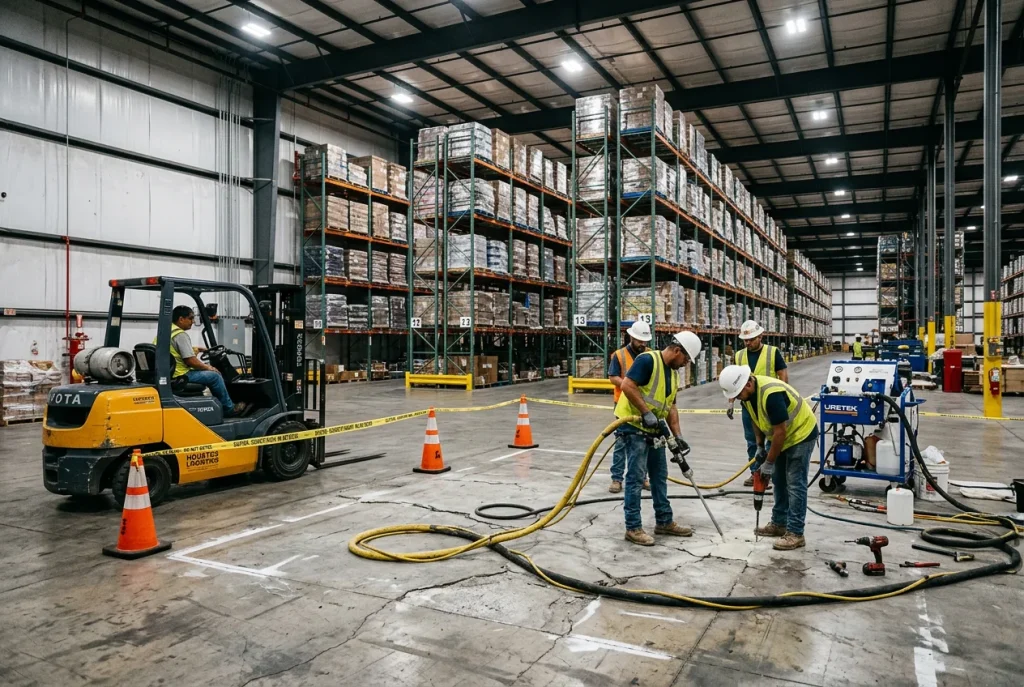
The single largest category of commercial concrete lifting in Houston. Warehouse floors take abuse from loaded forklifts running the same paths thousands of times per week. Settlement shows up first along dock doors, under heavy racking, and in high-traffic aisles. Differential settlement creates forklift instability that damages product, injures operators, and triggers OSHA attention. Polyurethane lifting restores floor grade without shutting down the facility — crews work zone by zone while operations continue in adjacent areas.
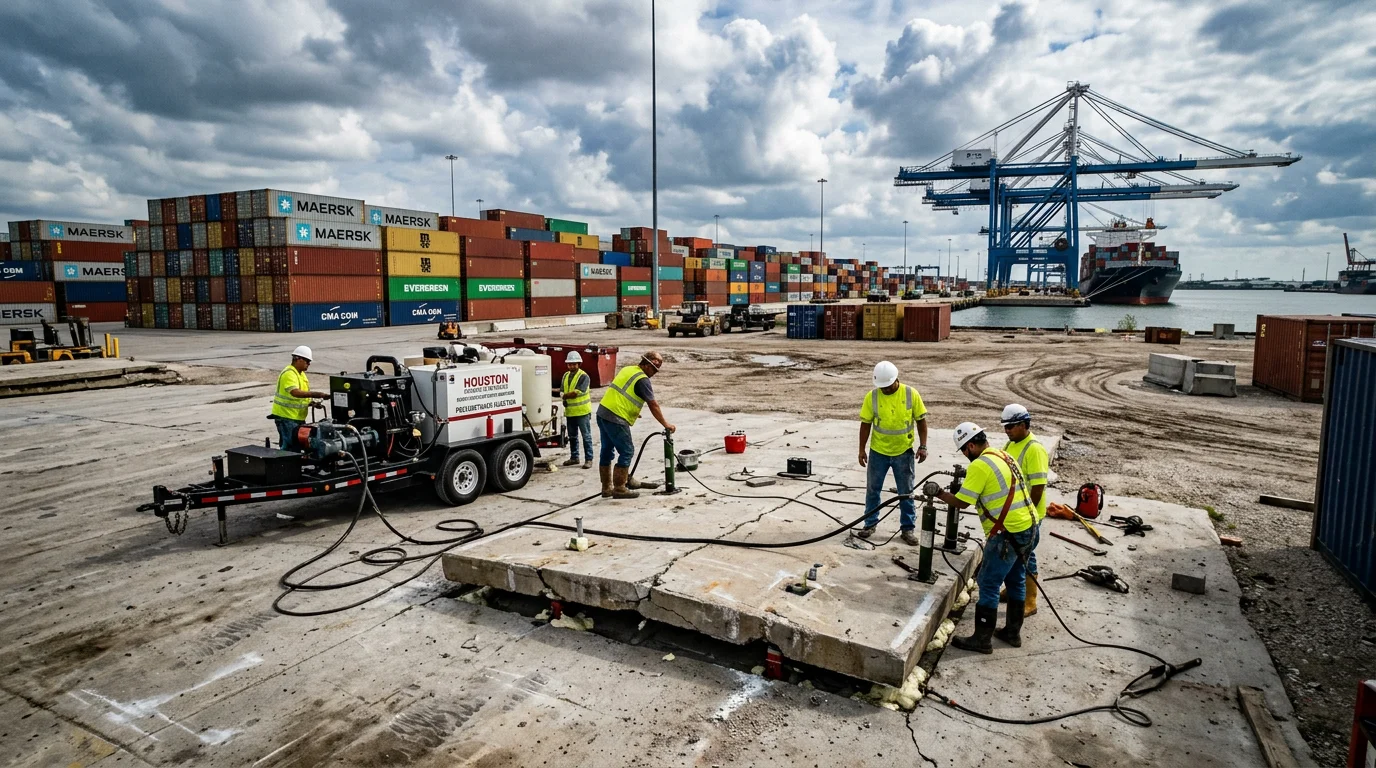
Houston's port complex is one of the busiest in the nation. Container yards, wharf aprons, intermodal transfer areas, and truck staging lanes all sit on concrete that handles extreme loads in a coastal environment where soil conditions are among the worst in Texas. Settlement at port facilities creates safety hazards for container handlers and delays cargo movement. Superior PolyLift has restored port concrete across the Houston Ship Channel corridor where salt air, heavy loads, and clay soil compound the challenge.
Runway taxiway connectors, terminal aprons, parking garage slabs, and pedestrian walkways all experience settlement in Houston's soil conditions. Airport concrete lifting requires FAA-compliant surface tolerances, coordination with airfield operations, and work windows that don't disrupt flight schedules. Polyurethane's rapid cure time — surfaces ready for aircraft traffic within hours — makes it the preferred method for airfield concrete repair.
Production floor settlement causes machinery misalignment, product quality issues, and safety hazards. Heavy equipment pads that settle even fractions of an inch can throw off CNC tolerances and vibration-sensitive processes. Polyurethane lifting restores pad elevation with the precision manufacturing environments demand — and the rapid cure means production resumes the same shift.
Settled concrete in parking structures creates trip hazards, vehicle damage from abrupt elevation changes, and water pooling that accelerates further deterioration. Multi-story garages present additional challenges because the concrete lifting must account for the structural load of floors above. Polyurethane's lightweight foam is ideal here — it restores grade without adding the structural burden that mudjacking's heavy slurry would impose.
| Facility Type | Primary Challenge | Typical Scope | Work Scheduling |
| Warehouse / Distribution | Forklift traffic settlement, racking zones | 5,000–50,000 sq ft | Zone-by-zone during operations |
| Port / Marine terminal | Extreme loads, coastal soil, 24/7 ops | 10,000–100,000+ sq ft | Night/weekend windows |
| Airport | FAA tolerances, airfield coordination | 2,000–20,000 sq ft | Airfield closure windows |
| Manufacturing plant | Machinery pads, production floor | 1,000–30,000 sq ft | Shift-change or weekend |
| Parking structure | Trip hazards, water pooling, structural load | 5,000–50,000 sq ft | Off-hours or phased |
| Retail / Office | ADA compliance, tenant disruption | 500–10,000 sq ft | After hours or phased |
Commercial projects are phased into work zones that are isolated with barriers while adjacent areas remain fully operational. Work scheduling aligns with facility operations — night shifts, weekend windows, or rotating zone closures — so the facility never fully shuts down. Each phase completes and returns to service before the next zone begins.
This is the operational question that matters most to facility managers: "Can I keep running while you're working?" The answer is almost always yes — with proper planning.
The project area is divided into work zones based on the facility's traffic patterns and operational priorities. Zone 1 is lifted while zones 2 through N remain active. When zone 1 cures and returns to service (typically within hours), zone 2 begins. This rolling approach means the facility is never fully offline — only the active work zone is restricted.
Different facilities need different scheduling approaches. A 24/7 distribution center may provide a 10 PM to 6 AM work window. A manufacturing plant might offer weekends. A retail space works best after store hours. Superior PolyLift builds the project schedule around the facility's operations, not the other way around. The rapid cure time of polyurethane foam — 15 to 30 minutes to full strength — makes these compressed work windows feasible in ways that mudjacking's 24 to 72 hour cure simply can't accommodate.
Commercial lifting crews work under the facility's safety protocols — hard hats, hi-vis vests, lockout/tagout procedures, confined space permits where applicable, and traffic management plans for active areas. Superior PolyLift's crews carry OSHA certifications and integrate with the facility's safety management system. Pre-project safety briefings with the facility's operations team are standard.
A dedicated project manager coordinates between the lifting crew and the facility's operations team throughout the project. Daily briefings on zone status, schedule adherence, and any scope adjustments keep everyone aligned. This communication layer is what separates a commercial-grade lifting contractor from a residential crew attempting commercial work.
Evaluate contractors on their commercial project volume and references, equipment capability for your facility type, foam density engineering for your traffic loads, ability to work within your operational schedule, safety certifications, and willingness to provide a detailed written scope with phasing plan — not just a per-square-foot number.
Choosing a contractor for commercial concrete lifting isn't the same as choosing one for a residential driveway. The stakes are higher, the scope is larger, and the consequences of poor work — re-settlement under heavy loads, schedule overruns that disrupt operations, or inadequate lift precision — are measured in operational dollars, not just repair costs.
Here's what to demand:
Commercial concrete lifting in Houston protects operational continuity, worker safety, and facility value — and polyurethane foam injection does it faster, lighter, and more precisely than any alternative. Whether it's a settled warehouse floor, a sunken port apron, or a parking structure with trip hazards, the PolyLift™ system restores grade with engineered precision and same-day return to service.Need a commercial concrete assessment? Contact Superior PolyLift™ to schedule a free site evaluation for your Houston facility. Their team assesses slab condition, maps voids, specifies the right foam density for your loads, and designs a phased project plan that keeps your operation running.
Explore how our expertise can benefit your project. Reach out to our team for a consultation and discover the best solutions for your needs.
At Superior PolyLift™, integrity and reliability are the core of our ethos. Our expert team crafts custom solutions that guarantee quality and durability for every project. Choose us for geotechnical excellence that endures.
Copyright © All rights reserved. 2024 • Terms of Use and Privacy Policy • Internet Marketing by Authority Solutions®