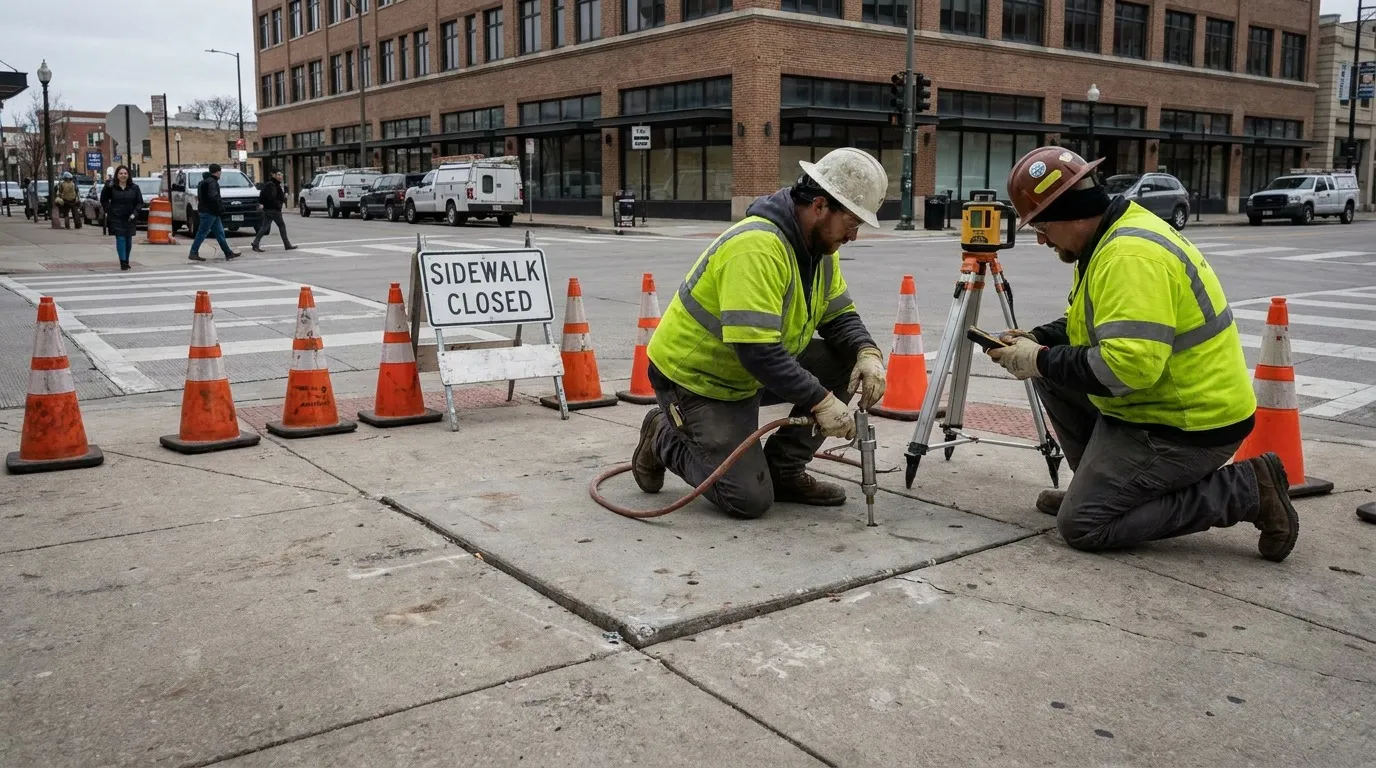
Municipal infrastructure concrete repair applies polyurethane injection, void fill, and soil stabilization to public sidewalks, street panels, storm drainage structures, bridge approach slabs, water and wastewater treatment slabs, and municipal building slabs. The method restores grade and load transfer without full replacement, compresses public right-of-way closure from days to hours, and aligns with typical DOT, FHWA, and municipal specifications for material class, injection procedure, QA/QC, and closeout documentation. It is not a substitute for structural rehabilitation of concrete elements that have themselves failed.
Municipal concrete rehabilitation sits at the intersection of engineering, procurement discipline, and public-service constraints that no private-sector project has to balance. Every specification decision is subject to public bid rules. Every work window is negotiated against traffic and pedestrian access. Every closeout deliverable is going into a public archive that a future inspector, a records request, or a resident complaint could pull five years later.
This article covers the polyurethane injection scope applied to municipal infrastructure: what it does well, where it fits into public works specifications, and where a program manager should specify a different scope entirely.
Table of contents
The Municipal Infrastructure Category: What's Actually in Scope
Municipal infrastructure concrete repair covers a defined but broad set of asset classes:
Sidewalks and pedestrian walkways. Panel settlement, joint offset, and pedestrian trip hazards subject to ADA 2010 Standards (vertical changes over 1/4 inch require beveling or remediation).
Street panels and roadway approach slabs. Pavement panel settlement, joint faulting, longitudinal joint drop, and bridge approach slab settlement (the "bump at the end of the bridge").
Storm drainage and sanitary sewer structures. Inlet frame settlement, manhole frame drop, and void fill around drainage structures where soil washout has occurred.
Water and wastewater treatment slabs. Process equipment pads, chemical containment slabs, and access walkways in treatment facilities.
Public building slabs. City hall, community center, library, and municipal service building slabs subject to standard commercial slab conditions.
Bridge and elevated structures. Approach slabs, wingwall support, culvert and box culvert void fill, and abutment backfill densification (subject to bridge-specific engineering review).
Airport pavements. Runway, taxiway, and apron panel lifting subject to FAA specifications (specialty scope).
Port and marine infrastructure. Dock slabs, container yard pavements, and terminal apron work.
The common thread is that the concrete itself is generally sound and the failure is in the subgrade. When that condition holds, polyurethane injection is the low-disruption scope. When the concrete itself has failed, structural rehabilitation or replacement is the honest scope.
Common Failure Modes in Public Works Slabs
Municipal slab failures typically trace to one of four causes:
Drainage washout. Fine soil is transported out from beneath a slab by concentrated water flow, most commonly around storm drain inlets, curb-and-gutter transitions, and downspout discharge points. The result is a void directly beneath the slab and settlement of the panel above.
Consolidation of engineered fill. Compacted embankment and structural fill continue to consolidate over the service life of the infrastructure, particularly under repeated loading. This produces bridge approach slab settlement, sidewalk drift at retaining wall backfill, and street panel drop above utility trench zones.
Expansive-soil cycling. In the Gulf Coast, Vertisol and Houston Black clay shrink-swell cycling produces seasonal movement that appears as recurring settlement across sidewalks, street panels, and municipal building slabs.
Utility trench settlement. Poorly compacted trench backfill over water, sewer, gas, and telecom utilities produces linear settlement patterns along the trench axis, visible on street panels and sidewalks above the utility corridor.
Each failure mode has a diagnostic signature. A qualified municipal specialty contractor uses GPR sweep, boroscope confirmation, and elevation survey to identify the failure mode before specifying scope. A generalist quotes injection without confirming what's under the slab.
Applicable Polyurethane Method Classes
Three polyurethane method classes are commonly specified in municipal infrastructure work:
Void fill. Fills subsurface voids beneath slabs without lifting. Used where the slab is at acceptable elevation but voids beneath it threaten load-bearing continuity. Typical scope: void fill under storm drain inlets, under utility vault covers, and under sidewalks where settlement has not yet occurred but voids have formed.
Concrete lifting. Injects and lifts settled slabs back to design elevation. Used where the slab has dropped from original grade. Typical scope: sidewalk panel lifting for ADA compliance, street panel lifting for pavement smoothness, bridge approach slab lifting.
Soil stabilization. Densifies weak subgrade in place. Used where the subgrade itself is inadequate to carry the design load, independent of any specific void or settlement. Typical scope: pre-construction soil improvement and retrofit stabilization under existing infrastructure.
Each method has its own specification, application equipment, and closeout deliverables. A municipal project specification typically names one method with defined boundaries. The underlying methodology is documented on the polyurethane concrete lifting service page.
Polyurethane injection is recognized in major DOT and federal specifications:
TxDOT recognizes polyurethane injection within its bridge preservation and pavement rehabilitation specifications.
FHWA supports polyurethane injection as an approved method category within its Pavement Preservation and Bridge Preservation program guidance.
AASHTO LRFD Bridge Design Specifications and pavement maintenance publications reference polyurethane injection as a recognized method.
Municipal specifications (city and county) commonly reference DOT specifications directly or maintain adapted specifications with equivalent material class and procedure requirements.
Specification alignment for a given project should be verified with the engineer of record and the owner's representative before scope is finalized. Contractors typically submit product technical data sheets, injection procedures, QA/QC plans, and traffic control plans for engineer review before work proceeds.
Procurement and Bidding Considerations
Municipal procurement adds constraints not present on private work:
Prevailing wage requirements. Federal-aid projects and many municipal projects require Davis-Bacon prevailing wage rates for field labor. The bid must reflect this cost.
Bonding and insurance thresholds. Municipal projects typically require performance and payment bonds, higher liability insurance limits, and additional insured endorsements for the owner and engineer.
DBE participation. Many municipal projects require documented disadvantaged business enterprise subcontracting at specified percentages.
Public bid transparency. Bids are typically opened publicly and become public record.
Buy America / Buy American compliance. Federally funded projects may require documented US-manufactured materials.
A qualified municipal specialty contractor has systems in place for each constraint. A contractor without a municipal track record typically does not, which is why bid qualification typically excludes firms without infrastructure experience from municipal work.
Public Right-of-Way and Traffic Control
Polyurethane injection's short work window is one of its principal advantages in municipal application. Sidewalk panel lifting completes in an hour or two per panel. Street panel lifting completes in 4 to 8 hours per bay. Bridge approach slab lifting completes in the same 4 to 8 hour window per bay. In every case the return-to-service time is measured in hours rather than days, which is what allows the work to fit standard maintenance-of-traffic (MOT) plans without extended corridor closures.
Traffic control plans are project-specific and coordinated with the owner and traffic engineer. Typical patterns include lane-by-lane closures with flagger operation, off-peak or overnight closures for high-volume corridors, and pedestrian detour routing for sidewalk work. The contractor supplies traffic control plans as part of the pre-construction submittal package.
Documentation and QA/QC Requirements
superior grouting municipal infrastructure closeout documentation 03
Municipal closeout documentation typically exceeds what private-sector work requires:
Daily injection log with per-port pressure, volume, lift measured, and material lot number
Pre- and post-elevation survey documenting the slab profile before and after injection
Photo documentation at defined intervals with GPS metadata where practical
Material traceability records including manufacturer certificates of analysis for the batches used
Reconciliation of planned vs actual material volume with variance explanations
Signed contractor completion report with engineer acceptance signature
As-built drawings showing injection zones marked on the site plan
QA/QC verification including any specified acceptance testing
This documentation package is delivered to the owner as part of contract closeout, becomes part of the asset management record, and supports future inspection and rehabilitation planning. Contractor selection should weight documentation capability heavily.
When Polyurethane Is Not the Right Municipal Scope
Polyurethane injection is not the right answer in several municipal scenarios:
Structural failure of the concrete itself. Through-slab cracking, active reinforcement corrosion, delamination, or spalling of the concrete matrix. Structural rehabilitation or replacement is the appropriate scope. These conditions are covered under foundation issues.
Slab thickness insufficient for revised loading. Where a slab was undersized or loading has been upgraded, replacement or structural overlay is the appropriate scope.
Extreme void volumes where bulk-fill economics favor cementitious grout. Some large-void applications favor cementitious slurry on unit cost grounds; the tradeoff is longer cure time and higher added weight.
Historic preservation contexts specifying cementitious methods. Some historic infrastructure specifications require cementitious rehabilitation for compatibility with original materials.
A qualified specialty contractor identifies these conditions during the pre-injection assessment and recommends an alternative scope rather than injecting foam that will not solve the underlying problem.
Case Framework: Three Municipal Scenarios
Three representative municipal scenarios illustrate how the scope-selection framework plays out. Each is a composite for framework illustration only.
Downtown sidewalk panel with ADA trip hazard. 4-inch panel, 1-1/2 inch vertical offset at the joint with the adjacent panel, small subgrade void confirmed by boroscope. Polyurethane lifting to restore elevation within ADA tolerance; 1 to 2 hours per panel; sidewalk closure limited to the work window.
Street panel over utility trench. 7-inch reinforced panel, longitudinal settlement of 3/4 inch above a sewer trench, no through-slab cracking. Polyurethane lifting to restore elevation and grade; 4 to 6 hour lane closure per bay; return to traffic within the work window.
Storm drain inlet frame settlement. Cast-iron inlet frame dropped 1 inch relative to surrounding pavement due to void formation from washout. Polyurethane void fill to stabilize subgrade around the inlet, followed by targeted lift of the inlet frame; 4 to 8 hours per inlet; drainage function unaffected during work.
Each scenario represents a scope that polyurethane injection handles routinely. Scopes NOT in the framework (structural pier cap failure, active reinforcement corrosion in a bridge deck, complete replacement of a failed street panel) represent conditions where polyurethane is not the appropriate specification.
Emergency vs Programmed Repair
Municipal concrete rehabilitation splits into emergency and programmed categories:
Emergency repair responds to acute defects: post-storm washout that has opened a void beneath a sidewalk, sudden settlement discovered during a routine inspection, or damage discovered after utility work. Response time is measured in days to weeks. Polyurethane injection fits emergency response well because equipment can mobilize quickly and work windows are short.
Programmed repair is scheduled as part of the municipality's capital improvement or asset management plan. Response time is measured in months. Polyurethane injection fits programmed repair when the asset management assessment has identified subgrade support failure as the dominant defect mode. When the assessment identifies structural concrete failure, the programmed scope is replacement rather than injection.
Key Takeaways
Municipal infrastructure concrete repair covers sidewalks, streets, storm drainage, bridge approaches, water and wastewater treatment slabs, public buildings, and specialty facilities (airport, port).
The four common failure modes are drainage washout, engineered fill consolidation, expansive-soil cycling, and utility trench settlement. Each has a diagnostic signature identifiable by GPR and elevation survey.
Three polyurethane method classes apply: void fill, concrete lifting, and soil stabilization. Each has distinct specifications and closeout deliverables.
Polyurethane injection is recognized in TxDOT, FHWA, AASHTO, and municipal specifications. Specification alignment for a specific project must be verified with the engineer of record.
Municipal procurement adds constraints not present in private work: prevailing wage, bonding, DBE participation, public bid transparency, environmental compliance.
Return-to-service in hours rather than days is the operational advantage that fits polyurethane injection to public right-of-way constraints.
Closeout documentation is substantial and becomes part of the public asset management record.
Polyurethane is not the right scope when the concrete itself has structurally failed, when slab thickness is insufficient for revised loading, or when historic preservation specifies cementitious methods.
Conclusion
Municipal infrastructure concrete rehabilitation is engineering, procurement, and public-service coordination executed in the same project. Polyurethane injection fits municipal specifications when the failure is in the subgrade rather than the concrete itself, when work windows are short, and when documentation rigor supports long-term asset management. It does not fit every municipal scope. A qualified specialty contractor identifies the correct scope for the specific asset, produces the closeout documentation that public archives expect, and stands behind the work under the specification language of the contract.
Marcus Trevino is a Senior Infrastructure Remediation Specialist at Superior PolyLift in Houston, TX, with 18+ years of experience solving complex concrete lifting and foundation stabilization problems for commercial, municipal, and industrial clients.
Search
Discover Innovative Concrete Solutions Today
Explore how our expertise can benefit your project. Reach out to our team for a consultation and discover the best solutions for your needs.
Yes. Polyurethane injection is recognized in TxDOT, FHWA, AASHTO, and most municipal specifications for the appropriate scope of work. Specification details vary by owner. Contractors submit product data sheets, injection procedures, QA/QC plans, and traffic control plans for engineer review before work proceeds. Engineer of record confirmation is the authoritative source for specific project applicability.
Typical sidewalk panel lifting completes in 1 to 2 hours per panel including port drilling, staged injection, port finishing, and elevation verification. Return-to-service (pedestrian traffic) is typically within the same work window. For a longer corridor with multiple panels, work is executed panel by panel to minimize public disruption.
At minimum: daily injection log with per-port pressure and volume, pre- and post-elevation survey, photo documentation, material traceability records, planned vs actual material volume reconciliation, contractor completion report with engineer acceptance, as-built drawings showing injection zones, and QA/QC verification. This becomes part of the asset management record.
Yes, subject to FAA specifications. Airport pavement work is a specialty subcategory requiring FAA-familiar contractors, specific material class documentation, and coordinated maintenance-of-traffic with airport operations. Not every polyurethane contractor is qualified for airport work; specifically qualified specialty firms should be used.
Prevailing wage (Davis-Bacon on federally funded work, state prevailing wage on state and municipal work in many jurisdictions) increases the labor cost component of the bid. On short-duration polyurethane work the labor component is a smaller share of total cost than on labor-intensive replacement work, so the prevailing wage impact is proportionally smaller. The bid should reflect the applicable wage determination.
Void fill fills subsurface voids without changing the slab elevation. It is specified where the slab is at acceptable elevation but voids beneath it threaten future load-bearing performance. Concrete lifting injects and lifts settled slabs back to design elevation. It is specified where the slab has dropped. Both use polyurethane injection; the specification differs in the target outcome.
Replacement is the appropriate scope when the concrete itself has structurally failed: through-slab cracking from top to bottom, active reinforcement corrosion with delamination, insufficient slab thickness for revised loading, or severe chemical damage to the concrete matrix. Polyurethane restores subgrade support; it does not restore compromised concrete.
Yes. Equipment mobilization is typically 1 to 3 days depending on distance from the base of operations. Emergency response is a common polyurethane injection scope for post-flood, post-storm, and post-utility-failure conditions. Rapid response requires the contractor to maintain emergency-ready equipment and crew availability, which is a procurement criterion worth verifying.
At Superior PolyLift™, integrity and reliability are the core of our ethos. Our expert team crafts custom solutions that guarantee quality and durability for every project. Choose us for geotechnical excellence that endures.