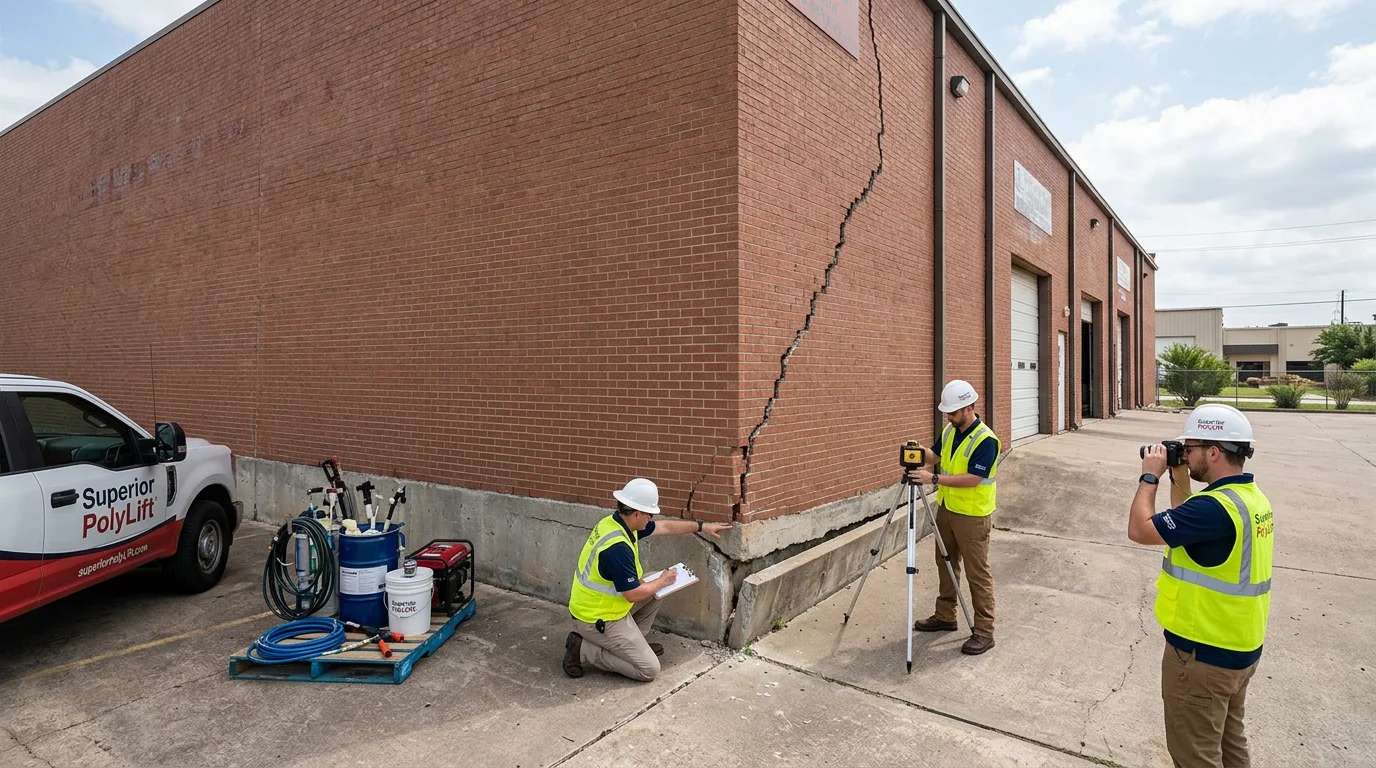
Commercial foundation repair in Houston addresses settlement, cracking, and structural displacement in warehouses, office buildings, retail spaces, industrial facilities, and multi-family complexes — structures where foundation failure disrupts business operations, creates safety hazards, and threatens asset value. Commercial repair differs from residential work in scale, compliance requirements, scheduling constraints, and the need to maintain operations during the repair process.
When a warehouse floor develops a 2-inch slope across a racking aisle, forklifts become unstable. When an office building's foundation shifts, interior partition walls crack and ceiling tiles drop. When a retail storefront settles, the front door won't close, the floor tiles crack, and customers notice. Commercial foundation repair isn't optional maintenance — it's an operational necessity with financial consequences that compound every week the problem goes unaddressed. Superior PolyLift's foundation repair services have stabilized commercial foundations across every major building type in Greater Houston — from single-story retail to multi-story office, from cold storage warehouses to port-adjacent industrial facilities — using polyurethane foam injection engineered for the region's demanding clay soil conditions.
This guide covers what makes commercial foundation repair different from residential, which Houston building types face the greatest risk, how projects are executed without shutting down operations, and what property owners and facility managers should look for in a commercial foundation repair partner.
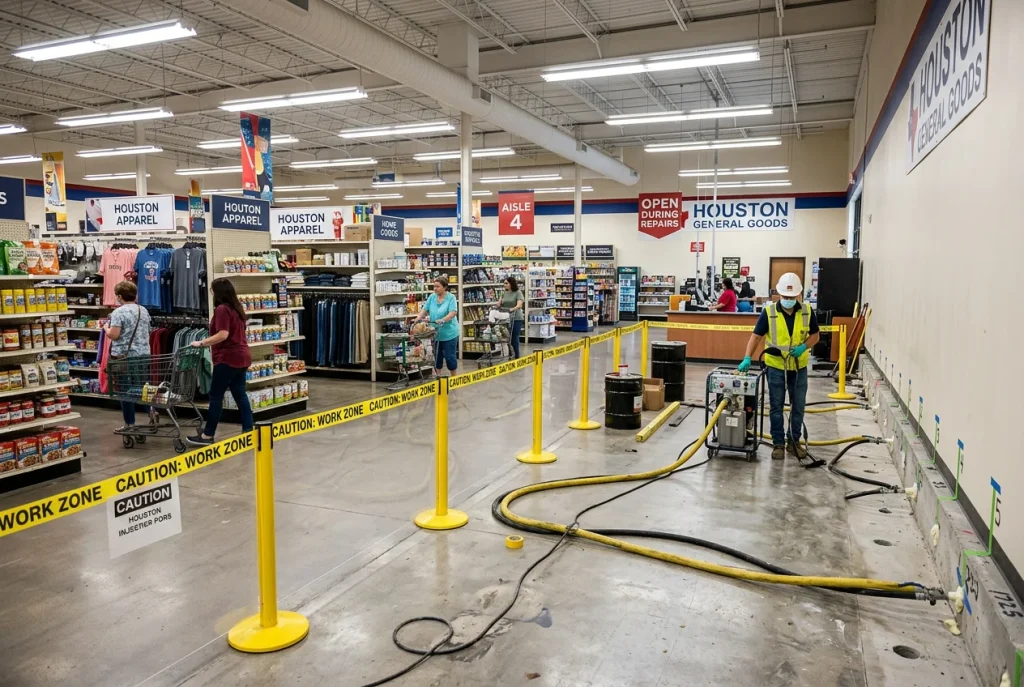
Commercial foundations support heavier structural loads, cover larger footprints, must meet code requirements that residential buildings don't encounter, and serve buildings where operational downtime during repair carries direct financial consequences. The diagnostic approach is more data-intensive, the repair engineering is more complex, and the project management requires coordination with tenants, building managers, and sometimes municipal authorities.
A residential foundation supports a single family's home. A commercial foundation supports a business — employees, equipment, inventory, customers, and revenue. That difference shapes every aspect of the repair.
Commercial buildings impose loads that residential structures don't approach. Warehouse racking systems concentrate tens of thousands of pounds on small footprint areas. Multi-story offices transfer floor loads through columns to the foundation. Retail freezer units and commercial kitchen equipment create point loads that residential foundations never see. The foundation repair must account for these existing loads during the lifting process — over-lifting beneath a loaded column can stress the structure above.
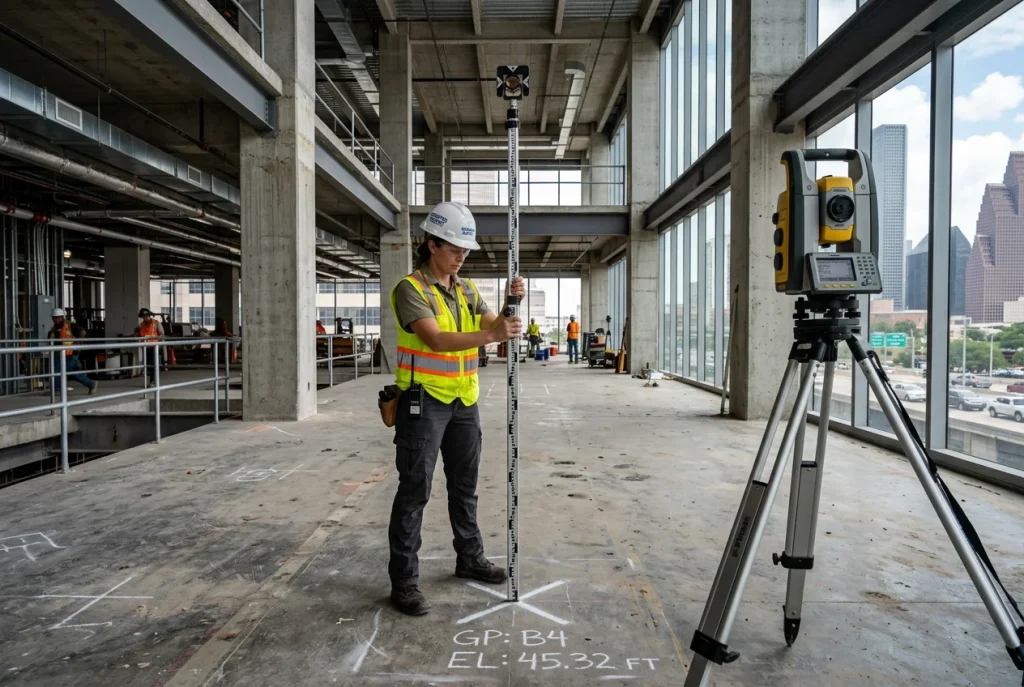
Residential foundation assessment often involves a visual inspection and a basic elevation survey. Commercial assessment requires more: detailed elevation surveys at tighter grid spacing, structural load analysis per Deep Foundations Institute guidelines, review of the building's original geotechnical report (if available), and sometimes GPR scanning to map sub-slab conditions. The data requirements are higher because the consequences of misdiagnosis are higher.
Commercial buildings must meet building code requirements for structural integrity, ADA accessibility, fire egress, and occupancy classification. Foundation repair that changes floor elevation must verify that the corrected building still meets these requirements. Door clearances, ramp slopes, and threshold heights all need to be checked post-repair. In Houston, certain commercial repairs may require engineering documentation for permitting.
The financial impact of shutdown is the defining constraint on commercial foundation repair. A 200,000-square-foot distribution center can't close for two weeks while the foundation is repaired. A medical office can't reschedule a week of patient appointments. A retail store can't lose holiday-season revenue. Polyurethane foam injection's rapid cure time (15 to 30 minutes) and zone-phased execution allow commercial repairs to proceed while the building remains operational — the core advantage that makes foam the preferred commercial method.
| Factor | Residential Repair | Commercial Repair |
| Foundation area | 1,000–3,000 sq ft | 5,000–200,000+ sq ft |
| Structural loads | Light residential | Heavy, concentrated, multi-story |
| Diagnostic tools | Basic elevation survey | Detailed survey + load analysis + GPR |
| Code compliance | Standard residential | ADA, fire egress, occupancy, structural |
| Downtime tolerance | Flexible | Hours to days maximum |
| Project management | Homeowner coordination | Tenant + building manager + engineer |
| Repair documentation | Basic warranty | Engineering records, permit documentation |
Warehouses and distribution centers, tilt-wall industrial buildings, multi-story office buildings, retail strip centers, multi-family apartment complexes, and medical facilities are the most vulnerable — each for different reasons related to their load profiles, foundation types, and exposure to Houston's clay soil conditions.
Houston's commercial building stock sits on the same Beaumont clay as every residential property. But commercial buildings stress that clay differently — heavier loads, larger footprints, and more complex drainage patterns create foundation challenges that residential construction doesn't face.
The most common commercial foundation repair in Houston. Warehouse slab-on-grade foundations carry concentrated loads from racking systems, forklift traffic, and stored inventory. Settlement typically appears first along dock doors (where the foundation transitions to the apron), under heavy racking bays, and in high-traffic aisles. A warehouse foundation that settles 1 to 2 inches beneath a loaded rack can compromise the entire storage system's stability.
Houston's most common industrial construction type. Tilt-wall buildings pour concrete wall panels on the floor slab, then tilt them into position as the exterior walls. The connection between the wall panel base and the foundation is critical — foundation settlement can displace the wall panel, opening gaps at the base, stressing connections, and potentially compromising the building envelope. Foam injection stabilizes the foundation without disturbing the wall panel connections.
Foundation settlement in multi-story buildings creates cascading effects — a 1-inch settlement at the foundation can produce a 3-inch displacement at the third floor through frame racking. Interior partition walls crack, ceiling grids shift, and mechanical systems that depend on level floors (elevators, escalators) malfunction. The repair must address the foundation settlement without creating uneven lifting that introduces new stress into the structural frame.
Strip center foundations span multiple tenant spaces, each with different interior loads and configurations. Settlement in one bay can affect adjacent tenants through shared walls and common foundations. Repair coordination involves multiple tenants, landlord approval, and scheduling around retail operating hours — often requiring after-hours or overnight work.
Apartment complexes and condominiums combine commercial-scale foundations with residential occupancy. Foundation repair affects multiple dwelling units simultaneously, requires coordination with property management and tenants, and must maintain habitability during the repair process. Houston's multi-family construction boom in the 2000s and 2010s placed thousands of units on Beaumont clay — and many are now showing settlement symptoms as the soil goes through its second and third decade of moisture cycling.
| Building Type | Primary Foundation Risk | Common Repair Scope | Scheduling Constraint |
| Warehouse / Distribution | Racking loads, dock settlement | Slab interior + perimeter | Zone phased, night/weekend |
| Tilt-wall industrial | Wall panel connection stress | Perimeter + panel base zones | Production schedule windows |
| Multi-story office | Frame racking, cascading displacement | Targeted column zones | After hours, floor by floor |
| Retail strip center | Multi-tenant, shared foundation | Bay-by-bay phased | After hours, tenant coordinated |
| Multi-family residential | Multiple units, occupancy constraints | Building-wide phased | Unit-by-unit, maintain habitability |
| Medical facility | Equipment sensitivity, patient access | Precision zones around equipment | Weekends, appointment gaps |
Zone-phased execution divides the foundation into work areas that are repaired sequentially — each zone is isolated, repaired, cured, and returned to service before the next zone begins. Polyurethane foam's 15 to 30 minute cure time makes this phased approach feasible for commercial schedules that can't tolerate multi-day shutdowns. Work is scheduled during off-peak windows — nights, weekends, tenant transitions — and coordinated with building operations throughout.
The operational question every commercial property owner asks: "How much of my building do I lose, and for how long?" With polyurethane foam injection, the answer is usually: one zone at a time, for hours — not the entire building for days.
The foundation is divided into repair zones based on settlement severity, structural priority, and operational impact. The highest-priority zone — typically the area with the most severe settlement or the greatest safety concern — goes first. That zone is isolated with barriers, repaired through foam injection with real-time monitoring, cured (15 to 30 minutes), and returned to service. Then the next zone begins.
For a 100,000-square-foot warehouse with settlement across six zones, this might mean two zones per night over three consecutive nights — with the warehouse fully operational during daytime hours. For a retail space, it might mean one overnight session covering the entire store footprint.
Superior PolyLift assigns a dedicated project manager to every commercial foundation project. That project manager coordinates with the building's operations team on zone sequencing, work window scheduling, utility isolation (if needed around plumbing or electrical), and daily status communication. This coordination layer is what allows the building to keep running — the operations team knows exactly which areas are restricted, when they'll reopen, and what to expect next.
Real-time elevation monitoring continues during and after each zone repair. If the building is occupied during the repair — common in phased commercial work — the monitoring verifies that the lift in one zone hasn't created unintended movement in adjacent zones. This is particularly important in multi-story buildings where foundation adjustment in one area transfers through the structural frame.
Demand documented commercial project experience with buildings similar to yours, a diagnostic process that includes detailed elevation surveys (not just visual inspection), multiple repair technology options (foam and piers), phased scheduling capability, engineering documentation for code compliance, and written warranty terms with specific coverage details.
The commercial foundation repair market in Houston ranges from highly qualified engineering-driven firms to residential contractors attempting commercial work they're not equipped to handle. The difference shows up in the diagnostic quality, the repair precision, and the project management.
Superior PolyLift brings commercial-grade diagnostic capability, polyurethane foam injection technology, and dedicated project management to every commercial foundation repair project in Houston — backed by a portfolio that spans warehouses, industrial facilities, retail, office, and multi-family across the Greater Houston area.Ready to assess your commercial foundation? Contact Superior PolyLift™ for a free commercial foundation evaluation. Their team conducts a thorough diagnostic assessment and provides a written scope with phased scheduling options designed around your building's operations.
Explore how our expertise can benefit your project. Reach out to our team for a consultation and discover the best solutions for your needs.

At Superior PolyLift™, integrity and reliability are the core of our ethos. Our expert team crafts custom solutions that guarantee quality and durability for every project. Choose us for geotechnical excellence that endures.
Copyright © All rights reserved. 2024 • Terms of Use and Privacy Policy • Internet Marketing by Authority Solutions®