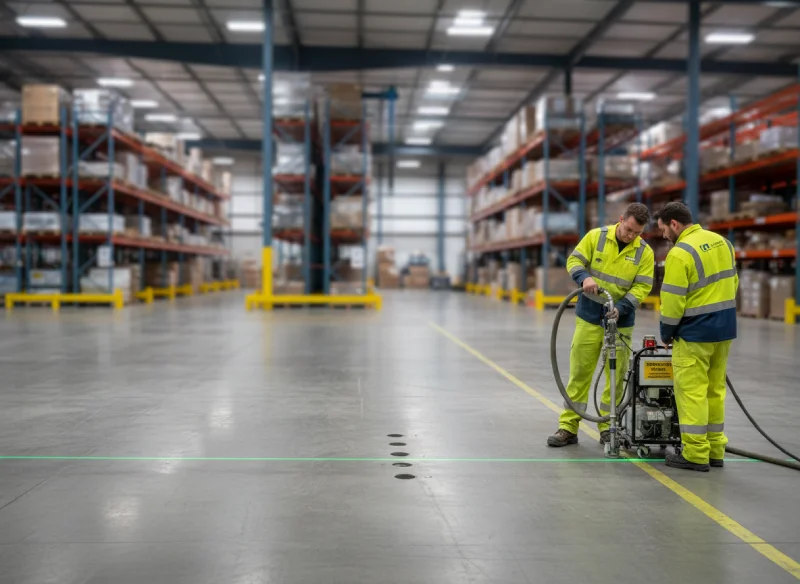
Polyurethane foam injection levels uneven concrete through controlled expansion of high-density polymers injected beneath settled slabs, filling subsurface voids while exerting precise upward lifting force, achieving elevation accuracy within one-eighth inch and restoring structural integrity with minimal operational disruption.
Understanding the technical process behind polyurethane foam injection proves essential for facility managers, engineers, and contractors responsible for maintaining operational concrete surfaces.
This advanced geotechnical solution addresses subsurface void formation and differential settlement through chemical expansion rather than mechanical force, delivering superior precision compared to traditional methods. The process combines materials science with sophisticated injection techniques to restore concrete elevation while simultaneously stabilizing underlying soils.
Superior PolyLift™ specializes in uneven concrete leveling for industrial and commercial facilities requiring minimal downtime and maximum performance durability.
Concrete settlement occurs when supporting soils beneath slabs lose volume through various mechanisms. Soil consolidation under sustained loading compresses particles, reducing void space and overall volume. Erosion from subsurface water flow removes fine soil particles, creating cavities beneath concrete structures.
Primary void formation mechanisms include:
These processes create voids between concrete undersides and bearing soils. Without continuous support, concrete spans across these voids like bridges, concentrating stress at remaining contact points. Progressive void expansion leads to differential settlement, where portions of slabs sink at different rates based on local support conditions.
Properly supported concrete distributes structural and operational loads uniformly across bearing soils. When voids form, load distribution becomes concentrated at reduced contact areas. This stress concentration accelerates soil compression at remaining support points, expanding void areas progressively.
Industrial settlement consequences include:
Expansive clay soils undergo significant volume changes with moisture content variations. Wet conditions cause clay expansion, lifting concrete temporarily. Subsequent drying shrinks clay volume, creating voids beneath previously lifted areas.
Moisture-related settlement factors:
Polyurethane foam concrete leveling utilizes two-component chemical systems stored separately until injection. Component A contains isocyanate compounds providing reactive chemical groups. Component B consists of polyether polyol with catalysts, surfactants, and blowing agents.
Critical chemical components include:
The reaction proceeds through multiple stages. Initial mixing creates liquid polyurethane prepolymer through isocyanate-polyol bonding. Blowing agent decomposition generates carbon dioxide gas creating foam cell structure. Crosslinking reactions between polymer chains solidify the matrix.
High-density geotechnical polyurethane formulations achieve controlled expansion ratios between fifteen-to-one and twenty-five-to-one depending on application requirements. Material enters injection ports as liquid with viscosity similar to motor oil. Chemical reaction initiates expansion within seconds of component mixing.
Expansion force proves sufficient to lift heavily loaded concrete slabs. Typical formulations generate expansion pressures exceeding one hundred pounds per square inch. This force proves adequate for raising warehouse floors supporting fully loaded pallet rack systems.
Cured polyurethane foam achieves compressive strength between eighty and one hundred twenty pounds per square inch depending on formulation density.
Key performance specifications:
Professional evaluation begins with comprehensive settlement pattern analysis. Technicians measure elevation differentials using precision leveling equipment. Ground-penetrating radar or similar technologies identify subsurface void locations and dimensions.
Assessment procedures include:
Assessment data informs injection strategy development. Technicians calculate required foam volumes based on void dimensions and desired lift height. Injection port locations are strategically planned to achieve uniform lifting force distribution.
Strategic drilling creates injection access through concrete slabs. Five-eighths inch diameter holes provide adequate access for injection equipment while minimizing structural impact. Hole depth extends through full slab thickness, typically four to twelve inches depending on application.
Tapered injection ports install into drilled holes, creating sealed connections between injection equipment and subsurface void spaces. Port design prevents foam backflow during injection while enabling equipment attachment and removal.
Specialized injection equipment meters and mixes polyurethane components with precision.
Equipment specifications include:
Systematic injection sequencing ensures uniform lifting and prevents localized over-elevation. Technicians begin injecting at lowest settlement points, gradually working toward higher areas. This approach prevents foam migration away from areas requiring greatest lift. Multiple passes through injection port sequences enable precise elevation control through incremental material addition.
Initial injection passes fill subsurface voids without significant slab movement. Foam expands into cavity spaces, displacing air and compressing loose soils. Subsequent passes generate upward lifting force as expanding foam contacts slab underside across broader areas. Final passes make fine elevation adjustments, achieving specified tolerances.
Precision leveling equipment monitors slab elevation throughout injection operations. Optical levels or laser measurement systems track vertical movement at critical reference points. Technicians compare real-time measurements against target elevations, adjusting injection parameters accordingly. This feedback loop enables achievement of one-eighth inch accuracy specifications.
Monitoring also detects uneven lifting requiring corrective action. If one slab section rises faster than adjacent areas, technicians redirect foam injection to slower-moving zones. This attention prevents creating new differential settlement problems while correcting existing issues. Continuous monitoring throughout multi-hour projects maintains consistent quality standards.
Understanding foam expansion timing proves essential for process control.
Expansion timeline stages:
Rapid expansion enables responsive process control. Technicians observe immediate slab response to injection, making real-time adjustments. This responsiveness contrasts sharply with cement-based methods requiring hours before material achieves sufficient strength for evaluation.
Understanding performance differences between leveling methods informs appropriate technology selection:
| Performance Factor | Polyurethane Foam | Traditional Mudjacking | Complete Replacement |
| Cure Time | 15 minutes | 24-48 hours | 28 days full strength |
| Material Weight | 2-4 lbs/ft³ | 100-150 lbs/ft³ | 150 lbs/ft³ |
| Injection Port Size | 5/8 inch diameter | 1-2 inch diameter | N/A - full demolition |
| Elevation Precision | ±1/8 inch | ±1/4 inch | ±1/4 inch |
| Service Life | 20+ years | 5-7 years typical | 20-30 years |
| Moisture Resistance | Fully waterproof | Absorbs water | Good when properly placed |
| Installation Time | 2-6 hours typical | 4-8 hours typical | 7-14 days minimum |
Loading dock concrete platforms require precise elevation maintenance for efficient operations. Dock plates bridging trucks and facilities demand consistent height relationships. Settlement creates gaps or excessive slopes impeding material handling equipment movement. Forklift operators struggle with uneven transitions, reducing productivity and increasing accident risk.
Polyurethane foam injection restores proper dock elevations with minimal operational disruption. Rapid cure times enable return to service within hours rather than days. Precision elevation control maintains proper relationships with truck bed heights across various vehicle types. Durable repairs withstand continuous heavy equipment traffic without deterioration.
Modern warehouse operations depend on extremely level concrete floors for high-density storage systems. Narrow-aisle guided equipment requires floor flatness within stringent tolerances. Settlement creates elevation changes interfering with automated guidance systems. Uneven floors stress rack uprights, compromising structural stability and load capacity.
Foam injection corrects settlement without removing or relocating storage systems. Work proceeds incrementally around operational areas, maintaining business continuity. Minimal injection port sizes preserve floor surface integrity. Immediate cure enables rack system usage hours after completion rather than requiring extended facility shutdowns.
Precision manufacturing equipment requires stable, level mounting surfaces for proper operation. Machine tool performance depends on consistent geometry maintained through vibration isolation mounting. Settlement beneath equipment pads compromises precision, increasing scrap rates and reducing production quality. Uneven floors cause alignment problems for material conveyor systems moving components between workstations.
Polyurethane foam stabilizes equipment mounting areas while facilities remain operational. Injection can proceed during production shifts with minimal disruption. Quick curing prevents extended machine downtime for remounting and recalibration. Long-term stability prevents recurrence requiring repeated interventions.
Expanding polyurethane foam fills irregular void spaces completely. Material flows into cavities following paths of least resistance, conforming to complex subsurface geometries. Expansion pressure forces foam into confined spaces inaccessible to flowable cement slurries. Complete void filling eliminates future settlement risk from remaining unsupported zones.
Foam expansion also compacts surrounding loose soils. Outward expansion pressure during curing densifies adjacent soil particles. This compaction effect extends beyond immediate injection zones, improving overall subgrade stability. Densified soils provide better long-term support, preventing progressive settlement continuation.
Polyurethane foam achieves excellent adhesion to concrete undersides. Chemical bonding occurs between foam and concrete during curing, creating integrated composite structure. This adhesion helps distribute loads more uniformly across repaired areas. Bonded foam prevents concrete underside spalling that might otherwise occur from moisture or freeze-thaw exposure.
Strong adhesion also prevents foam displacement from dynamic loading. Repetitive traffic loading or vibration from equipment operation cannot dislodge properly bonded foam. Material remains in place providing continuous support over decades of service. This permanence contrasts with unbonded materials potentially migrating under sustained loading.
Closed-cell polyurethane foam structure prevents water absorption and transmission. Individual foam cells remain sealed, blocking moisture pathways through material. This hydrophobic characteristic proves critical in applications with subsurface moisture issues. Foam maintains structural properties and dimensions regardless of saturation conditions.
Moisture resistance prevents freeze-thaw damage in cold climates. Water cannot penetrate foam to freeze and expand during cold cycles. This durability eliminates a primary failure mechanism affecting cement-based repair materials. Facilities in northern climates benefit particularly from this performance advantage.
The following table outlines typical project durations for various facility applications:
| Facility Type | Typical Area Size | Assessment Time | Installation Duration | Return to Service |
| Loading Dock | 2,000-5,000 sq ft | 1-2 hours | 4-6 hours | Immediate (15 min cure) |
| Warehouse Aisle | 5,000-15,000 sq ft | 2-3 hours | 6-12 hours | Immediate (15 min cure) |
| Manufacturing Floor | 10,000-25,000 sq ft | 3-4 hours | 12-24 hours | Immediate (15 min cure) |
| Parking Structure Deck | 20,000-50,000 sq ft | 4-6 hours | 24-48 hours | Immediate (15 min cure) |
Professional installations include comprehensive post-repair elevation verification. Precision leveling equipment measures achieved elevations at numerous reference points. Survey data documents compliance with project specifications and tolerance requirements. This verification provides objective evidence of successful repair completion.
Elevation surveys also identify any areas requiring adjustment before project completion. If measurements reveal discrepancies exceeding specified tolerances, additional foam injection corrects problems immediately. This quality assurance process ensures clients receive repairs meeting all performance criteria before contractors demobilize from sites.
Responsible contractors recommend periodic elevation monitoring following major repairs. Annual surveys track potential settlement recurrence or new problem development. Early detection enables proactive intervention before minor issues become significant operational problems. Documented stability over time validates repair effectiveness and material performance.
Monitoring data also informs maintenance planning and budgeting. Facility managers gain insights into settlement patterns and timing, enabling strategic capital planning. Understanding which areas remain stable versus those showing progressive movement helps prioritize future repair investments.
Polyurethane foam injection typically costs between eight and twenty-five dollars per square foot depending on project complexity and settlement severity. This represents premium pricing compared to traditional mudjacking at three to six dollars per square foot. However, direct cost comparison overlooks numerous factors affecting total project economics.
Superior performance characteristics justify premium pricing through lifecycle cost analysis. Twenty-plus year material durability eliminates need for repeated repairs required with shorter-lived alternatives. Minimal operational disruption prevents productivity losses and revenue impacts during repairs. Precision results reduce risks of overcorrection requiring additional remediation.
Fifteen-minute cure time enables facility operations to continue with minimal interruption. Manufacturing facilities avoid extended production shutdowns costing thousands per hour in lost output. Warehouses maintain order fulfillment schedules preventing customer service impacts. Retail operations avoid closing during peak business periods when floor repairs become necessary.
Traditional replacement methods require multi-day facility closures for demolition, material placement, and curing. These extended shutdowns create substantial indirect costs exceeding direct construction expenses. Revenue losses, customer inconvenience, and employee displacement costs often dwarf material price differences between repair alternatives.
Superior material durability delivers lower lifecycle costs despite higher initial investment. Twenty-year performance compared to five-year traditional repair life reduces total repair frequency significantly. Facilities require one polyurethane intervention versus four traditional repairs over equivalent timeframes. Reduced maintenance frequency minimizes cumulative operational disruptions over building lifespans.
Permanent repairs also prevent progressive damage to adjacent systems and structures. Unrepaired settlement allows problems to expand, increasing eventual repair scope and cost. Early intervention with durable solutions arrests damage progression, protecting facility value and avoiding exponentially increasing future repair expenses.
Polyurethane foam injection represents the most advanced technology available for correcting uneven concrete in industrial and commercial facilities. The process combines sophisticated materials science with precision application techniques to deliver results unattainable through traditional mechanical methods. By simultaneously filling subsurface voids and exerting controlled lifting force, this technology addresses both settlement symptoms and underlying causes through single interventions.
The combination of rapid curing, minimal invasiveness, precision elevation control, and exceptional durability creates compelling value propositions for facility operators. While premium pricing exceeds basic mudjacking costs, comprehensive analysis reveals superior lifecycle economics when operational impact and performance longevity receive appropriate consideration. Facilities demanding maximum uptime, precision tolerances, and long-term stability consistently select polyurethane foam injection as their preferred concrete leveling solution.
Understanding the technical process details empowers facility managers, engineers, and contractors to specify appropriate solutions for specific applications. The expanding foam mechanism, material characteristics, and installation methodology combine to create uniquely effective repair technology suitable for demanding industrial environments. Contact Superior PolyLift™ to discuss how polyurethane foam injection can address your facility's concrete leveling challenges with precision and permanence.
Explore how our expertise can benefit your project. Reach out to our team for a consultation and discover the best solutions for your needs.

At Superior PolyLift™, integrity and reliability are the core of our ethos. Our expert team crafts custom solutions that guarantee quality and durability for every project. Choose us for geotechnical excellence that endures.
Copyright © All rights reserved. 2024 • Terms of Use and Privacy Policy • Internet Marketing by Authority Solutions®