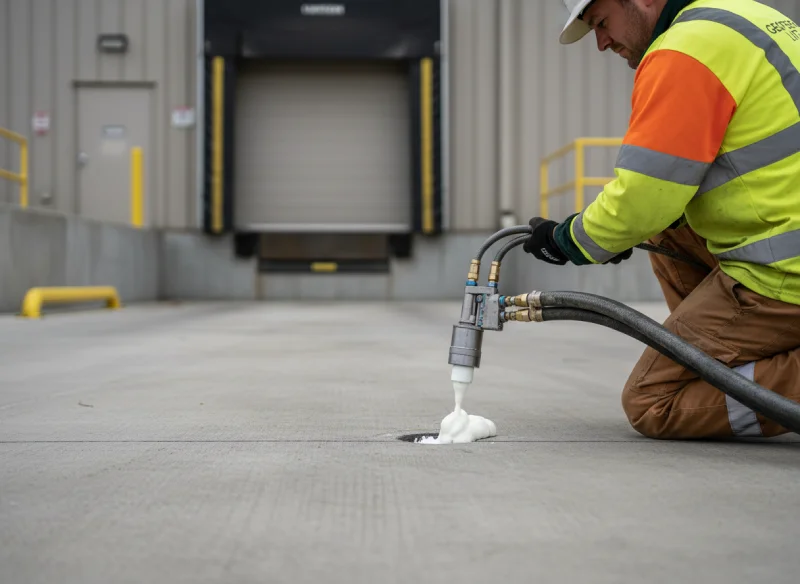
Polyurethane foam prevents future concrete settlement through synergistic mechanisms including complete subsurface void elimination, mechanical soil densification increasing bearing capacity fifty to two hundred percent, permanent hydrophobic barrier creation blocking erosion pathways, and lightweight material application avoiding secondary settlement from additional loading on compromised substrates.
Traditional concrete leveling methods address immediate elevation problems without preventing recurrence, creating cycles of repeated repairs and escalating costs.
Polyurethane foam injection fundamentally differs by simultaneously correcting existing settlement while eliminating conditions causing future subsidence. This comprehensive approach treats symptoms and root causes through single interventions, delivering permanent solutions rather than temporary fixes.
Superior PolyLift™ provides polyurethane foam concrete lifting technology engineered for industrial and commercial applications requiring long-term stability and performance reliability.
Settlement prevention begins with complete elimination of all cavities beneath concrete structures. Polyurethane foam expansion follows paths of least resistance through soil matrices, penetrating interconnected void spaces regardless of configuration complexity or distance from injection points. Low-viscosity liquid components flow into distant cavities before chemical reactions initiate expansion, ensuring comprehensive coverage throughout target zones.
Fifteen to forty-fold volumetric expansion forces material into every accessible space. This expansion behavior proves critical for filling irregular void geometries created through erosion, soil consolidation, or organic matter decomposition. Complete cavity occupation eliminates potential settlement pathways, preventing future subsidence from void migration or expansion.
Void filling advantages include:
Complete void filling creates continuous contact between concrete undersides and support materials. This uniform interface distributes structural and operational loads evenly across entire slab areas rather than concentrating stress at isolated bearing points. Even load distribution prevents differential settlement caused by localized soil overstressing.
Traditional cement-based materials may leave unfilled pockets or create uneven support patterns from incomplete cavity penetration. Polyurethane foam's expansion characteristics ensure intimate contact with both concrete surfaces and surrounding soils, eliminating discontinuities causing future settlement problems.
Polyurethane foam expansion actively improves subsurface conditions through mechanical soil compaction. Expanding material exerts outward pressure on surrounding soil particles, forcing them into tighter configurations and significantly increasing density. This compaction effect extends beyond immediate injection zones, improving substrate conditions across broad areas.
Soil densification proves particularly beneficial for loose fill materials, poorly compacted substrates, or naturally weak bearing soils. Expansion pressure reorganizes particle arrangements, increasing contact points between grains and improving load transfer characteristics. The process creates integrated soil-foam composite matrices functioning as unified support systems.
Quantified performance improvements:
Chemical bonding between polyurethane foam and soil particles creates integrated composite structures rather than distinct material layers. This bonding prevents separation between foam and soil under loading, ensuring long-term stability. The resulting dense load-bearing support systems resist foundation movement regardless of operational loading variations or environmental exposure.
Composite matrix formation proves particularly valuable for granular soils lacking natural cohesion. Foam provides binding action connecting individual particles into continuous structures. This transformation fundamentally alters soil mechanical properties, improving performance beyond levels achievable through densification alone.
Polyurethane foam's cellular architecture provides exceptional water infiltration resistance. Individual foam cells seal during polymerization creating isolated chambers preventing moisture passage between cells. This closed-cell structure functions as permanent subsurface waterproof membranes blocking groundwater access to erodible soils.
Closed-cell content typically exceeds ninety percent in properly formulated geotechnical products. This high proportion ensures minimal connected porosity through material cross-sections. Water cannot penetrate foam masses even under sustained hydrostatic pressure conditions, maintaining barrier effectiveness regardless of groundwater table elevations.
Waterproofing performance characteristics:
Water infiltration represents the primary mechanism driving progressive soil erosion beneath concrete structures. Subsurface water flow transports fine soil particles, creating and expanding void spaces over time. Polyurethane foam injection interrupts this process by displacing existing water and preventing future infiltration reaching erodible materials.
The waterproof barrier blocks water access regardless of source, whether from surface precipitation, groundwater table fluctuations, or utility line failures. Without water flow, particle transport mechanisms cease completely, preventing erosion progression independent of traffic intensity or environmental conditions. This protection proves particularly critical for facilities near waterways, in high water table areas, or with inadequate surface drainage.
Material weight critically impacts settlement prevention on compromised bearing soils. Polyurethane foam weighs only two to four pounds per cubic foot compared to cement-based mudjacking slurries adding one hundred to one hundred fifty pounds per cubic foot. This dramatic weight difference prevents secondary settlement from repair material loading on already unstable substrates.
Heavy repair materials can induce additional consolidation in weak soils, negating elevation restoration benefits over time. Lightweight polyurethane avoids this problem entirely, providing robust structural support without overstressing compromised bearing capacity. This characteristic proves essential for structures built on expansive clays, organic soils, or poorly compacted fills.
Load minimization benefits:
Despite minimal weight, polyurethane foam provides sufficient compressive strength supporting substantial operational loads. High-density formulations achieve eighty to one hundred twenty pounds per square inch compressive capacity, adequate for industrial equipment, warehouse rack systems, and heavy vehicle traffic. The material delivers necessary structural performance without compromising bearing soil stability through excessive loading.
Professional polyurethane foam installations demonstrate service life expectations ranging from twenty to over one hundred years depending on formulation selection and environmental exposure conditions. This exceptional longevity dramatically exceeds traditional mudjacking approaches typically lasting five to ten years before requiring replacement. Extended durability eliminates repeated repair cycles, reducing total lifecycle costs and operational disruptions.
Field performance documentation spanning decades validates durability claims across diverse applications. State transportation departments report successful infrastructure stabilization maintaining performance over twenty-plus year evaluation periods. Commercial facilities document concrete elevation stability decades after initial foam injection without recurrence requiring intervention.
Durability mechanisms include:
Polyurethane foam maintains fixed dimensions throughout service life without expansion, contraction, or degradation affecting structural positioning. This dimensional stability proves critical for maintaining precise elevation tolerances required in industrial facilities. Material neither swells in saturated conditions nor shrinks during dry periods, preventing settlement recurrence from seasonal moisture variations.
Closed-cell structure prevents water absorption that might cause dimensional changes in other materials. Temperature cycling produces minimal dimensional variation within foam matrices. Chemical composition resists biological attack potentially causing material breakdown. These characteristics combine ensuring permanent elevation restoration rather than temporary fixes requiring periodic adjustment.
Polyurethane foam achieves eighty percent of final strength within sixty seconds of injection, representing one of the fastest foundation stabilization methods available. Full structural capacity develops within fifteen to thirty minutes, enabling immediate loading without extended waiting periods. This rapid strength gain proves essential for facilities requiring quick return to operation following settlement corrections.
Chemical reactions driving foam formation and curing proceed rapidly at ambient temperatures typical in subsurface environments. Catalyst formulations optimize reaction kinetics achieving target cure rates across expected temperature ranges. This reliability ensures consistent performance regardless of seasonal variations or geographic locations.
Operational continuity advantages:
Full strength development within thirty minutes enables immediate structural loading without graduated capacity buildup periods. Foam achieves design compressive strength sufficient for supporting operational requirements from cure completion forward. This immediate capacity contrasts sharply with cement-based materials requiring twenty-four to forty-eight hours minimum before bearing weight.
Industrial facilities benefit substantially from immediate loading capability. Manufacturing equipment can remount within hours rather than days. Warehouse rack systems reload immediately following corrections. Distribution operations resume shipping schedules without extended delays. These operational continuity benefits often exceed direct material cost considerations in total project value assessments.
Understanding performance differences between settlement prevention approaches informs technology selection for specific applications:
| Prevention Mechanism | Polyurethane Foam Injection | Traditional Mudjacking | Complete Replacement |
| Void Elimination | Complete filling all cavities | Partial filling, gaps remain | Eliminates existing voids only |
| Soil Improvement | 50-200% capacity increase | Minimal, may worsen from weight | Requires new compaction |
| Waterproofing | Permanent closed-cell barrier | Permeable, allows infiltration | Depends on drainage design |
| Material Weight | 2-4 lbs/ft³ minimal | 100-150 lbs/ft³ significant | 150 lbs/ft³ maximum |
| Service Life | 20-100+ years documented | 5-10 years typical | 30-50 years new concrete |
| Cure Time | 15 minutes full strength | 24-48 hours minimum | 7-28 days progressive |
| Settlement Prevention | Addresses all mechanisms | Temporary elevation only | Site conditions dependent |
| Cost Over Lifecycle | Single intervention required | Multiple repair cycles | High initial investment |
State transportation departments document successful polyurethane foam applications maintaining infrastructure performance on challenging subgrades. Bridge approach slabs experience substantial traffic loading and seasonal moisture variations creating settlement conditions. Foam injection stabilizes these critical transition zones preventing rough pavement conditions and structural damage.
Tennessee Department of Transportation and other agencies report decades-long performance from foam-stabilized bridge approaches. Material withstands millions of traffic load repetitions without settlement recurrence. Waterproofing prevents erosion from subsurface drainage flows common near bridge abutments. These applications validate technology effectiveness under demanding loading and environmental exposure.
Precision manufacturing operations require stable equipment mounting surfaces maintaining tight tolerances over extended periods. Settlement beneath equipment pads compromises production quality through alignment changes. Polyurethane foam injection stabilizes mounting areas while facilities remain operational, minimizing production disruptions.
Multiple facilities document elevation stability decades after initial foam treatment without recurrence requiring intervention. Equipment maintains calibration longer between adjustments. Production quality metrics improve through enhanced dimensional stability. These performance outcomes validate foam injection as permanent solution rather than temporary fix.
High-density storage facilities utilizing narrow-aisle equipment require extremely level floors maintaining precise tolerances. Settlement creates elevation changes interfering with automated guidance systems and stressing rack structures. Foam injection corrects existing problems while preventing future occurrences through comprehensive subsurface stabilization.
Distribution centers report maintaining floor tolerances years after foam treatment without progressive settlement requiring additional corrections. Rack system loading capacities remain consistent through stable foundation support. Automated equipment operates reliably without guidance issues from floor irregularities. These operational benefits demonstrate technology value beyond direct repair cost considerations.
High-performance geotechnical polyurethane formulations meet stringent specifications ensuring consistent field performance across diverse applications and conditions.
Critical specifications include:
Professional installations include quality verification procedures documenting achieved results and validating specification compliance. Plate load testing measures post-treatment bearing capacity improvements confirming adequate soil densification. Elevation surveys verify precise correction achievement and provide baseline documentation for long-term stability monitoring.
Core sampling through treated zones enables laboratory analysis of foam distribution, density uniformity, and soil interaction characteristics. Ground-penetrating radar surveys map subsurface material distribution patterns confirming complete void filling. These verification procedures provide objective evidence supporting warranty coverage and long-term performance expectations.
Polyurethane foam prevents future concrete settlement through comprehensive mechanisms addressing every aspect of subsidence causes and progression pathways. Complete void elimination establishes continuous structural support preventing differential settlement recurrence. Mechanical soil compaction increases bearing capacity by fifty to two hundred percent, stabilizing weak substrates prone to consolidation. Permanent waterproof barriers block erosion mechanisms regardless of groundwater conditions or surface drainage adequacy.
The material's exceptional service life ranging from twenty to over one hundred years, combined with rapid cure enabling immediate loading, creates compelling value propositions justifying premium costs through lifecycle analysis. Lightweight characteristics prevent secondary settlement from repair material weight, critical for maintaining stability on compromised bearing soils. These synergistic prevention mechanisms deliver permanent solutions eliminating repeated repair cycles inherent in traditional approaches.
For industrial and commercial facilities prioritizing long-term stability, operational continuity, and lifecycle cost optimization, polyurethane foam injection represents optimal settlement prevention technology. Floor leveling company selection should emphasize technical expertise, material quality, and documented performance history ensuring repairs deliver decades of trouble-free service. Contact Superior PolyLift™ to discuss how polyurethane foam technology can provide permanent settlement prevention for your facility's critical concrete infrastructure.
Explore how our expertise can benefit your project. Reach out to our team for a consultation and discover the best solutions for your needs.

At Superior PolyLift™, integrity and reliability are the core of our ethos. Our expert team crafts custom solutions that guarantee quality and durability for every project. Choose us for geotechnical excellence that endures.
Copyright © All rights reserved. 2024 • Terms of Use and Privacy Policy • Internet Marketing by Authority Solutions®