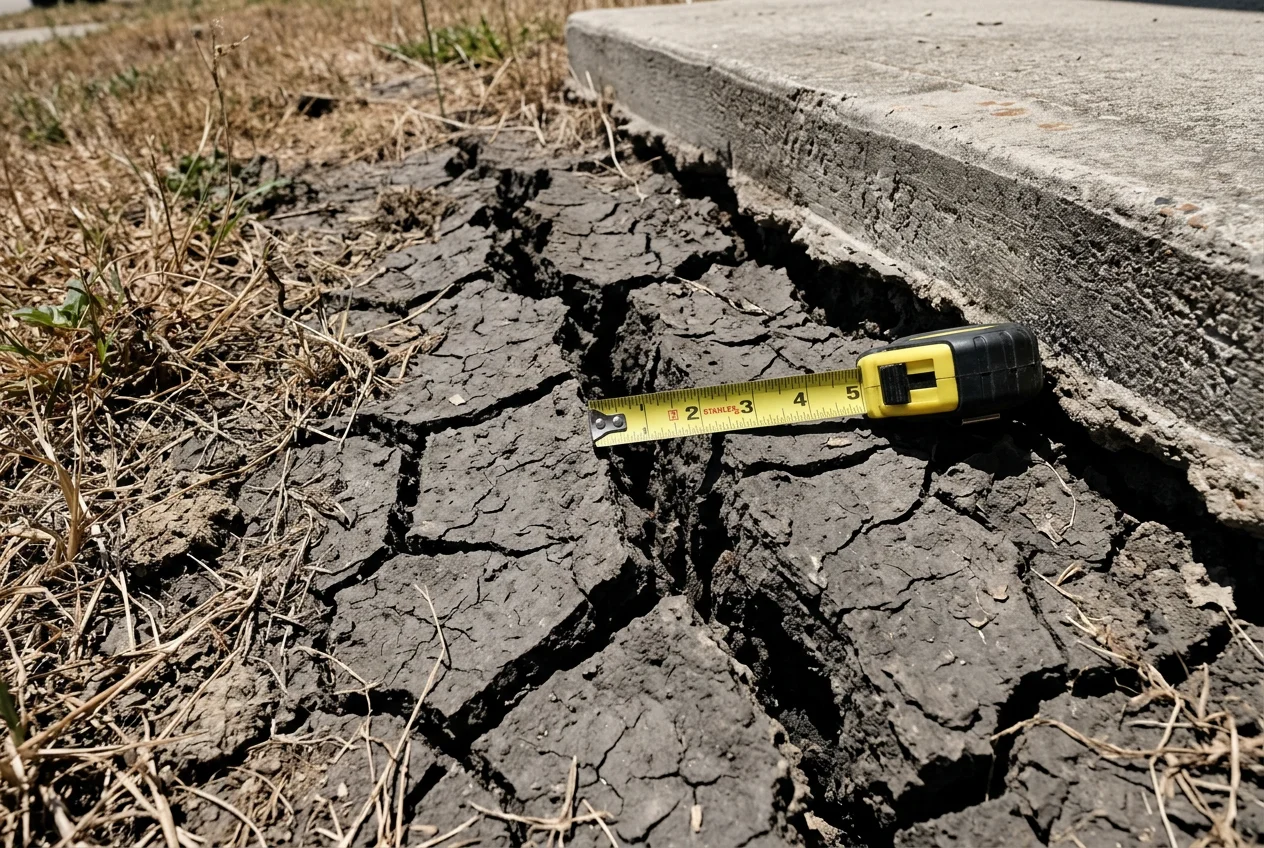
Houston sits on the Beaumont clay formation — one of the most expansive soil types in North America. This clay absorbs water and swells during wet periods, then shrinks and cracks during droughts, creating a continuous cycle of soil movement that forms voids beneath concrete slabs, displaces foundations, and produces the settlement, cracking, and structural damage that property owners across Greater Houston deal with constantly. Understanding this soil is the first step to understanding why concrete moves here — and what to do about it.
If you own property in Houston, your concrete is moving. Not dramatically — not in a way you'd notice day to day. But over months and years, the soil beneath your slabs and foundations expands and contracts with every rain event and every drought cycle, and that movement accumulates. Cracks appear. Slabs tilt. Foundations shift. Doors stop closing. The root cause isn't bad concrete or poor construction — it's the soil. And until you understand the soil, every repair is treating a symptom, not a cause. Superior PolyLift's concrete lifting services are engineered specifically for Houston's clay soil conditions — addressing the voids and soil instability that the Beaumont formation creates beneath every concrete surface in the region.
This guide explains what makes Houston's soil uniquely challenging, how the wet-dry cycle creates damage, which concrete surfaces are most vulnerable, and what property owners can do to manage — not just react to — the soil beneath their investment.
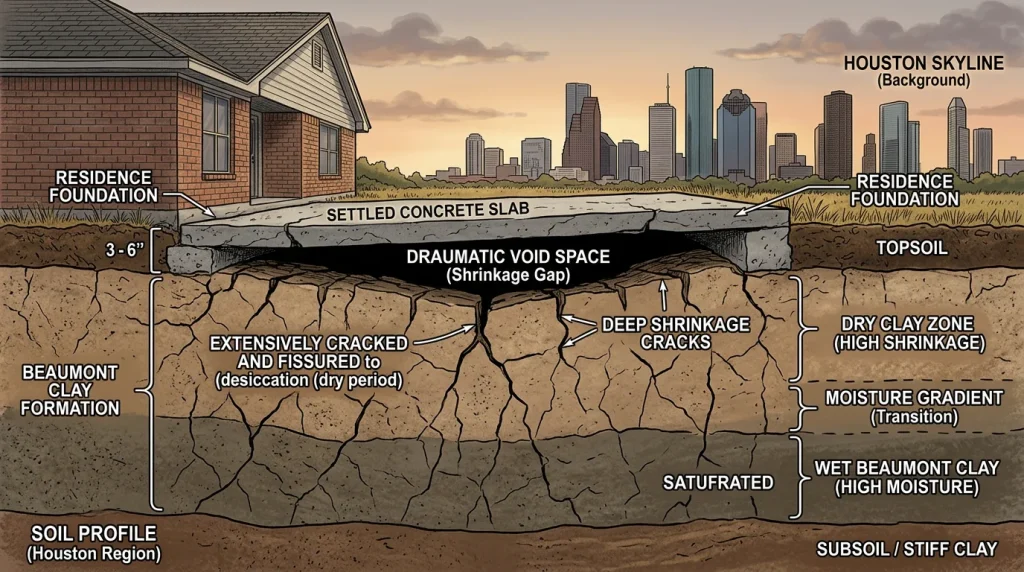
The Beaumont clay formation is a geological deposit of highly plastic, expansive clay soil that underlies most of Greater Houston and the upper Texas Gulf Coast. It has one of the highest shrink-swell potentials in the United States — meaning it expands significantly when wet and contracts dramatically when dry. This constant volume change creates movement beneath concrete slabs and foundations that no amount of surface-level repair can prevent without addressing the soil itself.
The Beaumont formation was deposited over thousands of years by the Brazos and Trinity river systems as they shifted across the coastal plain. The resulting clay is rich in montmorillonite minerals — the specific type of clay that exhibits the most extreme expansion and contraction behavior when moisture content changes.
Picture a sponge. When you add water, it swells. When it dries, it shrinks. Houston's expansive clay does the same thing — except it's beneath your concrete, and the forces involved are measured in thousands of pounds per square foot.
During wet periods — Houston receives over 50 inches of rain annually — the clay absorbs moisture and swells upward. This upward pressure can heave concrete slabs and push foundations out of their original position. During dry periods — and Houston's summers regularly produce 90+ consecutive days above 90°F — the clay loses moisture, shrinks, and pulls away from the concrete above. The gap that forms between the soil surface and the slab underside is a void. That void is where settlement begins.
Beaumont clay's plasticity index — the laboratory measurement of how much the soil changes volume with moisture — typically ranges from 30 to 60+. Anything above 20 is considered "highly expansive." Houston's clay routinely tests at the extreme end of this scale. The soil can swell 15 to 25 percent by volume when fully saturated and contract just as dramatically when desiccated. That kind of movement exerts forces that residential and commercial concrete simply wasn't designed to resist indefinitely.
The Beaumont formation covers virtually all of Harris County and extends through Fort Bend, Brazoria, Galveston, Chambers, and Liberty counties. If your property is in the Greater Houston metro area, you're on Beaumont clay — the question isn't whether the soil will move, but when and how much.
| Soil Property | Beaumont Clay (Houston) | National Average | Significance |
| Plasticity Index | 30–60+ | 10–20 | 2–3x more expansive than average |
| Shrink-Swell Potential | Very High | Low–Moderate | Extreme volume change with moisture |
| Annual Rainfall Exposure | 50+ inches | 30 inches (US avg) | More wet-dry cycling |
| Summer Heat Duration | 90+ days above 90°F | Varies widely | Accelerates soil desiccation |
| Moisture Sensitivity | Extreme | Moderate | Small moisture changes = large movement |
The wet-dry cycle creates damage through a repeating four-stage process: soil saturation and swelling during rain, soil desiccation and shrinkage during drought, void formation as soil pulls away from the slab underside, and slab settlement as the unsupported concrete drops into the void space. Each cycle compounds the damage from the previous one — voids grow larger, settlement increases, and cracks propagate further with every season.
This isn't a one-time event. It's a cycle that repeats twice a year in Houston — once during spring rains and once during late-summer drought — and each repetition makes the situation worse.
Houston's heavy rainfall events — 2 to 5 inches in a single afternoon isn't unusual — saturate the clay soil rapidly. The clay absorbs water and expands, pushing upward against the concrete above. On some properties, this upward pressure causes visible heaving — sections of slab that are pushed above their original grade. The heaving is temporary and reverses when the soil dries, but the damage it causes to concrete joints and foundation connections can be permanent.
Houston's summer heat bakes the moisture out of the clay. The soil contracts, developing deep desiccation cracks — fissures that can extend 5 to 10 feet below the surface. As the soil volume decreases, it pulls away from the underside of concrete slabs and foundation footings, creating void space.
The void is the critical phase. The concrete above is now unsupported over a portion of its span. The void may be a fraction of an inch across a small area or several inches across a large zone — depending on the soil's moisture loss, the slab's size, and the drainage conditions around the property.
Unsupported concrete settles under its own weight and the loads placed on it. A warehouse slab with forklift traffic settles faster than an unloaded residential patio, but both eventually drop into the void space. The settlement creates the visible symptoms — cracked slabs, tilted surfaces, uneven joints, and trip hazards — that prompt property owners to seek repair.
And then it rains again. The soil re-swells, partially closing some voids while opening others. The cycle repeats. Over years, the cumulative effect is progressive damage that worsens with each season.
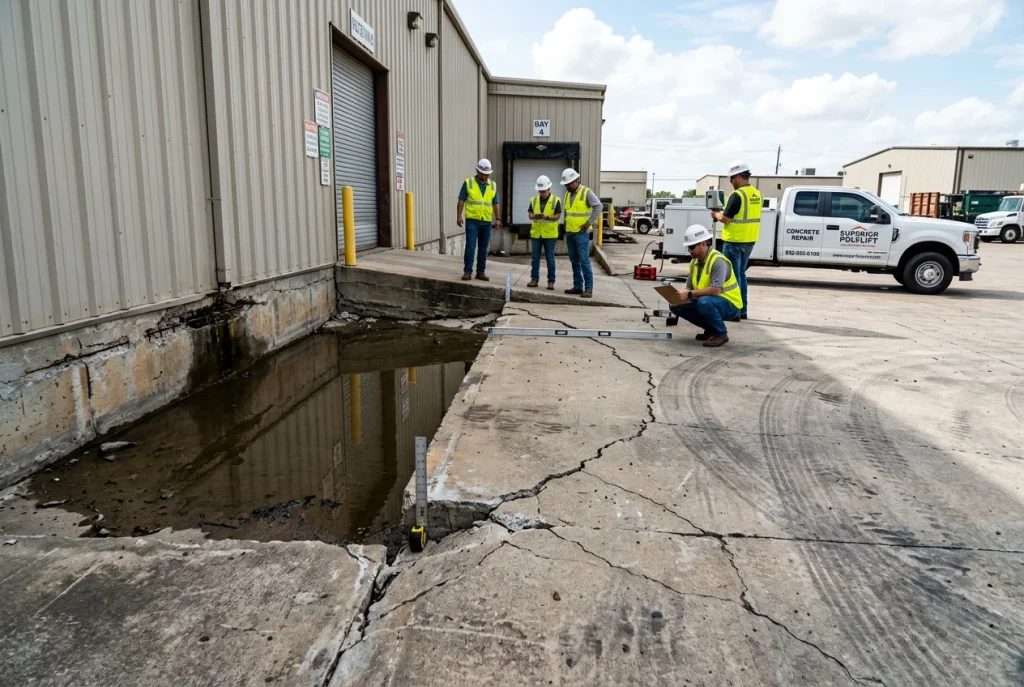
Every concrete surface on Houston's Beaumont clay is vulnerable, but the most affected are surfaces with the greatest exposure to moisture variation: driveways and approach slabs near downspout discharge, parking lot panels near catch basins and drainage structures, loading docks adjacent to building transitions, and any slab where one edge is exposed to irrigation or rainfall while the adjacent edge is sheltered — creating differential moisture conditions that cause one side to move more than the other.
Differential moisture is the key concept. Uniform moisture conditions — where the entire soil mass beneath a slab is equally wet or equally dry — produce relatively uniform movement that concrete can tolerate. Differential moisture — where one section of soil is saturated while an adjacent section is desiccated — produces differential movement that concrete cannot tolerate. The slab wants to stay flat. The soil beneath it is moving unevenly. Something has to give, and it's always the concrete.
| Vulnerability Factor | Why It Causes Damage | Most Affected Surfaces |
| Moisture differential | Uneven soil movement beneath slab | Building perimeters, partially covered areas |
| Tree root desiccation | Localized soil moisture extraction | Slabs within 30–50 ft of mature trees |
| Utility trench settlement | Under-compacted backfill | Driveways, parking lots, sidewalks over utilities |
| Plumbing leaks | Localized sustained saturation | Interior foundation slabs, bathroom zones |
| Poor drainage | Concentrated water at slab edges | Driveways near downspouts, parking lot low points |
| Irrigation over-watering | Excess moisture along landscaped edges | Building perimeter slabs, sidewalks next to beds |
Managing Houston's clay soil starts with moisture consistency — keeping the soil around your concrete at a relatively stable moisture level year-round through proper drainage, strategic irrigation during dry periods, and addressing plumbing leaks promptly. When settlement has already occurred, polyurethane foam injection fills the voids, densifies the weakened soil, and raises the concrete back to grade — addressing the underground condition that caused the surface problem.
You can't change the soil. It's Beaumont clay, and it's going to expand and contract for as long as it exists. But you can manage the moisture conditions that control how dramatically it moves — and you can repair the damage when it occurs with methods that account for the soil's ongoing behavior.
Water must flow away from concrete edges, not pool against them. Gutter downspouts should discharge at least 5 feet from slabs. Surface grading should slope away from buildings and concrete at a minimum 2 percent grade. Catch basins and French drains can intercept water before it saturates the clay beneath critical slabs. These aren't optional measures in Houston — they're foundational to managing clay soil.
During Houston's extended dry periods, the soil around foundations and critical slabs benefits from controlled watering. Soaker hoses placed 12 to 18 inches from the foundation perimeter, running 15 to 20 minutes per zone every other day during drought conditions, maintain enough moisture to prevent the extreme desiccation that creates deep soil cracking and void formation.
Under-slab plumbing leaks are one of the most common triggers for localized foundation distress in Houston. If you notice unexplained wet spots, elevated water bills, or localized heaving in one area of a slab, hydrostatic testing of the plumbing system should be the first diagnostic step — before assuming the foundation itself has failed.
When voids have already formed and settlement has occurred, polyurethane foam injection fills the void space, densifies the weakened soil surrounding the void, and lifts the concrete back to its original elevation. The closed-cell hydrophobic foam resists the moisture cycling that created the problem — unlike mudjacking slurry, which is water-soluble and erodes during the same wet-dry cycles that caused the original damage.
Superior PolyLift's engineering approach goes beyond just filling the visible void. Their injection strategy accounts for the ongoing shrink-swell behavior of Beaumont clay — densifying the soil zone beneath the slab to increase its load-bearing capacity and reduce its susceptibility to future moisture-driven volume changes.Ready to assess your concrete? Contact Superior PolyLift™ for a free site evaluation that includes settlement measurement, void mapping, and soil condition assessment — engineered for Houston's specific geotechnical challenges.
Explore how our expertise can benefit your project. Reach out to our team for a consultation and discover the best solutions for your needs.

At Superior PolyLift™, integrity and reliability are the core of our ethos. Our expert team crafts custom solutions that guarantee quality and durability for every project. Choose us for geotechnical excellence that endures.
Copyright © All rights reserved. 2024 • Terms of Use and Privacy Policy • Internet Marketing by Authority Solutions®