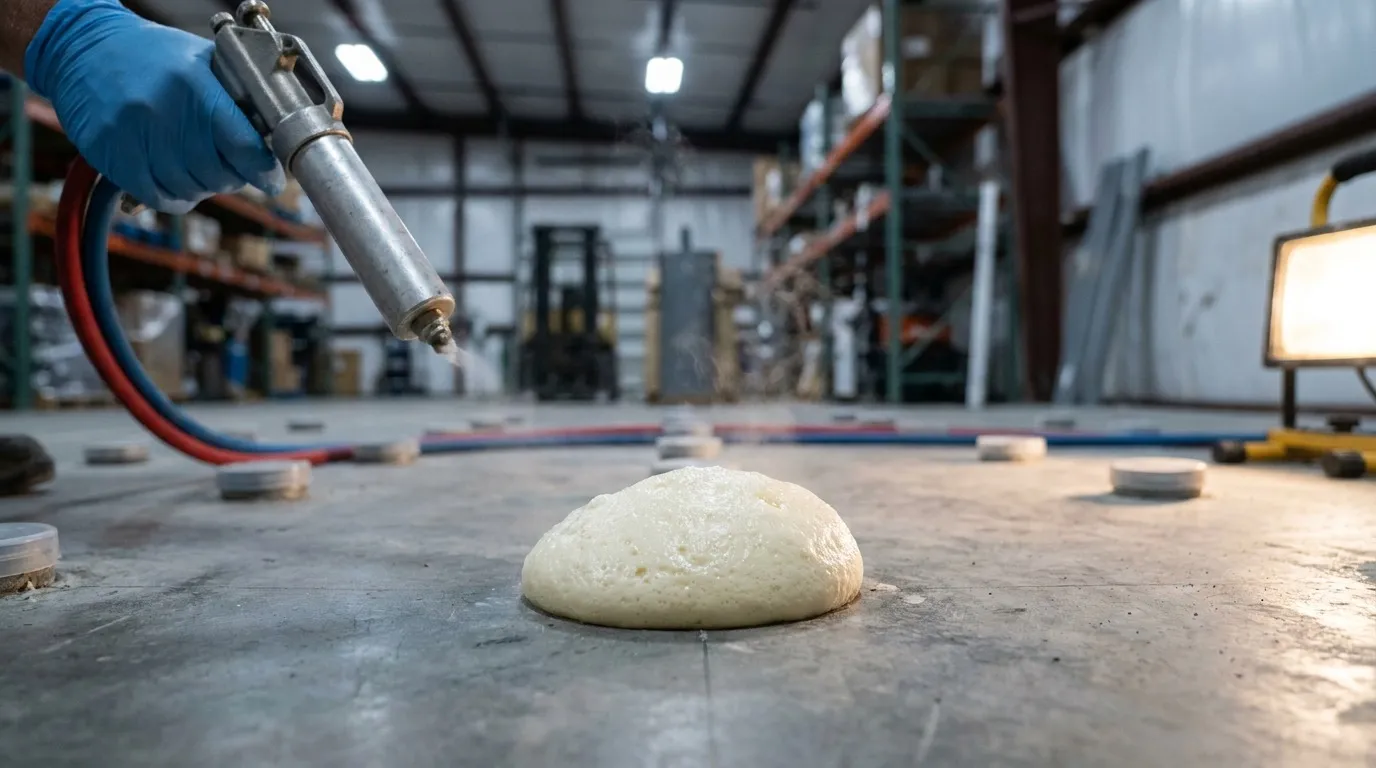
Polyurethane expanding foam repairs concrete by injecting a two-component resin that reacts on mixing and expands 20 to 30 times its liquid volume, filling voids beneath a settled slab and, in lifting applications, generating controlled uplift force against the underside of the slab. The reaction is exothermic and produces a rigid closed-cell structure that resists water, chemical attack, and biological degradation. Cure develops in defined phases (cream, rise, tack-free, full cure) that gate every operational decision in the field, from injection sequencing to return-to-service timing.
Every specification decision about polyurethane concrete repair traces back to the chemistry of the material. The foam does not "fill" the void in the sense of stuffing it. It reacts, expands, and structurally becomes replacement fill. Understanding that distinction is what separates a specifier making an engineering decision from a specifier trusting a brochure.
This article walks through the science that actually matters for commercial, municipal, and industrial concrete repair: expansion ratio, cell structure, cure kinetics, load-bearing development, and the environmental durability that governs service life. It stops before the marketing claims start.
Consumer-grade "expanding foam" and industrial-grade polyurethane concrete lifting foam share a broad chemistry class but differ in every operational detail that matters. Consumer canister foam is single-component, moisture-cured, low in compressive strength, high in open-cell content, and carries no load-bearing specification. Industrial polyurethane concrete lifting foam is two-component, chemically cured, with defined compressive strength (typically 40 to 100 psi at 4 lb/ft³, higher at 6 to 8 lb/ft³), closed-cell content generally above 90 percent, and documented performance under ASTM D1621, D1622, and D2856.
The confusion between the two categories persists in casual conversation. It should not persist in a specification document. When engineers, facility managers, and specifiers reference "expanding foam concrete repair" for infrastructure, they mean the industrial two-component system. Everything below is about that system.
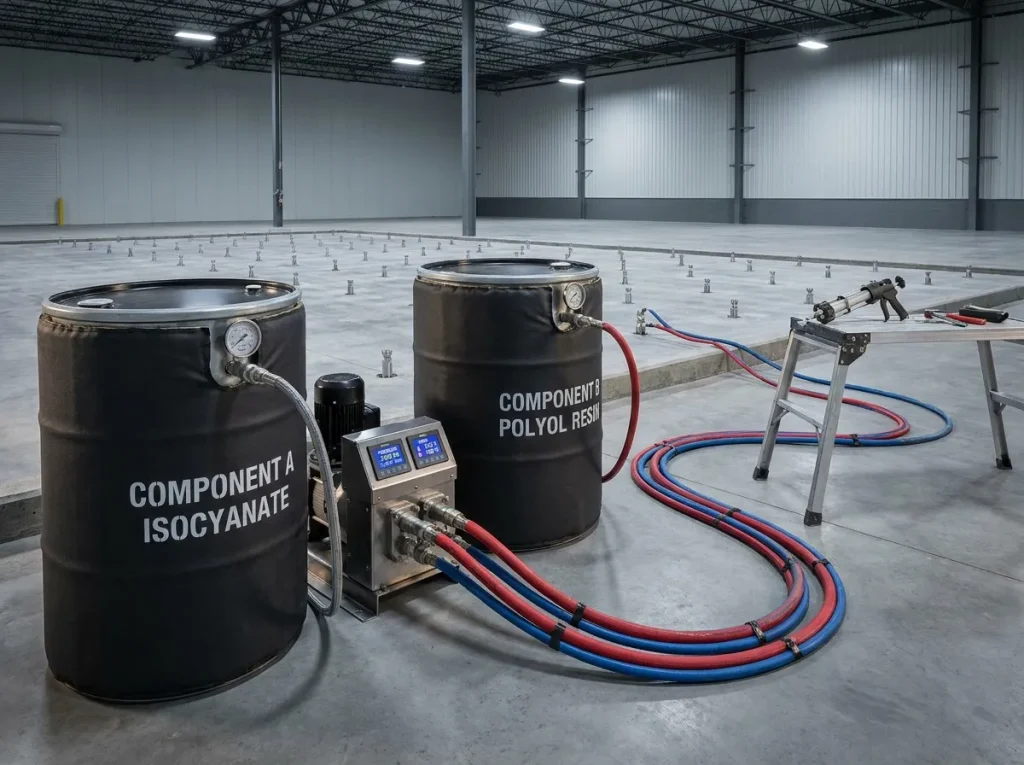
Polyurethane forms when an isocyanate (Component A) reacts with a polyol (Component B) in the presence of a catalyst. The reaction is a step-growth polymerization producing urethane linkages between the two component molecules. In lifting-grade formulations, a blowing agent is dissolved in the polyol side; when the components mix, the blowing agent vaporizes and generates the gas that expands the reacting mass into foam.
The proportioning ratio between A and B is not adjustable in the field. Manufacturer-specified ratios (typically 1:1 by volume for modern lifting formulations) are enforced by a proportioning pump that delivers both components at matched temperature and pressure to a mixing head at the injection gun. Any deviation from the specified ratio produces incomplete reaction, off-spec density, and unreliable compressive strength. This is why applicator certification and equipment calibration are non-negotiable procurement items. A certified crew running calibrated equipment produces the material the specification calls for. An uncalibrated crew produces something that looks like foam but does not perform like foam.
Expansion ratio is the volume of cured foam produced per volume of liquid component. For most lifting formulations, expansion ratio runs 20:1 to 30:1 in unconstrained conditions and reduces as pressure increases in confined void spaces. In practice, a gallon of mixed A+B liquid expands to roughly 3 cubic feet of foam in open air and correspondingly less when reacting against slab and subgrade constraints.
Density and expansion ratio are inversely related. Higher expansion produces lower density (lighter, less compressive strength). Lower expansion produces higher density (heavier, greater compressive strength). Lifting formulations sit in a controlled band:
| Density | Typical Application | Compressive Strength (ASTM D1621) |
| 2 lb/ft³ | Non-structural fill; insulation | ~10-20 psi |
| 4 lb/ft³ | Light commercial slab lifting | ~40-60 psi |
| 6 lb/ft³ | Commercial lifting | ~60-90 psi |
| 8 lb/ft³ | Heavy commercial / industrial | ~90-140 psi |
| 10+ lb/ft³ | Infrastructure / DOT | ~140-200+ psi |
A qualified specifier matches density to the loading tier of the application. A generalist quotes "4 lb foam" for every project. The load rating of the resulting installation is the differential.
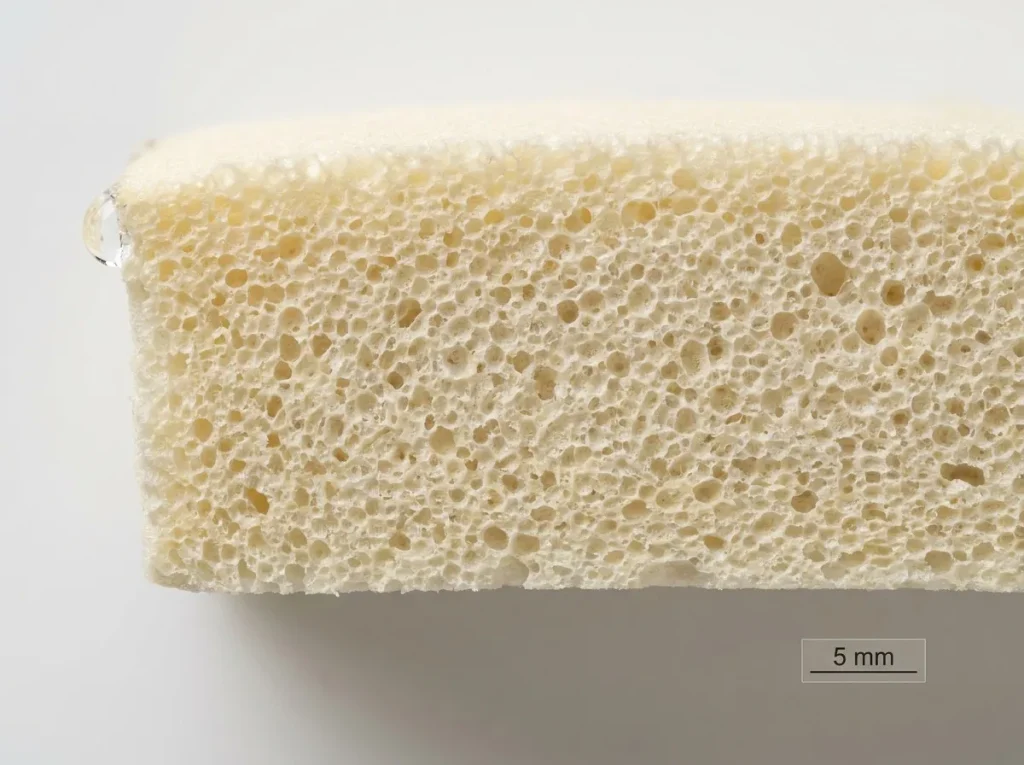
The blowing agent and reaction kinetics determine whether the resulting foam is closed-cell or open-cell.
Closed-cell foam has fully sealed cell walls, each cell isolated from its neighbors. Water cannot pass through the cell walls, chemicals cannot penetrate the matrix, and compressive load distributes across the intact cellular network. Lifting-grade polyurethane is specified as closed-cell (typically greater than 90 percent closed-cell content per ASTM D2856) for exactly this reason: the material has to hold load and resist water indefinitely in subgrade conditions.
Open-cell foam has interconnected cell voids, permeable to water and gas. Open-cell polyurethane is used for insulation and for hydrophilic sealing grouts where controlled water reaction is the design intent. Open-cell foam is not appropriate for lifting.
A contractor who cannot articulate this distinction is not specifying material at engineering rigor. A contractor who quotes "polyurethane foam" without qualifying it as closed-cell has left an important variable unspecified.
The polymerization reaction is exothermic; it releases heat as the urethane bonds form. Peak temperature inside a reacting foam mass typically reaches 180 to 250 degrees Fahrenheit for standard lifting formulations, higher for fast-set systems. The heat is a byproduct of the chemistry, not a design output, but it has operational consequences.
The generated heat drives its own reaction acceleration in a feedback loop: warmer components react faster, generating more heat, further accelerating the reaction. This is why fast-set formulations use temperature-controlled equipment and why cold-weather work requires component preconditioning with drum warmers. The reaction is self-limiting (the peak passes and the material cools) but the field crew must manage the peak by controlling injection volume per port and sequencing.
The exothermic reaction also produces small amounts of steam and, briefly, isocyanate vapor. This is why applicator PPE includes respiratory protection during injection and why confined-space specifications reference OSHA protocols for below-grade or enclosed work.
Polyurethane reaction progresses through four defined phases, each gating a different operational decision. Times below are typical for standard commercial lifting formulations at 75°F substrate; cold conditions extend each phase, warm conditions compress it.
| Phase | Typical Duration | Field Meaning |
| Cream time | 5 to 30 seconds | Components mixed; foam still injectable |
| Rise time | 30 seconds to 3 minutes | Foam expanding to final volume |
| Tack-free time | 5 to 15 minutes | Surface no longer sticky; safe to touch |
| Full cure | 1 to 24 hours | Full compressive strength developed |
Cream time governs how long the injected material stays fluid enough to migrate into void space. Rise time determines when the lift is complete. Tack-free time is when port patching can begin. Full cure is when return-to-service load can be applied. The compressive strength development curve on the product technical data sheet (TDS) is the authoritative source for return-to-service timing, not a single wall-clock number.
Compressive strength develops rapidly after cream time. Standard 4-lb hydrophobic lifting foam typically reaches 90 percent of design compressive strength within one hour of injection at 75°F substrate. This is why return-to-service for light loading is typically permitted within an hour: the material is already carrying most of its rated load by then.
The load path in a polyurethane-lifted slab moves from the applied load, into the concrete slab, through the foam matrix, and into the compacted subgrade below. The foam does not carry the load directly. The concrete slab still carries it. The foam replaces the failed subgrade support that used to be there, so the slab can continue to function as designed. This distinction matters when explaining why polyurethane is not a substitute for structural repair of the concrete itself, a point covered in depth under foundation issues.
Water. Closed-cell hydrophobic polyurethane does not absorb water, does not lose compressive strength when saturated, and does not erode under groundwater flow. This is the property that makes it appropriate for Gulf Coast subgrade conditions, high water tables, and post-flood remediation. Hydrophilic polyurethane (a different formulation class) reacts with water as part of its cure chemistry and is used for active infiltration sealing, not for lifting.
Chemicals. Cured polyurethane is chemically stable across normal soil pH ranges, most petroleum contamination, and typical concrete leachates. Aggressive chemical environments may require chemistry-matched formulations. For most commercial and municipal applications the standard hydrophobic lifting foam is chemically adequate.
Biological. Polyurethane is resistant to microbial degradation. Bacteria, fungi, and roots do not consume the cured foam. This resistance is one reason polyurethane installations from the 1990s remain in service in soil conditions where cementitious grouts would have deteriorated by biological attack.
UV. UV exposure degrades polyurethane surface finish over decades but has no meaningful effect on the injected mass, which is fully protected under the slab. Below-slab lifting applications require no UV coating.
Three field variables shift the reaction meaningfully:
Substrate temperature. The most important variable. Reaction rate roughly doubles for every 18°F increase in substrate temperature and halves for every 18°F drop. Cold-weather work requires component preconditioning; hot-weather work may require slower-set formulations to give the crew usable working time.
Humidity and substrate moisture. Major effect on hydrophilic systems (accelerates reaction) and minor effect on hydrophobic systems (very slight acceleration). For hydrophobic lifting foam, humidity is not typically a scheduling factor.
Component temperature at the pump. Distinct from substrate temperature. Components must arrive at the mixing head at manufacturer-specified temperature (typically 100 to 140°F) for proper viscosity and reaction. Heated hoses and pump preconditioning maintain this. An out-of-spec component temperature produces off-ratio proportioning even if the pump is calibrated.
Some polyurethane marketing overstates. Claims worth interrogating before you accept them into a specification:
The science supports the method's use in most concrete lifting and void-fill applications. It does not support every claim made about the method. A specifier evaluating a polyurethane bid should compare technical data sheet numbers side by side, not marketing language.
The science behind expanding foam concrete repair is not marketing. It is documented chemistry, defined test standards (ASTM D1621 for compressive strength, D1622 for density, D2856 for closed-cell content), and known cure kinetics that determine every operational decision from injection sequencing to return-to-service timing. The specifier who understands the chemistry can compare bids on technical grounds instead of taking marketing claims at face value. The specifier who does not understand the chemistry is trusting the contractor to fill in that judgment.
To scope a commercial, municipal, or industrial polyurethane concrete repair project in the Houston metro, schedule a site assessment.
Marcus Trevino is a Senior Infrastructure Remediation Specialist at Superior PolyLift in Houston, TX, with 18+ years of experience solving complex concrete lifting and foundation stabilization problems for commercial, municipal, and industrial clients.
Explore how our expertise can benefit your project. Reach out to our team for a consultation and discover the best solutions for your needs.

At Superior PolyLift™, integrity and reliability are the core of our ethos. Our expert team crafts custom solutions that guarantee quality and durability for every project. Choose us for geotechnical excellence that endures.
Copyright © All rights reserved. 2024 • Terms of Use and Privacy Policy • Internet Marketing by Authority Solutions®