Different concrete surfaces settle for different reasons, carry different loads, and need different lifting approaches — even though the core polyurethane injection technology is the same. A loading dock handling 80,000-pound trailers requires structural-grade high-density foam and precision grade control. A pool deck needs lightweight foam with waterproof sealed joints. A highway panel demands DOT-compliant tolerances and traffic-staged execution. Matching the injection plan to the surface type is what separates a repair that lasts from one that fails.
Concrete is concrete — until it settles. Then the differences between a residential driveway and a container yard apron start to matter enormously. The settlement patterns are different. The load profiles are different. The acceptable tolerances are different. And the scheduling constraints that determine when and how the lifting crew can access the surface are different for every application. Superior PolyLift's concrete lifting services address every surface type across Greater Houston — from small residential corrections to massive industrial slab restorations — with concrete lifting solutions engineered for each application's specific demands.
This guide breaks down the most common surface types that need lifting in Houston, what makes each one unique, and how polyurethane foam injection is adapted to deliver lasting results on every one of them.
Driveways, sidewalks, parking lots, loading docks, pool decks, garage floors, patios, and highway panels are the most frequently lifted surfaces in Greater Houston. Each surface type has a distinct settlement pattern driven by its location, traffic load, drainage exposure, and underlying soil conditions — and each requires a tailored injection approach.
Houston's expansive clay soil doesn't discriminate. It settles concrete wherever concrete sits — residential, commercial, and municipal. But the settlement shows up differently on different surfaces, and the repair approach must account for those differences.
Driveways settle most commonly at the transition between the street and the property — where the concrete meets a different sub-base or where utility trenches were backfilled with loose soil. The settlement creates a dip that catches water and accelerates further erosion. Commercial drive approaches at warehouses and retail sites take heavier loads and settle more aggressively. Lifting restores the smooth transition and eliminates the water trap.
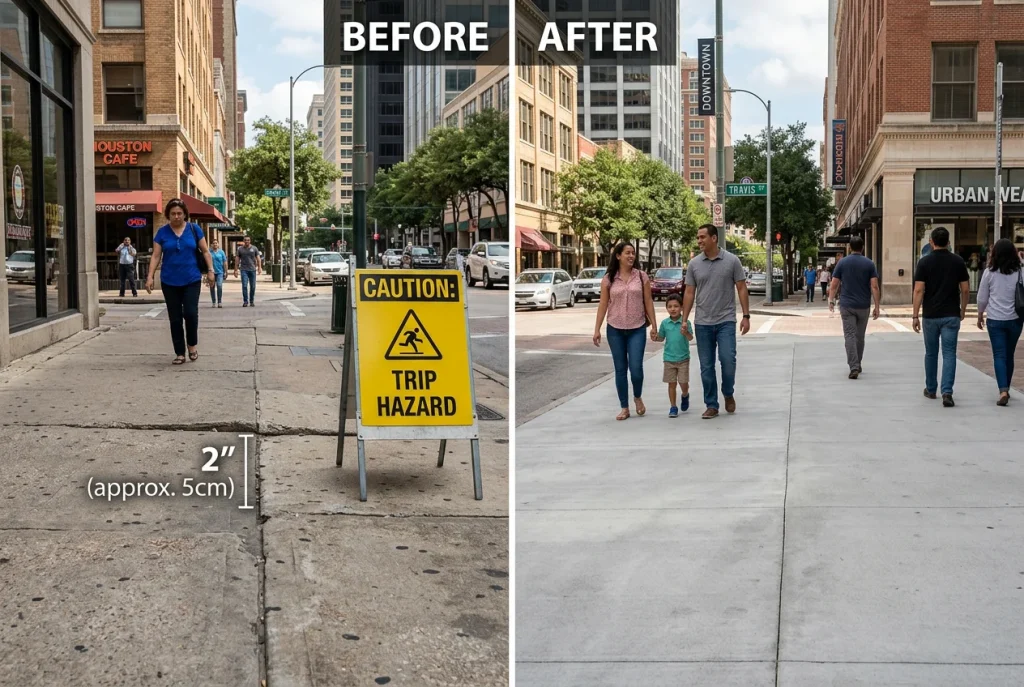
The most common concrete leveling application from a liability perspective. A raised edge between two sidewalk panels as small as half an inch creates a trip hazard that invites injury claims and ADA violations. Municipal sidewalks, commercial property walkways, and campus pedestrian paths all need flush, level surfaces. Polyurethane lifting raises the settled panel to match the adjacent one — often in under an hour per section.
Parking lot settlement typically occurs at expansion joints, near catch basins, and in areas where underground utilities were installed. Sunken panels create vehicle damage (scraping undercarriages on abrupt elevation changes), water pooling that accelerates pavement deterioration, and pedestrian trip hazards in walking paths between parked vehicles.
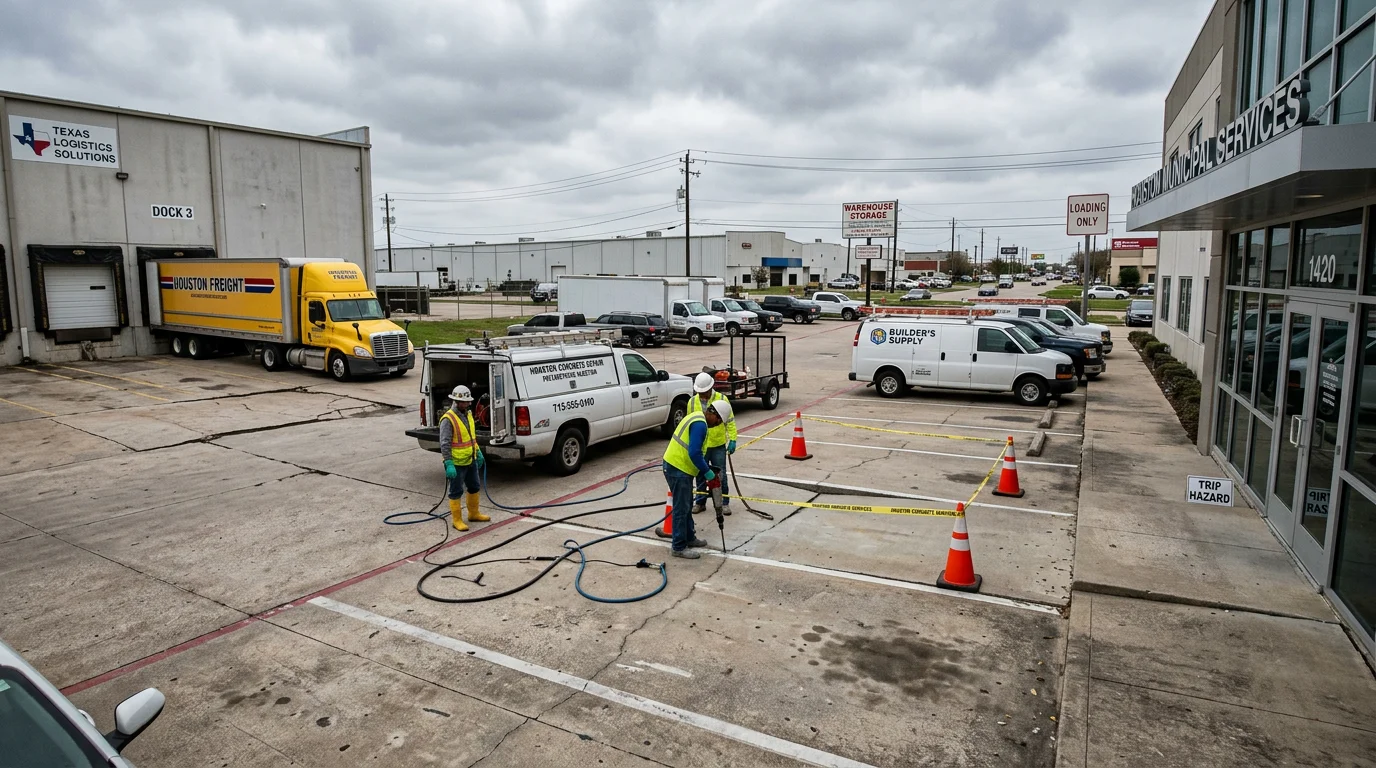
One of the most critical lifting applications for Houston's logistics and distribution sector. When loading dock concrete settles, a gap opens between the dock edge and the truck bay — creating a hazard for dock workers, damaging dock levelers, and preventing proper trailer seal. Even one inch of settlement at a dock face can disrupt loading operations. High-density foam restores the dock edge to flush grade with the truck bay floor.
Pool deck settlement creates tripping hazards around the pool perimeter and channels water toward the pool's edge in unintended directions. Lifting pool deck concrete requires foam that's fully waterproof (closed-cell polyurethane qualifies) and careful injection to avoid disturbing the pool shell or plumbing below. Joint sealing after the lift is essential to prevent water infiltration that causes recurrence.
Both residential and commercial garage floors settle — residential garages from soil compaction failure beneath the slab, commercial garages from heavy vehicle loads and drainage issues. Settlement near garage doors creates the most visible and functional problem: an uneven threshold that catches water, admits pests, and creates a step hazard.
DOT-maintained highways, city streets, and private access roads all develop panel settlement. Highway panel lifting requires traffic management plans, DOT-approved materials and methods, and execution within lane closure windows. Polyurethane's rapid cure time — surfaces ready for traffic within hours — makes it the preferred method for highway work because lane closures can be minimized.
| Surface Type | Common Settlement Location | Primary Concern | Typical Lift Range |
| Driveway | Street-to-property transition | Water trapping, erosion | 1–3 inches |
| Sidewalk | Panel joints | Trip hazards, ADA compliance | 0.5–2 inches |
| Parking lot | Expansion joints, catch basins | Vehicle damage, water pooling | 1–3 inches |
| Loading dock | Dock edge at truck bay | Operational disruption, worker safety | 0.5–3 inches |
| Pool deck | Perimeter panels | Trip hazards, water direction | 0.5–2 inches |
| Garage floor | Near door threshold | Water intrusion, step hazard | 1–4 inches |
| Highway panel | Joint transitions | Vehicle impact, lane smoothness | 0.5–2 inches |
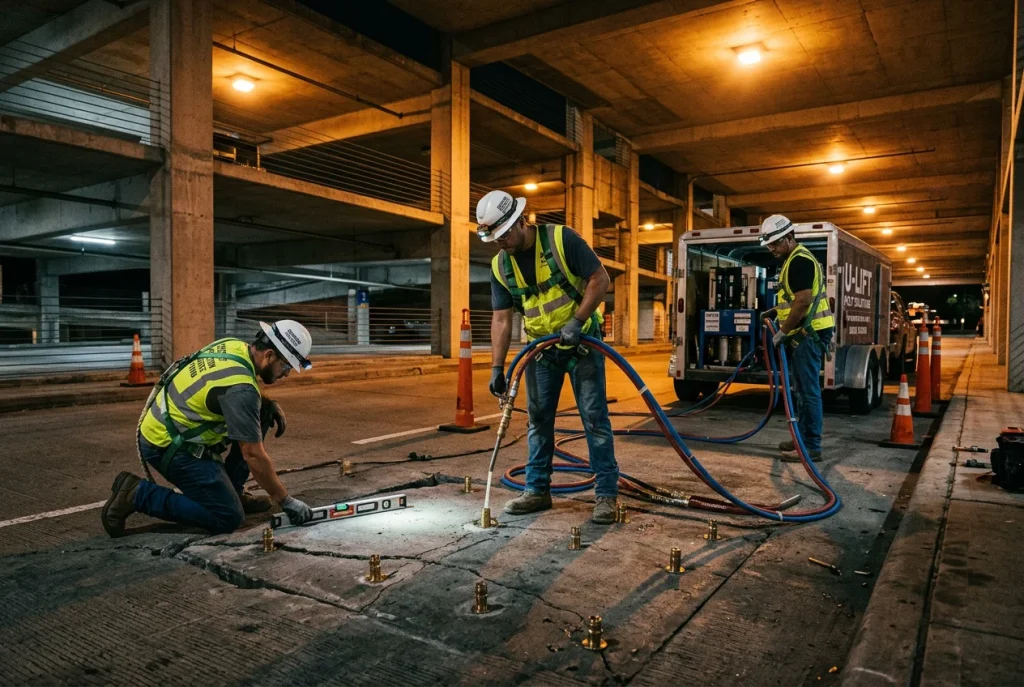
Foam density, injection port spacing, lift sequencing, and post-lift joint treatment all change based on the surface type. Light-duty surfaces like sidewalks use standard-density foam with wider port spacing. Heavy industrial surfaces like loading docks use high-density structural foam with tighter grids and staged lifting. Every project starts with understanding what the surface does and what it needs to do after the lift.
The polyurethane foam injection process is the same conceptual approach for every surface — drill ports, inject foam, monitor lift, patch ports. But the engineering details change significantly based on what the surface supports.
Standard-density foam (2 to 4 lbs/ft³) provides sufficient compressive strength for pedestrian traffic and light loads. Port spacing can be wider (4 to 6 feet) because the lift requirements are modest and the slab loads are low. The focus is on achieving a flush, level transition between panels and sealing joints to prevent water re-entry.
Medium-density foam (4 to 6 lbs/ft³) handles passenger vehicles, light trucks, and normal residential and commercial traffic. Port spacing tightens to 3 to 4 feet for more even lift distribution. Drainage assessment is especially important for these surfaces because water management is often the root cause of the original settlement.
High-density structural foam (6 to 10+ lbs/ft³) provides the compressive strength for heavy axle loads, forklift traffic, and repeated high-impact use. Port spacing is tightest (2 to 3 feet) for maximum foam coverage and support. Lifting is often staged — partial lift, cure, then final lift — to control the process on thick, heavily loaded slabs. Post-lift load testing or proof rolling may verify that the restored surface meets load-bearing requirements.
Every surface type benefits from joint sealing after the lift. Expansion joints and control joints that opened during settlement need to be cleaned and sealed with flexible joint sealant to prevent water infiltration — because water getting beneath the slab is how voids form in the first place. This step is often overlooked by less experienced contractors, and it's one of the most impactful things you can do to extend the repair's lifespan.
| Duty Level | Foam Density | Port Spacing | Staging Required | Joint Sealing |
| Light (sidewalk, patio) | 2–4 lbs/ft³ | 4–6 feet | Rarely | Recommended |
| Medium (driveway, parking) | 4–6 lbs/ft³ | 3–4 feet | Sometimes | Recommended |
| Heavy (dock, warehouse, highway) | 6–10+ lbs/ft³ | 2–3 feet | Often (staged lift) | Essential |
Houston's expansive Beaumont clay, high annual rainfall (50+ inches), proximity to the water table, and extreme heat all affect how concrete surfaces settle and how lifting projects must be engineered. Outdoor surfaces face the full spectrum of Gulf Coast weather. Indoor surfaces in un-climate-controlled buildings (warehouses, garages) deal with moisture vapor transmission through the slab. Every surface type in Houston needs a lifting approach that accounts for the soil beneath it — not just the concrete on top.
National concrete lifting contractors may not appreciate how different Houston's soil conditions are from most of the country. The Beaumont clay formation has a plasticity index that creates some of the most aggressive shrink-swell behavior in Texas. That means the soil that caused your original settlement will keep moving — and the repair must account for that ongoing movement.
Driveways, sidewalks, parking lots, pool decks, and patios face direct rain exposure. Houston's 50+ inches of annual rainfall saturates the clay soil beneath these surfaces during wet periods, then the soil dries and shrinks during droughts — creating and re-creating void space beneath the concrete in a continuous cycle. Polyurethane foam's hydrophobic properties resist this cycling, but proper drainage around the lifted surface is essential to reduce the moisture fluctuation that drives settlement.
Loading docks, garage floors, and covered walkways receive less direct rain but still deal with moisture from adjacent saturated soil, rising water tables, and condensation in Houston's humid climate. The soil beneath these surfaces may be wetter than expected because covered slabs don't allow the surface evaporation that helps balance soil moisture in open areas.
Warehouse floors and manufacturing plant slabs sit in enclosed environments but still interact with soil moisture through the slab. Moisture vapor transmission through concrete is a real factor in Houston — and it affects both the slab's long-term stability and the adhesion of any coatings or floor treatments applied after lifting. Post-lift moisture testing may be recommended for interior surfaces that will receive epoxy coatings or polished finishes.
Start with a site assessment that identifies the surface type, traffic load, settlement extent, void depth, soil conditions, and drainage patterns. The assessment determines foam density, port spacing, lift staging, and post-lift treatment. Don't accept a one-size-fits-all quote — a contractor who uses the same approach for a sidewalk and a loading dock isn't engineering the solution to your specific surface.
Every surface has a story. The sidewalk panel that rose half an inch settled because a tree root disrupted the soil beneath it. The loading dock that dropped two inches settled because heavy truck traffic compacted loose backfill around a buried utility. The pool deck that tilted inward settled because poor drainage concentrated water against the foundation edge. The lifting approach must address the story — not just the symptom.
Superior PolyLift's assessment process evaluates the surface type, the settlement pattern, the soil conditions, and the drainage environment before specifying foam density, injection strategy, and post-lift treatment. That surface-specific engineering is what the PolyLift™ system delivers — and it's why their repairs hold up across Houston's demanding Gulf Coast climate.Ready to assess your concrete? Contact Superior PolyLift™ for a free site evaluation. Whether it's a single sidewalk section or a 100,000-square-foot industrial slab, their team designs the lifting approach around your specific surface, your specific loads, and Houston's specific soil.
Explore how our expertise can benefit your project. Reach out to our team for a consultation and discover the best solutions for your needs.

At Superior PolyLift™, integrity and reliability are the core of our ethos. Our expert team crafts custom solutions that guarantee quality and durability for every project. Choose us for geotechnical excellence that endures.
Copyright © All rights reserved. 2024 • Terms of Use and Privacy Policy • Internet Marketing by Authority Solutions®