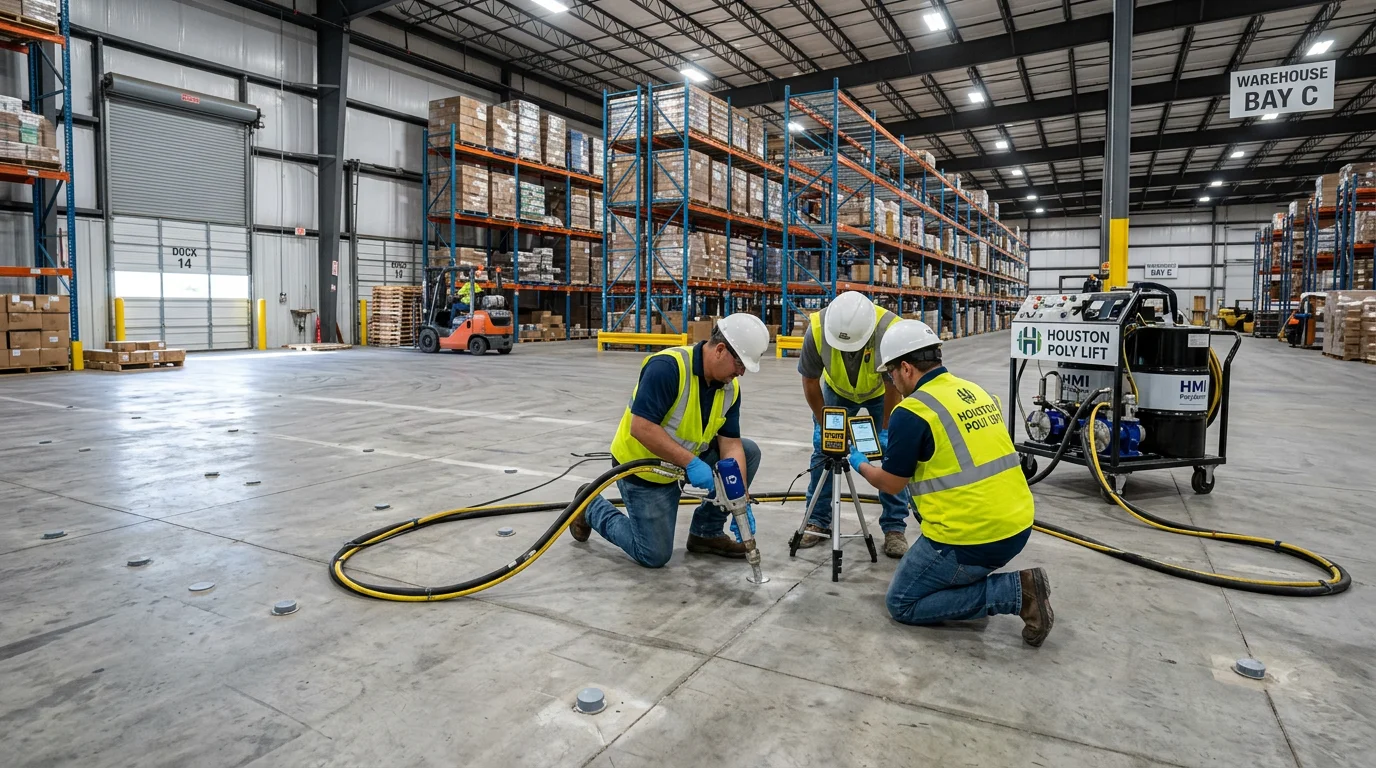
Polyurethane concrete lifting uses high-density, closed-cell expanding foam injected through small 5/8-inch ports beneath sunken concrete slabs to fill voids, stabilize soil, and raise the surface back to its original grade — all within hours, not weeks. The foam cures in 15 to 30 minutes, the slab is ready for traffic the same day, and the lightweight material won't re-load Houston's moisture-sensitive clay soils the way traditional mudjacking slurry does.
Sunken concrete costs money. Not just in repair bills — in tripped employees, damaged forklifts, liability claims, and operational shutdowns that burn revenue every hour a facility sits idle. Across Greater Houston, expansive clay soil swells during rain and shrinks during drought, creating voids beneath concrete slabs that lead to settlement, cracking, and dangerous uneven surfaces. Polyurethane concrete lifting is the engineered solution that addresses the root cause — void space and compromised soil — without tearing out and replacing the concrete. Superior PolyLift's concrete lifting services have restored thousands of commercial and industrial concrete surfaces across Houston's ports, warehouses, distribution centers, and municipal infrastructure using their proprietary PolyLift™ system.
This guide covers how the process works from first assessment to final cure, why polyurethane foam outperforms traditional methods in Houston's Gulf Coast climate, what factors affect project scope, and what facility managers need to know before scheduling a lift.
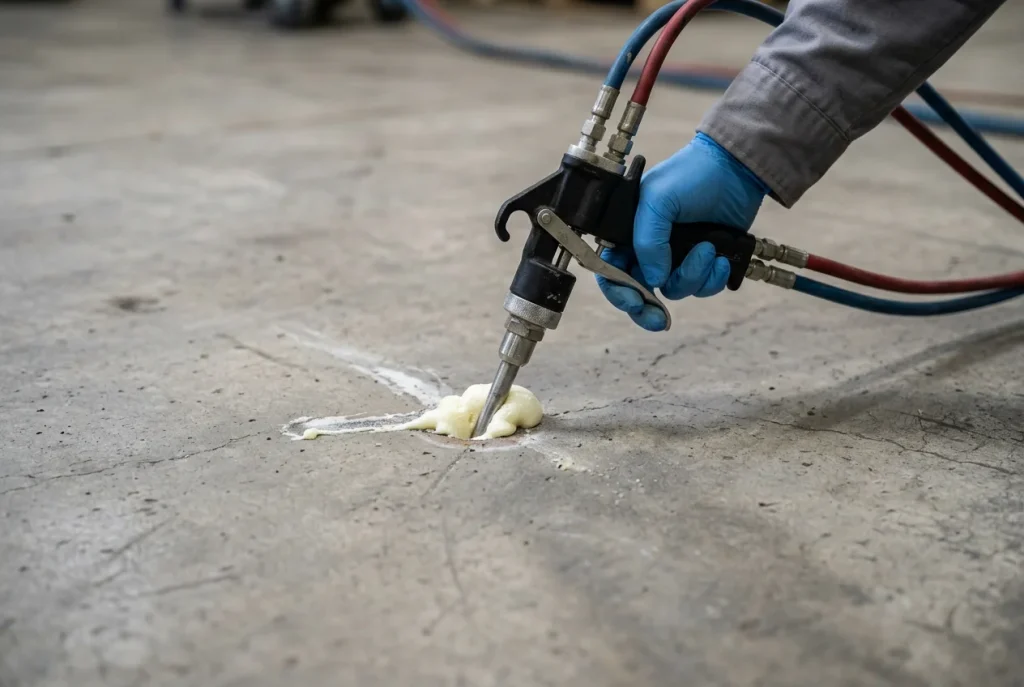
The process starts with drilling small 5/8-inch injection ports through the concrete surface on a calculated grid pattern. A two-part polyurethane resin is pumped through each port, expanding up to 30 times its liquid volume beneath the slab. The expanding foam fills voids, compresses loose soil, and generates controlled upward pressure that raises the concrete back to grade — all monitored in real time with laser levels and gauges.
Most facility managers have heard of concrete lifting foam but haven't seen the process up close. Here's the step-by-step sequence that Superior PolyLift's crews follow on every project:
Before any drilling happens, the crew assesses the slab condition, identifies settlement patterns, and maps the void space beneath the concrete. On complex commercial projects, this may include ground-penetrating radar (GPR) scanning to locate voids, buried utilities, and subsurface conditions that affect the injection plan. The assessment determines injection port spacing, foam density selection, and lift sequencing.
Small 5/8-inch holes are drilled through the concrete on a strategic grid pattern — typically 3 to 6 feet apart depending on slab thickness, void depth, and target lift height. These ports are significantly smaller than the 2-inch holes required for traditional mudjacking, which means less concrete damage and nearly invisible patch points after completion.
A two-part polyurethane resin — engineered to American Concrete Institute standards — is mixed at the injection gun and pumped through each port in a controlled sequence. The liquid resin expands beneath the slab — filling voids, densifying loose soil, and generating upward force that lifts the concrete. The crew monitors lift progress in real time using laser levels and precision gauges mounted on the slab surface. Injection moves from port to port in a planned sequence that distributes the lift evenly across the entire affected area.
This is where polyurethane foam injection separates from every other method. The foam's expansion rate and final volume are controllable — the operator adjusts injection speed and volume at each port to achieve precise elevation changes measured in fractions of an inch. If one section of the slab needs a half-inch lift while an adjacent section needs two inches, the crew calibrates each port individually. That precision is critical on industrial surfaces where forklift traffic, racking systems, and machinery require tight tolerances.
After the target elevation is reached, injection ports are patched with non-shrink grout that matches the surrounding concrete. The polyurethane foam reaches full structural strength in 15 to 30 minutes. The surface is ready for foot traffic immediately and vehicle or equipment traffic within hours — often the same business day.
| Process Step | What Happens | Time Required | Equipment Used |
| Site assessment | Void mapping, settlement measurement | 1–4 hours | GPR scanner, laser level |
| Port drilling | 5/8" holes on calculated grid | 30–90 minutes | Core drill |
| Foam injection | Two-part polyurethane pumped beneath slab | 1–4 hours | Injection rig, mixing gun |
| Real-time leveling | Monitored lift to target elevation | Concurrent with injection | Laser levels, gauges |
| Port patching + cure | Holes filled, foam reaches full strength | 15–30 minutes cure | Non-shrink grout |
| Return to service | Slab ready for full traffic | Same day | — |
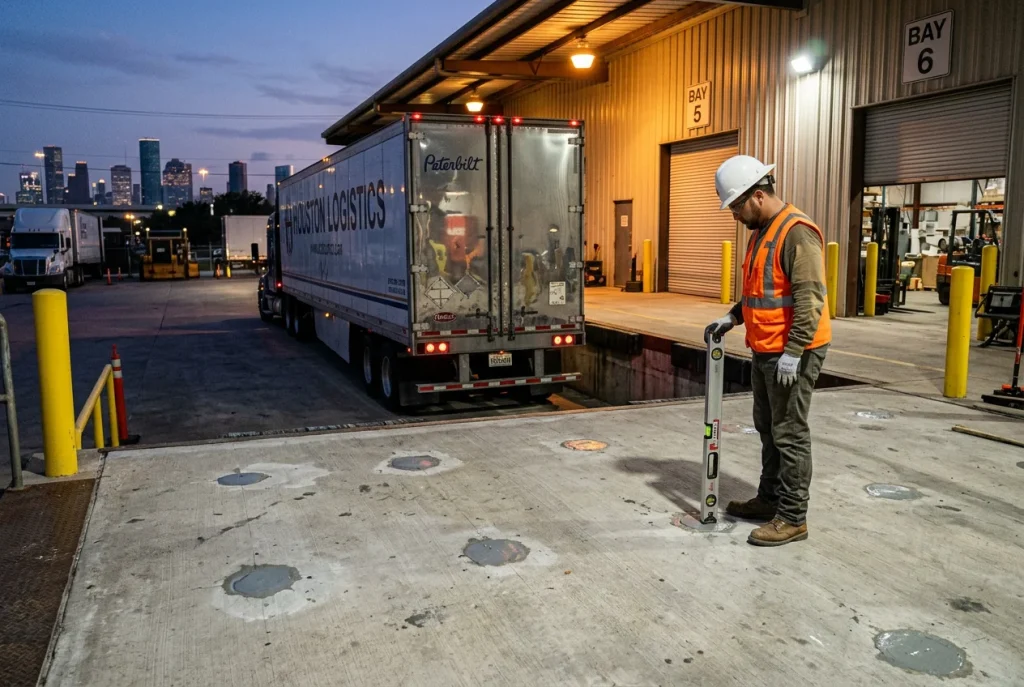
Houston's expansive clay soils swell when saturated and contract during drought, creating the void-settlement cycle that sinks concrete in the first place. Mudjacking pumps heavy cement slurry (100+ lbs per cubic foot) into those voids — adding weight that further compresses the already weakened soil and accelerates re-settlement. Polyurethane foam weighs under 4 lbs per cubic foot, is hydrophobic (repels water), and won't erode or wash out during Gulf Coast rain events.
This isn't an abstract comparison. It's the reason polyurethane has become the standard for commercial and industrial concrete leveling across Houston, and why engineers and facility managers are moving away from mudjacking for anything beyond temporary patches.
Mudjacking slurry weighs 100 to 150 pounds per cubic foot. On a 5,000-square-foot warehouse slab with 4-inch average void depth, that's tens of thousands of pounds of additional material loaded onto soil that already couldn't support the original concrete. Polyurethane foam at under 4 pounds per cubic foot fills the same void with a fraction of the weight — reducing the risk of future settlement from overloading.
Houston receives 50+ inches of rain annually. Mudjacking slurry is water-soluble — heavy rain events, rising water tables, and plumbing leaks can erode and wash out the slurry over time, recreating the voids it was supposed to fill. Polyurethane foam is closed-cell and hydrophobic. Water doesn't penetrate it, erode it, or degrade it. That moisture resistance is why polyurethane lifting routinely lasts 20+ years in Houston's climate while mudjacking typically holds 5 to 7 years before re-settlement begins.
Mudjacking requires 24 to 72 hours of cure time before the slab can handle traffic. Polyurethane cures in 15 to 30 minutes. For a distribution center that processes thousands of shipments daily or a port terminal that runs 24/7, that difference isn't a convenience — it's a financial necessity. Every hour of downtime costs real money.
Mudjacking uses 2-inch diameter injection holes. Polyurethane uses 5/8-inch ports — roughly the diameter of a dime. Smaller holes mean less concrete damage, less visible patching, and faster drilling time. On polished or decorative concrete surfaces, the difference is the line between acceptable repair and permanent visible damage.
| Factor | Polyurethane Foam | Mudjacking Slurry |
| Material weight | < 4 lbs/ft³ | 100–150 lbs/ft³ |
| Cure time | 15–30 minutes | 24–72 hours |
| Injection port size | 5/8 inch | 2 inches |
| Moisture resistance | Hydrophobic, closed-cell | Water-soluble, erodible |
| Typical lifespan (Houston) | 20+ years | 5–7 years |
| Soil re-loading risk | Minimal | High (heavy slurry) |
| Precision lift control | Sub-inch accuracy | Limited control |
| Return to service | Same day | 1–3 days |
Five factors drive project scope and cost: the total square footage of affected slab, the depth and volume of voids beneath the concrete, the required lift height, the foam density needed for the expected traffic loads, and site access constraints that affect crew setup and equipment positioning. Houston-specific factors — particularly soil composition and moisture conditions — also influence injection strategy.
Not every sunken slab is the same project. A 200-square-foot residential driveway settlement is a fundamentally different scope than a 50,000-square-foot warehouse floor with differential settlement across multiple zones. Here's what determines the engineering approach:
Larger slabs with deeper voids require more foam material and more injection ports. The crew calculates material volume based on the estimated void space — which is determined during the site assessment through probing, GPR scanning, or core sampling. A shallow void across a large area may use less material than a deep void under a smaller slab.
Minor settlements of half an inch to one inch require less foam and fewer injection stages than major corrections of three to four inches. Larger lifts may need to be staged — lifting in increments with curing time between stages — to prevent over-lifting or stress cracking in the concrete.
A pedestrian sidewalk and a container yard handling 80,000-pound loaded trailers need different foam formulations. Higher-density foam provides greater compressive strength but costs more per cubic foot. Superior PolyLift selects foam density based on the expected traffic load profile — lighter formulations for pedestrian and light vehicle surfaces, structural-grade high-density foam for heavy industrial applications.
Indoor projects require hose runs from the injection rig to the work area. Confined spaces, active production environments, and occupied buildings add complexity. Outdoor projects may involve traffic control, utility coordination, and weather scheduling around Houston's rain patterns. All of these factors affect crew size, timeline, and project cost.
The Beaumont clay formation underlying much of Greater Houston creates unique challenges. This expansive clay soil has one of the highest shrink-swell potentials in Texas — meaning the soil that caused the original settlement will continue cycling between wet expansion and dry contraction. The polyurethane injection plan must account for this by not just filling existing voids but also densifying the soil to resist future movement.
Schedule a site assessment before any work begins — this determines void locations, soil conditions, required foam density, and realistic project timeline. Confirm whether the project can be phased to maintain partial operations during the lift. And verify that the contractor uses real-time monitoring equipment, not visual guesswork, to control the lift.
The projects that go smoothly are the ones where the facility manager understands what's happening beneath their slab before the crew arrives. Here's what to prepare:
Superior PolyLift's assessment process includes slab condition evaluation, settlement measurement, void mapping, soil analysis, and a detailed project scope with foam density specifications — all before any drilling begins. That's the PolyLift™ standard for every commercial project in Houston.
| Pre-Project Question | Why It Matters |
| Has the slab been assessed in person? | Accurate scope requires physical evaluation, not phone estimates |
| Can the lift be phased? | Maintains partial operations during work |
| What monitoring equipment is used? | Laser levels ensure precision; visual guessing doesn't |
| What foam density is specified? | Must match expected traffic load profile |
| Is joint sealing included? | Prevents future water infiltration and void formation |
| What's the expected return to service? | Polyurethane = same day; mudjacking = 1-3 days |
Polyurethane concrete lifting is the engineered answer to Houston's concrete settlement problem — a problem driven by expansive clay soil, heavy rainfall, and the relentless loads that commercial and industrial facilities place on their slabs. The process fills voids, stabilizes soil, and restores elevation through small injection ports with foam that cures in minutes, weighs almost nothing compared to mudjacking slurry, and resists the moisture that makes Gulf Coast soil so unpredictable. It's not a patch. It's a precision-engineered repair that addresses what's happening beneath the surface.Ready to assess your concrete? Contact Superior PolyLift™ for a free site evaluation. Their team will map the voids, measure the settlement, and design an injection plan specific to your slab, your soil, and your traffic loads — backed by decades of geotechnical expertise across Greater Houston.
Explore how our expertise can benefit your project. Reach out to our team for a consultation and discover the best solutions for your needs.

At Superior PolyLift™, integrity and reliability are the core of our ethos. Our expert team crafts custom solutions that guarantee quality and durability for every project. Choose us for geotechnical excellence that endures.
Copyright © All rights reserved. 2024 • Terms of Use and Privacy Policy • Internet Marketing by Authority Solutions®