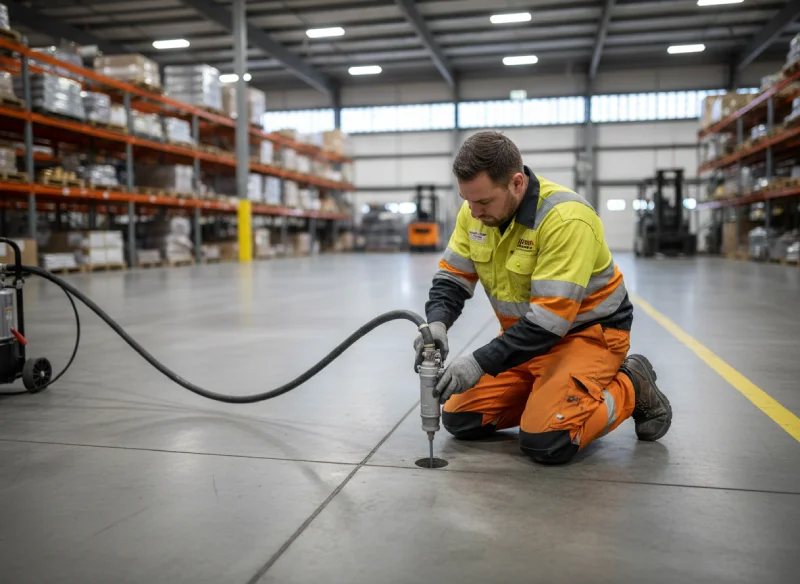
Uneven concrete can be leveled without excavation through polyurethane foam injection technology that eliminates demolition, soil removal, and replacement requirements, delivering precision elevation restoration through controlled subsurface material expansion while preserving existing structural integrity and operational continuity.
Traditional excavation-based concrete repair creates substantial operational disruptions, generates significant waste disposal costs, and requires extended facility downtime unacceptable for most industrial operations.
Modern non-excavation methods work through existing concrete structures rather than removing them, addressing subsurface void formation and differential settlement while facilities remain operational. This technological advancement fundamentally changes concrete maintenance economics and scheduling feasibility for mission-critical facilities.
Superior PolyLift™ provides uneven concrete leveling solutions for industrial and commercial operations requiring minimal downtime and maximum structural performance.
Traditional excavation-based concrete replacement requires complete facility area closure for extended periods. Heavy equipment operation creates safety zones preventing personnel access to adjacent spaces. Demolition generates noise, vibration, and airborne particulate contamination affecting neighboring operations. Material staging occupies valuable facility real estate for weeks.
Manufacturing facilities lose production capacity during shutdowns. Warehouse operations cannot fulfill orders from inaccessible areas. Distribution centers miss shipping schedules affecting customer commitments. These operational impacts often exceed direct construction costs, making excavation economically prohibitive regardless of material pricing.
Excavation processes fundamentally alter subsurface conditions beneath and adjacent to work areas. Heavy equipment vibration consolidates surrounding soils, potentially inducing settlement in previously stable zones. Complete soil removal eliminates natural consolidation developed over decades. Backfill compaction, even when performed properly, cannot replicate natural soil density achieved through prolonged consolidation.
Excavation-induced settlement mechanisms:
New concrete replacement requires twenty-eight days to achieve design strength, though surfaces may bear light traffic after seven days. This extended curing timeline compounds operational disruption beyond construction duration. Concrete production contributes substantial carbon emissions through cement manufacturing. Material transportation requirements increase project costs and environmental footprints.
Polyurethane foam injection operates through strategic subsurface material placement rather than mechanical lifting or structural removal. Small-diameter access ports penetrate concrete slabs at calculated locations based on void distribution patterns and required lift magnitudes. High-density expanding polymers inject beneath settled areas, filling cavities while generating controlled upward force.
The process preserves existing structural elements including reinforcing steel, embedded utilities, and surface treatments. Concrete remains in place throughout operations, maintaining structural continuity and avoiding material disposal requirements. Subsurface void filling occurs from deepest points upward, ensuring complete cavity elimination rather than creating new voids through incomplete filling.
Process execution sequence:
High-density geotechnical polyurethane formulations deliver structural performance exceeding traditional cement-based alternatives while weighing ninety-six percent less. This dramatic weight reduction prevents additional settlement risk inherent in mudjacking approaches adding one hundred to one hundred fifty pounds per cubic foot of material weight onto already compromised bearing soils.
Closed-cell polymer structure achieves complete water impermeability preventing moisture infiltration driving progressive soil erosion. Material maintains dimensional stability across temperature ranges from negative forty to positive one hundred fifty degrees Fahrenheit without expansion or contraction affecting structural positioning. Chemical inertness ensures compatibility with petroleum products, deicing salts, and industrial chemicals encountered in facility operations.
Superior material properties include:
Material and labor costs represent only partial economic considerations when evaluating concrete repair alternatives. The following comparison illustrates comprehensive cost factors:
| Economic Factor | Non-Excavation Foam Injection | Traditional Excavation & Replacement |
| Material Cost per Square Foot | $3-10 typical range | $8-15 typical range |
| Labor Requirements | 2-3 person crew, 4-12 hours | 5-8 person crew, 7-14 days minimum |
| Equipment Mobilization | Single injection trailer | Excavators, loaders, concrete trucks, compactors |
| Waste Disposal | Zero material removal | 100% existing concrete plus excavated soil |
| Facility Downtime | 4-12 hours typical | 7-14 days minimum |
| Return to Service | 15 minutes after completion | 7-28 days depending on loading |
| Adjacent Area Impact | Minimal - operations continue | Extensive - large perimeter closure |
| Future Maintenance | Minimal - 20+ year performance | Moderate - settlement continuation likely |
Lost productivity during extended facility shutdowns often exceeds direct construction costs by substantial margins. Manufacturing facilities producing high-value goods lose thousands of dollars per hour during unplanned production interruptions. Warehouse distribution centers face penalty clauses for missed shipping commitments. Retail operations sacrifice peak period revenue when floor repairs force temporary closures.
A typical warehouse facility processing five hundred pallets daily generates approximately ten thousand dollars daily revenue. Two-week excavation-based replacement costs one hundred forty thousand dollars in lost revenue plus direct construction expenses. Four-hour foam injection completion costs zero lost revenue, delivering total project savings exceeding one hundred fifty thousand dollars even accounting for premium material pricing.
Corporate sustainability initiatives increasingly prioritize waste minimization and carbon footprint reduction. Excavation-based replacement generates substantial waste requiring disposal permits, transportation logistics, and landfill tipping fees. Concrete demolition produces airborne particulate requiring dust control measures and potentially triggering air quality violations.
Non-excavation environmental advantages:
Non-excavation methods deliver optimal performance when concrete settlement results from subsurface void formation rather than structural deterioration. Facilities experiencing the following conditions represent ideal candidates for foam injection technology.
Prime application indicators:
Professional assessment determines whether existing concrete possesses sufficient integrity for non-excavation leveling versus requiring complete replacement. Engineers evaluate multiple structural characteristics during preliminary investigations.
Concrete thickness measurements verify adequate remaining cross-section after accounting for surface wear and bottom spalling. Core samples reveal internal condition including aggregate bonding, reinforcing steel condition, and void presence indicating deterioration progression. Structural load testing confirms capacity to support operational requirements following elevation restoration.
Disqualifying conditions requiring replacement:
Professional installations include comprehensive pre-injection and post-injection elevation surveys documenting achieved results. High-precision optical leveling equipment or laser measurement systems establish reference elevations at grid points across project areas. Post-repair surveys measure vertical adjustments at identical locations, quantifying achieved lift magnitudes and uniformity.
Survey data demonstrates compliance with project specifications and tolerance requirements. Documentation provides objective evidence supporting payment applications and warranty coverage. Periodic re-surveying during warranty periods tracks long-term stability, validating material performance and identifying any settlement recurrence requiring corrective action.
Responsible contractors recommend annual elevation monitoring for critical facility areas following major leveling projects. Comparative surveys identify progressive settlement trends enabling proactive intervention before operational impacts occur. Multi-year stability documentation validates repair effectiveness and material durability supporting future capital planning decisions.
Monitoring programs particularly benefit facilities with ongoing settlement risk from continuing soil consolidation, seasonal moisture variations, or operational loading changes. Early detection of renewed movement enables targeted remediation at lower costs than allowing problems to progress requiring more extensive repairs.
Modern polyurethane injection equipment incorporates sophisticated monitoring and control systems enabling precision unattainable with traditional methods. Multiple sensors track injection pressures, flow rates, material temperatures, and slab positioning throughout operations. Computer systems analyze data streams adjusting delivery parameters maintaining optimal conditions for uniform results.
Laser-based elevation monitoring provides continuous feedback on vertical slab movement during injection. Technicians observe lifting progress in real-time, modulating foam delivery achieving specification tolerances through incremental adjustments. This closed-loop control system prevents over-lifting requiring corrective measures and ensures uniform elevation across target areas.
Technology-enabled capabilities:
Contemporary geotechnical polyurethane formulations represent substantial improvements over early products. Engineers now select from twenty-plus specialized formulations optimized for specific soil conditions, loading requirements, and environmental exposures. Custom blend capabilities enable tailoring material properties to unique project demands.
Recent innovations include enhanced soil interaction characteristics improving load transfer between foam and bearing materials. Modified reaction kinetics provide extended working time for complex projects requiring precise multi-point coordination. Improved temperature stability maintains consistent expansion characteristics across broader ambient condition ranges.
While both polyurethane foam injection and traditional mudjacking avoid excavation, substantial performance differences distinguish these technologies:
| Performance Factor | Polyurethane Foam Injection | Traditional Mudjacking |
| Material Weight | 2-4 lbs/ft³ | 100-150 lbs/ft³ |
| Injection Port Size | 5/8 inch diameter | 1-2 inch diameter |
| Cure Time | 15 minutes | 24-48 hours |
| Service Life Expectancy | 20+ years | 5-10 years typical |
| Moisture Resistance | Complete waterproofing | Absorbs water, erodes over time |
| Precision Control | ±1/8 inch accuracy | ±1/4 inch accuracy |
| Soil Stabilization | Compacts bearing materials | Minimal soil interaction |
| Temperature Sensitivity | Stable across wide range | Performance varies with temperature |
| Project Cost | Premium pricing | Budget alternative |
Uneven concrete can be effectively leveled without excavation through polyurethane foam injection technology delivering superior economic, operational, and environmental performance compared to traditional replacement methods. The process preserves existing structural elements while addressing underlying settlement causes through controlled subsurface material placement and void filling.
For industrial and commercial facilities prioritizing operational continuity, cost control, and long-term performance, non-excavation leveling represents the optimal repair strategy when concrete remains structurally sound despite settlement-induced elevation changes. The combination of rapid completion, minimal disruption, precision results, and extended durability creates compelling value propositions justifying premium material costs through comprehensive lifecycle analysis.
Professional assessment remains essential for determining appropriate repair strategies for specific applications.
Concrete leveling companies with extensive industrial experience provide technical expertise evaluating structural conditions, recommending optimal approaches, and executing repairs achieving specification requirements.
Contact Superior PolyLift™ to discuss how non-excavation concrete leveling can address your facility's settlement challenges while maintaining operational schedules.
Explore how our expertise can benefit your project. Reach out to our team for a consultation and discover the best solutions for your needs.
At Superior PolyLift™, integrity and reliability are the core of our ethos. Our expert team crafts custom solutions that guarantee quality and durability for every project. Choose us for geotechnical excellence that endures.
Copyright © All rights reserved. 2024 • Terms of Use and Privacy Policy • Internet Marketing by Authority Solutions®