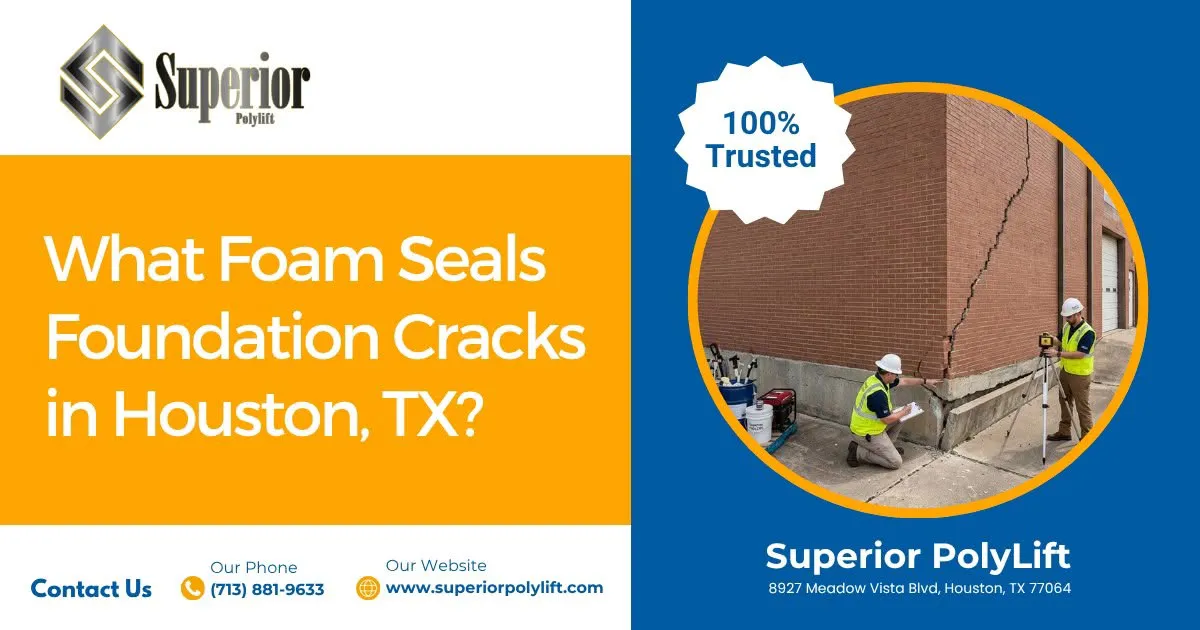
Polyurethane injection foam seals foundation cracks where the goal is stopping water. Hydrophobic formulations suit larger cracks and voids, while hydrophilic formulations penetrate fine cracks and curtain-grout behind walls. Foam seals against water but is not a structural repair, so actively moving or load-bearing cracks require a different approach.
When a crack appears in a Houston foundation, one of the first questions raised is whether polyurethane foam can seal it, and if so, which formulation is appropriate. Not all foundation cracks are the same, and using the wrong foam or a consumer-grade hardware store product can waste money or worsen the problem in Houston's expansive clay.
This guide explains which foams work for structural versus non-structural cracks, when injection foam is the right choice, and how to match the repair method to the foundation's actual condition rather than to whichever method a contractor happens to specialize in.
Houston sits atop highly plastic Gulf Coast clays that create persistent challenges for foundations across the entire metro area. These expansive clay soils shrink significantly during dry periods and swell when saturated, producing repeated cycles of volume change that subject shallow foundations to both uplift and settlement.
When clay soils dry and contract, they can pull away from the perimeter of a slab and create voids beneath the foundation. As these voids form, portions of the foundation may settle, leading to differential movement and cracking. Because the movement is uneven across the structure, the resulting cracks tend to concentrate where the differential is greatest rather than distributing evenly. Understanding which cracks are serious and which are cosmetic is essential before choosing any repair method.
Not all foundation cracks signal the same level of concern, and the orientation of a crack is the first and most reliable clue to what caused it and how urgently it needs attention.
| Crack Type | What It Usually Indicates | Concern Level |
| Vertical or near-vertical | Minor differential settlement or shrinkage | Often cosmetic if narrow and uniform |
| Diagonal from corners | Rotation of a foundation portion | Higher if widening toward one end |
| Horizontal | Lateral soil or hydrostatic pressure pushing walls inward | Serious |
| Stair-step in masonry | Uneven settlement | Requires correlation with floor levels |
Active cracks are still moving and may widen or lengthen over months or with seasonal moisture cycles. Dormant cracks have stabilized with no measurable change over an extended period. Distinguishing between the two usually requires monitoring over several months rather than relying on a single inspection, since seasonal movement in Houston clay can easily make a dormant crack appear active or an active one appear settled. If a crack is active and structurally significant, the priority is restoring load-bearing capacity rather than sealing, and sealing alone would mask a problem that is still developing. For dormant cracks that are simply leaking, flexible polyurethane injection is often the preferred solution.
Polyurethane foam comes in several formulations, each engineered for specific applications. Understanding these differences supports informed repair decisions and prevents the common error of treating all injection foam as a single product.
Hydrophobic foams repel water and expand minimally, forming dense, relatively rigid, closed-cell structures suitable for sealing larger cracks and voids where water is present but excessive expansion would be counterproductive.
Hydrophilic foams actively incorporate water into their structure, expanding significantly when encountering moisture. They form flexible gels or foams that can penetrate fine cracks, making them well suited to curtain grouting behind walls where the water source sits on the far side of the structure.
High-density rigid polyurethane lifting foams typically weigh 3.5 to 5 pounds per cubic foot, yet can carry up to approximately 14,000 pounds per square foot once cured, a strength-to-weight relationship that has no equivalent among cement-based materials. These specialized foams reach about 90 percent of compressive strength within roughly 15 minutes and are injected beneath slabs through small holes, typically around three-eighths inch in diameter, to fill voids, compact loose soils, and lift settled concrete back toward its original elevation.
The choice between epoxy and polyurethane depends on the crack's structural role, moisture condition, and whether movement has stopped. The two materials do different jobs rather than competing for the same one.
| Attribute | Epoxy Crack Injection | Polyurethane Foam Injection |
| Primary function | Structural crack repair; bonds concrete to restore strength | Leak sealing and void filling; forms water barrier |
| Suitable crack condition | Best on dry or slightly damp, non-actively leaking cracks | Ideal for wet, damp, or actively leaking cracks |
| Structural contribution | Provides significant structural capacity | Typically not considered structural |
| Re-injectability | Generally easier to re-inject through same crack path | More difficult to re-inject after cure |
For structurally significant cracks in foundations that have stabilized, epoxy injection provides the load-bearing capacity needed to restore the concrete's original strength. That is the job epoxy is formulated to do, and specifying polyurethane in its place will not deliver the same result regardless of how well the injection itself is performed.
Polyurethane excels in actively leaking or chronically damp conditions where epoxy will not bond reliably to the concrete face. Many polyurethane systems are moisture-reactive and may require that the crack be damp or pre-wetted to achieve full expansion. For dormant, non-structural cracks where the primary concern is water intrusion, polyurethane's flexibility and ability to cure in wet conditions are decisive advantages that epoxy cannot match.
The practical takeaway is that the two materials are complements rather than substitutes. Diagnosing whether the crack is structural or a water-intrusion problem determines which one belongs in the specification, and on larger projects both may be appropriate in different locations on the same structure.
Both epoxy and polyurethane resins are available in cartridge systems that allow controlled, low-pressure injection into foundation cracks.
Technicians glue surface-mounted plastic ports over the crack at roughly ten to twelve inch intervals using fast-setting epoxy paste, then bridge the crack between ports with the same paste, forming a surface seal that contains the resin during injection.
Once the paste hardens, the chosen resin is slowly injected starting at the lowest port. The resin flows into the crack under low pressure, filling it from the bottom until it appears at the next higher port, which confirms that section is full. The technician then caps the lower port and moves upward, repeating the process until the entire crack is filled. This methodical bottom-up approach ensures complete crack penetration and minimizes the risk of voids or incomplete sealing.
While polyurethane foam has legitimate and important applications in foundation work, it is not appropriate for every situation. Misapplication leads to inadequate repairs and ongoing structural problems.
Using polyurethane foam in cracks that are structural in nature will not restore the original strength of the foundation and could leave the structure vulnerable if underlying settlement or loading issues persist. The crack may stop leaking while the condition that produced it continues unchecked. When differential settlement is significant, the appropriate repair may involve underpinning, installing piers beneath the foundation to transfer loads to deeper, more stable strata, combined with hydraulic lifting to restore elevation.
Products marketed for filling large gaps around windows and doors are primarily intended for insulation and air sealing. These form lightweight, low-strength foam not designed to resist hydrostatic pressure, carry structural loads, or maintain integrity under prolonged wetting. They will appear to seal a crack initially and then fail once water pressure returns. Professional geotechnical foams are specifically engineered for predictable expansion, high compressive strength, adhesion to concrete, and long-term environmental stability, and they are manufactured to published density and compressive strength standards rather than to general-purpose specifications. Using consumer-grade products for foundation repair is ineffective and potentially unsafe.
Understanding typical repair costs helps property operators budget appropriately and evaluate contractor proposals against one another on a comparable basis.
| Repair Type | Typical Cost |
| Targeted epoxy crack injection (minor cracks) | $300 to $800 |
| Moderate foundation repair in Texas | $3,300 to $7,000 |
| Typical Houston projects | $3,300 to $6,800 |
| Underpinning with piers | $1,000 to $3,000 per pier |
Minor issues such as hairline cracks can often be addressed with targeted methods for as little as $300 to $800, which makes early intervention considerably cheaper than waiting for the crack to widen. Underpinning is priced per pier, so total cost depends on how many piers are needed to stabilize the affected area. That number is determined by the extent and pattern of settlement rather than by the size of the structure alone, which is why two similar buildings can receive very different quotes.
Foundation repair in Houston's challenging soil conditions requires more than off-the-shelf products. A geotechnical and polyurethane grouting specialist can provide accurate diagnosis, engineered solutions, and long-term structural stability.
Professional contractors use advanced foam injection methods for concrete lifting, void filling, and stabilization that are minimally invasive and fast-curing. These engineered solutions address the root causes of foundation movement rather than covering symptoms, and they can typically be performed without excavation or extended site disruption.
When evaluating contractors, look for specialists who can explain the difference between structural and non-structural repairs, demonstrate knowledge of Houston's specific soil challenges, and provide warranties backed by proper engineering analysis rather than boilerplate language. A contractor who recommends the same method for every crack, regardless of orientation, moisture condition, or whether movement has stopped, has not actually diagnosed the problem.
Polyurethane foam seals foundation cracks well when the problem is water. Hydrophobic formulations handle larger cracks and voids, hydrophilic formulations penetrate fine cracks and curtain-grout behind walls, and both cure reliably in the damp conditions where other materials struggle to bond at all. That is a genuine strength, not a fallback.
What foam does not do is restore structural capacity, and that single distinction is where the majority of failed crack repairs originate. A structurally significant crack on a stabilized foundation calls for epoxy, and a crack still moving because of active settlement calls for underpinning before any sealing is attempted. Diagnosis comes first, material selection second, and drainage correction alongside both, because no crack repair of any kind outlasts the water that caused the problem in the first place.
Get an accurate diagnosis before choosing a repair method.
Schedule a Houston foundation assessment today.

Explore how our expertise can benefit your project. Reach out to our team for a consultation and discover the best solutions for your needs.

At Superior PolyLift™, integrity and reliability are the core of our ethos. Our expert team crafts custom solutions that guarantee quality and durability for every project. Choose us for geotechnical excellence that endures.
Copyright © All rights reserved. 2024 • Terms of Use and Privacy Policy • Internet Marketing by Authority Solutions®