Foam foundation repair uses high-density polyurethane foam injected beneath a settled or damaged foundation to fill voids, stabilize weakened soil, and lift the structure back toward its original elevation. It's faster than traditional pier systems, less invasive than underpinning, and specifically effective on Houston's slab-on-grade foundations — the most common foundation type in the region — where the Beaumont clay beneath the slab is the root cause of nearly every foundation problem.
Foundation distress is one of the most stressful problems a Houston property owner faces. Cracks in the walls. Doors that won't close. Floors that visibly slope. The instinct is to assume the worst — and the repair quotes that follow often reinforce that fear with proposals for dozens of steel piers at thousands of dollars each. But not every foundation problem needs piers. Many of Houston's foundation issues are driven by void space and soil instability beneath the slab — conditions that foam foundation repair addresses directly, precisely, and at a fraction of the cost and disruption of traditional methods. Superior PolyLift's foundation repair services have stabilized commercial and residential foundations across Greater Houston using polyurethane foam injection engineered for the region's aggressive clay soil conditions.
This guide covers how foam foundation repair works, when it's the right solution versus other methods, what Houston property owners should know about their slab foundations, and how to evaluate whether your foundation problem needs foam, piers, or both.
Small injection ports are drilled through or adjacent to the foundation slab. High-density, two-part polyurethane resin is pumped through the ports, expanding beneath the foundation to fill voids, compress loose soil, and generate controlled upward pressure that lifts settled sections back toward their original position. The foam cures in 15 to 30 minutes and reaches structural load-bearing capacity the same day.
The process mirrors concrete lifting — because the underlying engineering is the same. Voids beneath the foundation are the problem. Filling those voids and stabilizing the soil is the solution. Here's the step-by-step sequence:
Before any injection, a detailed assessment maps the foundation's current condition. This typically includes an elevation survey — measuring floor elevation at a grid of points across the entire structure to identify where settlement has occurred and how severe the displacement is. The elevation data creates a map that shows exactly which zones need lifting and by how much. On commercial structures, this may include GPR scanning to locate voids, buried utilities, and subsurface conditions.
Ports are drilled through the slab at strategic locations — typically along the perimeter, at interior bearing points, and at locations where the elevation survey indicates the greatest settlement. The ports are small (5/8 inch) and positioned to reach the void zones identified during assessment.
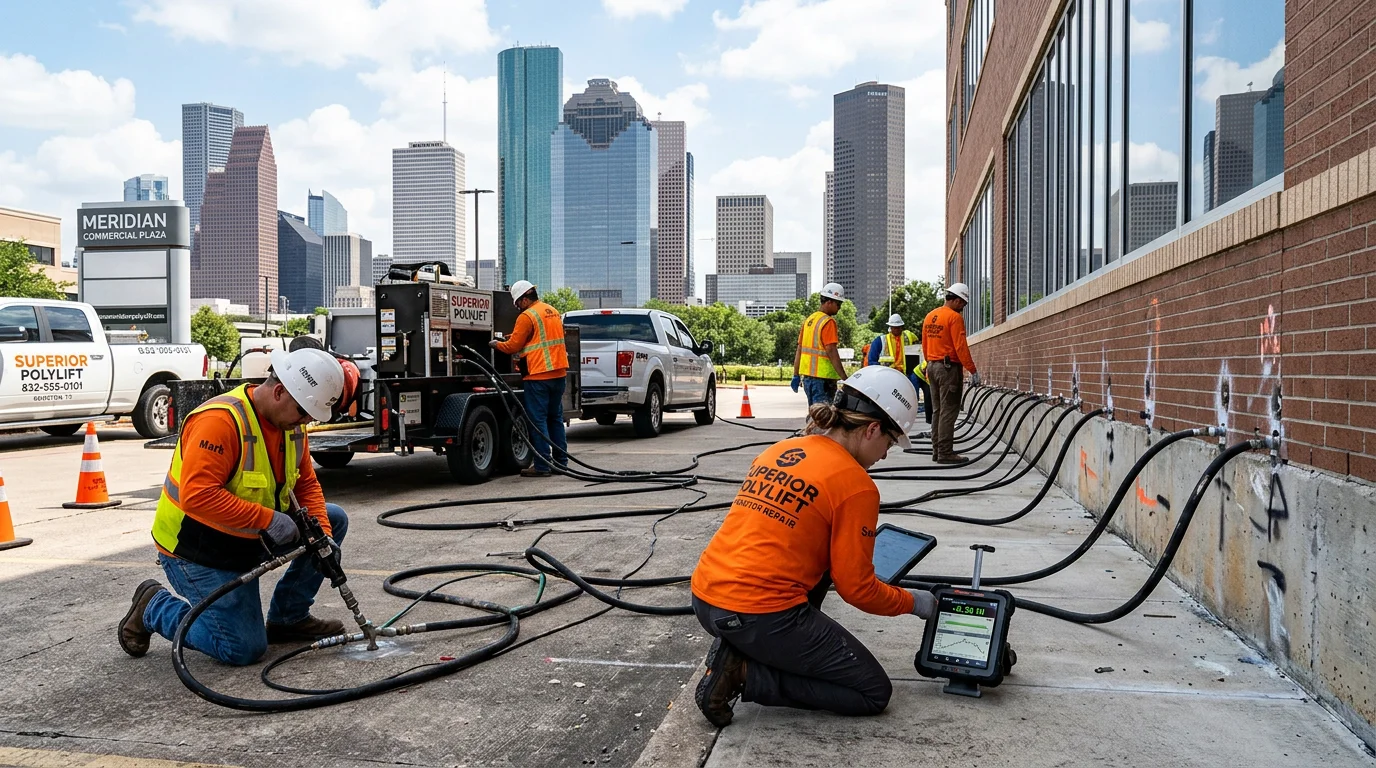
Two-part polyurethane resin is injected through each port in a calculated sequence. The foam expands beneath the foundation, filling voids and compressing loose soil. As the foam generates upward pressure, the foundation begins to lift. Technicians monitor the lift in real time using precision gauges and laser levels positioned across the structure — controlling the injection rate at each port to achieve uniform, controlled elevation change.
The foam reaches full structural strength in 15 to 30 minutes. A post-lift elevation survey verifies the achieved correction against the target. The data documents exactly how much each zone was lifted — creating a permanent record that's valuable for insurance claims, property transactions, and ongoing maintenance planning.
| Repair Phase | What Happens | Duration | Monitoring |
| Elevation survey | Map settlement across full structure | 1–3 hours | Digital elevation instruments |
| Port installation | Drill injection ports at strategic locations | 30–90 minutes | Port spacing per void map |
| Foam injection | Fill voids, densify soil, lift foundation | 2–6 hours | Real-time laser levels and gauges |
| Cure | Foam reaches full load-bearing capacity | 15–30 minutes | — |
| Post-lift verification | Re-survey elevation, document correction | 1–2 hours | Before/after elevation comparison |
Foam foundation repair is most effective when the foundation problem is caused by void space and soil instability beneath the slab — which describes the majority of foundation issues in Houston. It's less appropriate when the foundation has severe structural cracking that requires mechanical reinforcement, or when the settlement is driven by deep bearing failure that requires piers reaching stable strata below the active clay zone.
Not every foundation problem has the same solution. Understanding what's causing the distress determines whether foam, piers, or a combination is the right approach.
Some Houston foundation projects benefit from a combined approach: piers at the perimeter for deep load transfer, and foam injection beneath the interior slab for void filling and soil stabilization. This combination addresses both deep bearing failure at the edges and shallow void-driven settlement in the center — a common pattern on large commercial slabs in Houston.
| Foundation Condition | Best Method | Why |
| Void-driven settlement (1–3") | Foam injection | Fills voids, densifies soil, same-day cure |
| Interior slab settlement | Foam injection | Reaches interior zones through small ports |
| Deep bearing failure (20–40 ft) | Steel piers | Transfers load to stable deep strata |
| Severe structural cracks | Piers + structural reinforcement | Mechanical connection required |
| Perimeter settlement + interior voids | Piers (perimeter) + Foam (interior) | Combined approach for complex patterns |
| Plumbing-leak-induced heave | Plumbing repair + monitoring | Address moisture source first |
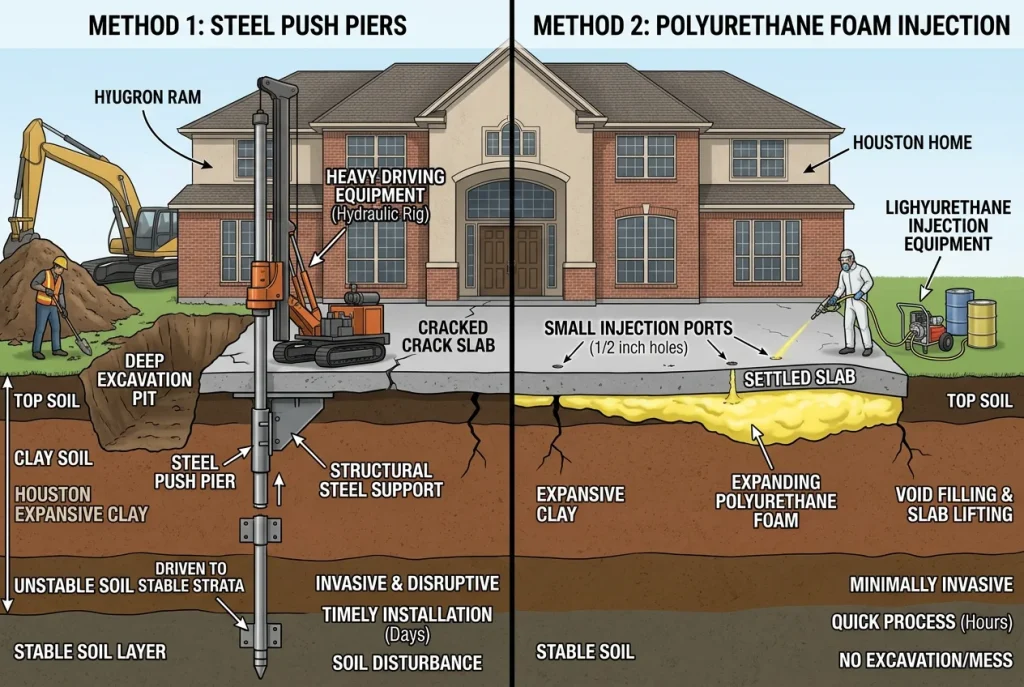
Houston's slab-on-grade foundations — both monolithic and post-tension — sit directly on Beaumont clay soil with no basement or crawl space buffer. This means the foundation's performance is directly tied to the soil's moisture content. When the clay shrinks, the foundation settles. When the clay swells, the foundation heaves. Every foundation repair decision in Houston must account for this ongoing soil-structure interaction.
Most Houston properties — residential, commercial, and industrial — are built on slab-on-grade foundations. This construction type places the concrete foundation directly on prepared soil without a basement or pier-and-beam structure underneath. It's cost-effective for Gulf Coast construction, but it means the foundation has no tolerance for soil movement beneath it.
The entire foundation — the floor slab and the perimeter beam — is poured as one continuous concrete piece. Monolithic slabs are common in light commercial buildings and residential construction. Their strength is simplicity. Their weakness is that if the soil moves unevenly beneath the slab, the monolithic structure can't flex to accommodate the movement — it cracks.
Steel cables embedded in the slab are tensioned after the concrete cures, creating a pre-stressed structure with higher load capacity and better resistance to cracking than a standard monolithic slab. Post-tension foundations are the dominant choice for new Houston construction. They perform well under moderate soil movement, but extreme differential settlement can still overwhelm the tensioning system and cause distress.
The critical concept for Houston property owners: your foundation's condition is a direct reflection of what the soil beneath it is doing. A foundation that was perfectly level five years ago may have settled two inches today — not because the concrete failed, but because the clay beneath it lost moisture and contracted. Repairing the foundation without addressing the soil condition is like treating a fever without addressing the infection.
Demand a detailed elevation survey before any repair is proposed — not just a visual walk-through. Ask whether they offer foam injection, pier systems, or both — a contractor limited to one method will recommend that method regardless of what the foundation actually needs. Verify commercial project experience, insurance coverage, and written warranty terms that specify exactly what's covered and for how long.
Houston has hundreds of foundation repair contractors. The quality range is enormous. Some are engineering-driven firms with diagnostic equipment, multiple repair technologies, and documented commercial track records. Others are sales-driven operations that recommend the most expensive option on every call.
Here's what separates them:
Superior PolyLift provides pre-repair elevation surveys, foam injection and soil stabilization with detailed project documentation, and written warranty terms — all standard for every foundation project in Houston.Ready to assess your foundation? Contact Superior PolyLift™ for a free foundation evaluation. Their team conducts a thorough assessment — elevation survey, void mapping, and soil condition analysis — before recommending any repair approach.
Explore how our expertise can benefit your project. Reach out to our team for a consultation and discover the best solutions for your needs.

At Superior PolyLift™, integrity and reliability are the core of our ethos. Our expert team crafts custom solutions that guarantee quality and durability for every project. Choose us for geotechnical excellence that endures.
Copyright © All rights reserved. 2024 • Terms of Use and Privacy Policy • Internet Marketing by Authority Solutions®