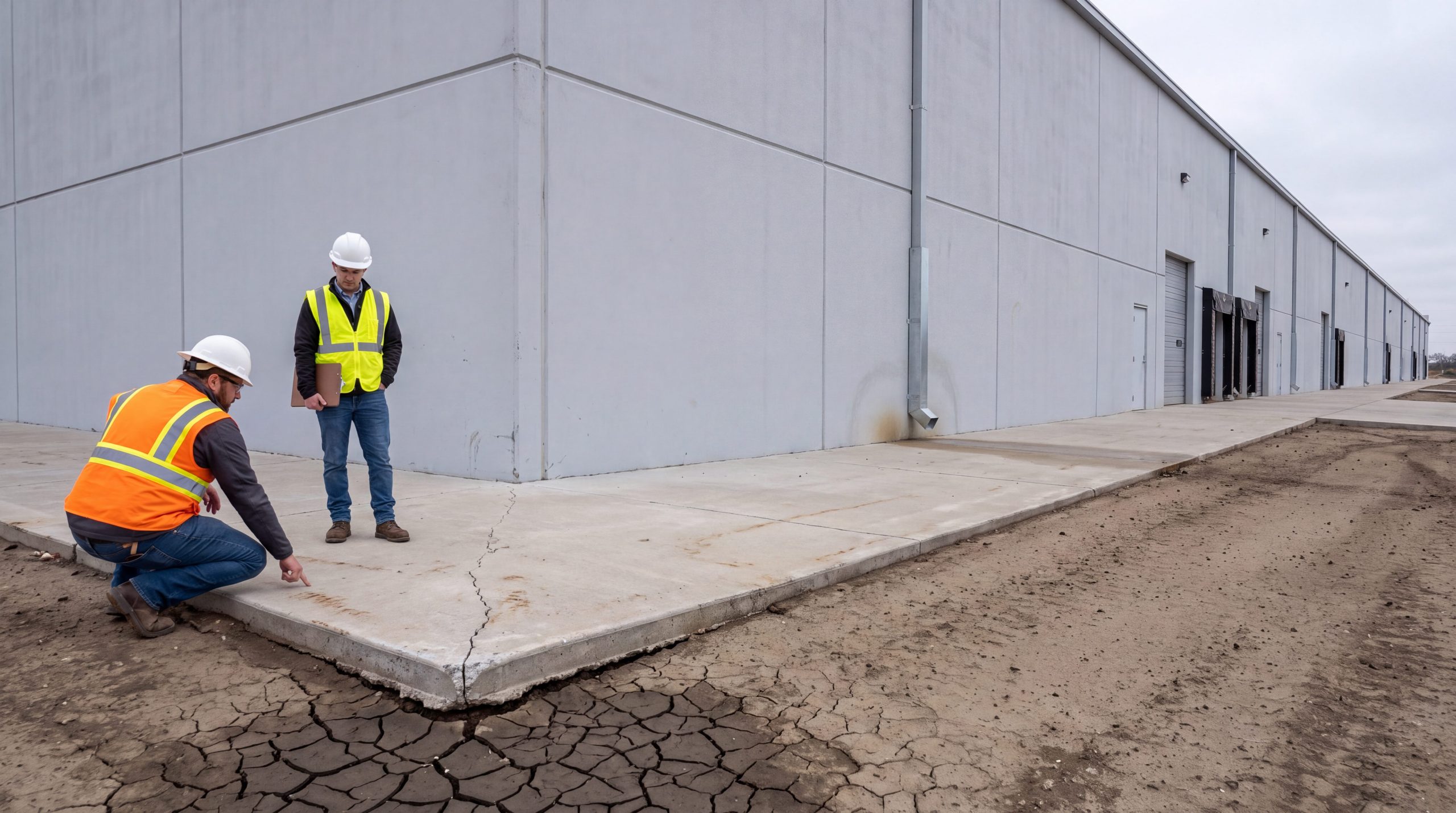
Most Houston foundation problems on commercial slabs start in the soil, not the concrete: expansive clay that shrinks and swells, water tables that rise and fall, drainage that softens the slab edge, and local causes such as leaks or poor backfill. Knowing which applies decides what any foundation repair has to address.
Houston foundation problems under commercial slabs usually come from soil that loses or changes support, driven by clay movement, water and site-specific conditions beneath the building.
A commercial slab on grade is only as stable as its subgrade, the compacted native soil or fill that carries it, which on most Houston sites is some mix of clay, silty clay and imported fill. When that layer shrinks, swells, softens, consolidates or erodes, the foundation slab follows it. Settlement is the downward movement that results, and differential settlement is the case where one part of a slab moves more than another, which is what cracks floors, opens joints and racks door frames.
Asset managers often hear all of this described as one foundation problem, but each foundation issue behaves differently and calls for different related work. The table below maps the common causes on Houston commercial sites to what they do and what a site assessment looks for.
| Cause | What it does beneath the slab | Typical pattern on a commercial slab | What the assessment checks |
|---|---|---|---|
| Expansive clay shrinkage | Clay loses volume as it dries, opening gaps under the slab | Perimeter and corner drop after dry periods | Soil type, moisture history, gaps at the slab edge |
| Expansive clay swelling | Clay gains volume as it wets, pushing sections up unevenly | Interior heave or raised panels near wet areas | Elevation survey against reference points |
| Water table changes | Saturation softens the subgrade and reduces bearing support | Broad softening in low areas after wet seasons | Grade, standing water, seasonal timing of movement |
| Poor perimeter drainage | Runoff concentrates at the slab edge and carries fines away | Settlement near downspouts, ponding or grade breaks | Downspout outlets, grading, signs of washout |
| Plumbing or drain leaks | Water erodes or softens soil along the line | Linear settlement following a pipe route | Leak history, line locations, void detection |
| Consolidating backfill | Loose trench or fill material compacts over time | Settlement along utility trenches or added sections | Construction records, trench locations |
| Concentrated loads | Heavy repeated loads compress weak subgrade | Drop at joints in forklift aisles or under racking | Load paths, joint condition, slab thickness |
More than one cause is usually at work on the same foundation, such as a perimeter that dropped after a dry summer and then settled further near a downspout.
Houston Black clay moves by shrinking when it dries and swelling when it takes on water, so a foundation slab built on it sees changing support through each wet and dry cycle.

Much of the Houston, TX area sits on expansive clay, including the Houston Black clay series. Soil scientists classify it as a Vertisol, a soil order defined by clay minerals that take water into their structure and change volume as they do. In the field it shows up as deep desiccation cracks in dry months and slick, plastic soil after rain.
Shrink-swell cycles are the repeated contraction and expansion of that clay as moisture changes. Soil at the slab perimeter dries and wets far more than soil under the middle of a large floor, which the concrete shields. That is why so many commercial settlement patterns start at the edges and corners of a building.
Three conditions make clay movement worse on an operating site:
None of this means every clay site will settle. Many commercial buildings on expansive clay were designed for it, with moisture conditioning, select fill or a deeper foundation type such as drilled piers. Where a foundation slab does move, clay behavior is one of the first explanations an assessment tests, and the original geotechnical report is the most useful record of what was planned.
Water matters because it changes clay volume and soil strength at once, and Houston sites combine high water tables, heavy rain and drainage problems at the foundation edge.
Groundwater close to the surface keeps the subgrade wet for long periods, and saturated soil carries less load than the same soil at a moderate moisture content. A seasonal rise and fall of the water table can also move clay through the same shrink-swell cycle.
Drainage is where most of the controllable risk sits. Downspouts discharging at the foundation line, paving graded toward the building, clogged trench drains at docks and planting beds against the slab all concentrate water where the slab is most exposed. Over time that water softens the subgrade and can carry fine soil from under the slab edge, leaving a void. A void is any gap between the underside of the slab and the soil that should support it.
During a site walk, the drainage questions are simple and specific:
Drainage is the clearest example of why a cause must be corrected alongside foundation repairs: lifting a slab edge that still receives roof runoff leaves the problem in place.
Local causes are conditions specific to one Houston building, such as leaks, backfill, fill quality and loading, and they often explain settlement that regional soil and climate do not.
Two Houston foundations on the same clay can behave differently because of what happens within a few feet of each slab. The local causes that come up most often are these:
These causes are why voids are so common under settled commercial slabs. Our polyurethane void filling page covers how voids beneath commercial slabs are filled once the source of soil loss is corrected.
Regional subsidence lowers broad areas of ground gradually, while local slab settlement is movement of one slab relative to its surroundings, usually caused by conditions just beneath it.
Coastal subsidence is part of the Houston context and often comes up when owners ask why buildings move. Because it acts across wide areas, it tends to lower a building and its surroundings together rather than tilt one slab corner against another.
Local foundation settlement produces the elevation differences behind trip edges, open joints, cracked floors and binding doors. The distinction matters: an owner who blames a dropped dock apron on regional subsidence may overlook a failed downspout or leaking drain that can be corrected.
A practical way to separate the two in the field:
Signs of foundation problems point toward a cause by their location, shape and timing, so map them before any foundation repairs.
Each sign is evidence, not a diagnosis. The table below pairs common signs with the cause families they most often suggest and the next check.
| Sign on a commercial slab | Likely cause family | Next check |
|---|---|---|
| Corner or perimeter drop after a dry season | Clay shrinkage at the slab edge | Gap at the slab edge, moisture conditions along the perimeter |
| Raised interior panels after wet weather | Clay swelling or trapped water | Elevation survey, leak checks in the area |
| Settlement near a downspout or ponding area | Drainage concentrating water | Downspout outlets, grading, washout at the edge |
| Straight line of settlement across a floor | Leak or trench backfill along a utility | Utility locations, leak testing, void detection |
| Dropped panels at joints in a forklift aisle | Weak subgrade under repeated loads | Joint condition, slab thickness, sounding for voids |
| Doors and frames binding near one area | Differential settlement at walls or columns | Elevations at walls and columns, crack mapping |
| Hollow sound under a slab section | Void from erosion or decay | Sounding, ground-penetrating radar (GPR), coring where approved |
For more on how these signs show up across a building, see our page on signs of settlement in commercial buildings. Timing is often as useful as location. Foundation movement that appears after a dry summer, after a storm season, or after a plumbing repair or new paving tells the assessment where to look first.
A site assessment reviews elevations, cracks, drainage, voids and records so the owner's engineer can decide what caused the settlement and whether foundation repairs are appropriate.

The review replaces assumptions with field evidence and usually covers five areas:
The assessment produces evidence, and the decisions sit with the right people. Superior PolyLift does not provide design or engineering services. The owner's licensed engineer determines the cause of building distress, whether the structure is adequate, and whether slab-zone work is the proportionate response. Where the evidence points below the slab zone, to piles, drilled piers, caissons or structurally failed concrete, the engineer routes the problem to the appropriate trade.
Outcomes on any specific building depend on that assessment and on engineering review; no general article can say why a particular slab moved.
When slab work does follow, records matter as much as the repair. At Superior PolyLift, every injection is documented with field logs, material batch traceability and post-lift elevation verification, so the owner can compare future surveys against the condition at closeout.
Actionable Tip
Before your site assessment, walk the building after the next heavy rain and photograph every downspout outlet, ponding area and slab edge where water stands. Mark each location on a floor plan beside the settled areas you already know about. That one sheet often shows whether drainage, a utility line or clay movement explains the pattern, and it gives your engineer a starting point.
Polyurethane injection fits where the concrete is sound, the settlement comes from lost support in the slab zone, and the cause has been identified and corrected or scheduled for correction.
Polyurethane injection fills voids beneath a slab and can raise a settled slab in monitored increments through small injection ports, typically 5/8 inch, that are patched afterward. As general method facts, lifting foams are typically 4 to 8 lb/ft³, and lift precision of about 1/8 inch (3 mm) is achievable under monitored conditions, depending on operator skill. Work can be phased around operating hours, including nights and weekends, and treated areas typically return to service about 30 minutes after the last injection.
Foundation repair methods differ by layer: injection works in the slab zone, while pier installation carries loads to deeper soil. Injection does not repair structurally failed concrete or other structural problems, it does not address deep foundation failure in piles, drilled piers or caissons, and it does not stop an active sinkhole. It also cannot hold a slab in place if a leak or drainage problem keeps removing support, which is why the cause is corrected alongside the repair. When comparing foundation repair companies, check that each proposal names the cause and the related drainage or leak work. For how this work is scoped on commercial buildings, see our page on commercial foundation repair in Houston.
Many Houston sites sit on expansive clay, including the Houston Black clay series, which shrinks as it dries and swells as it wets. Combined with high water tables, heavy rain and drainage that concentrates water at slab edges, that clay gives commercial slabs changing support through the year. Local causes such as leaks and loose backfill add to it. Which causes apply to a specific foundation is decided by site assessment and engineering review.
No. Many commercial buildings on expansive clay perform well because the original design accounted for it through moisture conditioning, select fill or deeper foundation elements. Settlement tends to appear where moisture at the slab changes unevenly, where drainage concentrates water at the perimeter, or where local causes such as leaks or poor backfill are present. A site assessment tests whether clay movement explains the pattern on a given building.
Settlement shows up as a measurable change in elevation, such as a dropped panel, an open joint with an offset, or doors that bind near one area. Normal shrinkage and temperature cracks in concrete usually show no elevation change across the crack. An elevation survey tied to fixed reference points is the clearest way to separate the two, and it gives the owner's engineer measured evidence instead of a visual impression.
Usually not on its own. Coastal subsidence lowers broad areas of ground gradually and tends to move a building and its surroundings together. Differential slab settlement, where one area drops relative to columns, walls or adjacent paving, usually traces to conditions just beneath the slab, such as clay movement, drainage, leaks or backfill. The owner's engineer can judge whether regional change plays any part on a specific site.
Yes. Downspouts that discharge at the foundation line, grading that falls toward the building and ponding at docks or entrances concentrate water at the slab edge. That water softens the subgrade and can carry fine soil away, leaving voids. Settlement near downspouts or ponding areas often points to this cause. Any foundation repairs in those areas need the drainage corrected alongside them, or the soil keeps losing support.
Foundation repair cost on a commercial slab follows the cause and the scope: the area and depth of settlement, the size of any voids, whether drainage or leak work is needed, access around equipment and traffic, phasing such as night or weekend work, and the closeout records required. Because those drivers vary from building to building, cost is set after a site assessment rather than from a general figure.
Houston foundation problems on commercial slabs are rarely a mystery once the ground is read in order: the clay, the water, the drainage, then the local conditions under each building. Superior PolyLift works only on commercial, industrial, municipal and federal infrastructure, and our foundation repair services start with what is happening underneath each settled slab before any work is proposed. When you send a message through our contact page, include your settlement map, drainage photos and any soil records so our team can review them against the slab conditions on site.
Call (866) 912-3281 to talk through what may be moving beneath your settled slab, or Request a site assessment to map the elevations, drainage and voids before any repair is chosen.
Explore how our expertise can benefit your project. Reach out to our team for a consultation and discover the best solutions for your needs.

At Superior PolyLift™, integrity and reliability are the core of our ethos. Our expert team crafts custom solutions that guarantee quality and durability for every project. Choose us for geotechnical excellence that endures.
Copyright © All rights reserved. 2024 • Terms of Use and Privacy Policy • Internet Marketing by Authority Solutions®