Foam foundation repair uses polyurethane injection to fill voids and lift settled foundation slabs where the concrete is still sound and the soil beneath has lost support. For commercial and industrial owners, its value depends on scope: knowing which slab conditions it covers, where it stops, and what engineering review must decide first.
Foam foundation repair means injecting expanding polyurethane beneath a settled foundation slab to restore support and elevation, without removing the concrete.
In engineering terms, a foundation is the part of a structure that transfers its loads into the ground. Many commercial and industrial buildings sit on a slab foundation, a slab on grade where the floor bears directly on prepared soil, with thickened edges, a footing or grade beams carrying the walls and columns. Others rest on deep elements such as piles or drilled caissons. Foam foundation repair works in the slab zone: the concrete slab and the soil immediately beneath it.
Polyurethane injection is the method. A two-component polyurethane is mixed at the injection gun, passes through a small port drilled in the slab, and reacts in the space below to form a rigid closed-cell foam. The space it fills is the void, meaning any gap between the underside of the slab and the soil that should be carrying it. The soil itself is the subgrade: the compacted native soil or fill that supports the slab.
Foundation repair with foam, foundation foam repair and polyurethane foam foundation repair all describe this work. What matters for a commercial owner is the line between what the foam can do and what it cannot: inside it, the foam restores support to sound concrete; outside it, the problem belongs to a structural engineer, a different trade, or both.
Foam foundation repair fits commercial and industrial slabs that settled because the soil beneath them consolidated, washed out or shrank, while the concrete itself remained intact.
Superior PolyLift's foundation work covers three activities: foundation slab lifting, which raises a settled floor slab toward its intended elevation; slab settlement correction where panels have dropped unevenly at joints, columns or the perimeter; and deep soil stabilization, which treats weak soil below the slab.
On a commercial property, foundation issues usually show up as uneven floors, cracks in interior portions of the slab, sticking doors and windows at frames near settled areas, or sinking concrete at the building perimeter. Those signs justify a closer look but do not, on their own, mean structural damage. Typical foam candidates are a floor slab that dropped along an exterior wall where runoff softened the soil, warehouse panels sunk at joints under forklift traffic, voids found by sounding or ground-penetrating radar (GPR) beneath a sound slab, and slabs over utility trenches where backfill consolidated.
The table below sets out how common commercial slab conditions line up with the scope of foam foundation repair.
| Condition | Inside foam scope? | What decides it |
|---|---|---|
| Sound floor slab settled over a void | Yes | Void extent and the cause of soil loss |
| Perimeter slab settlement from drainage | Yes, with drainage correction | The drainage problem must be corrected alongside the repair |
| Interior panels sunk at joints | Usually | Loading, joint condition and slab thickness |
| Loose soil several feet below the slab | Often, by deep soil stabilization | Depth and soil type found at site assessment |
| Slab cracked through and structurally failed | No | Replacement or structural repair is a separate scope |
| Movement traced to piles or caissons | No | Deep foundation failure sits below the slab zone |
| Active sinkhole or ongoing soil loss | No | Geotechnical investigation comes first |
Settled exterior flatwork such as sidewalks and dock aprons is covered on our polyurethane foam concrete lifting page; this article stays with building floor and foundation slabs.
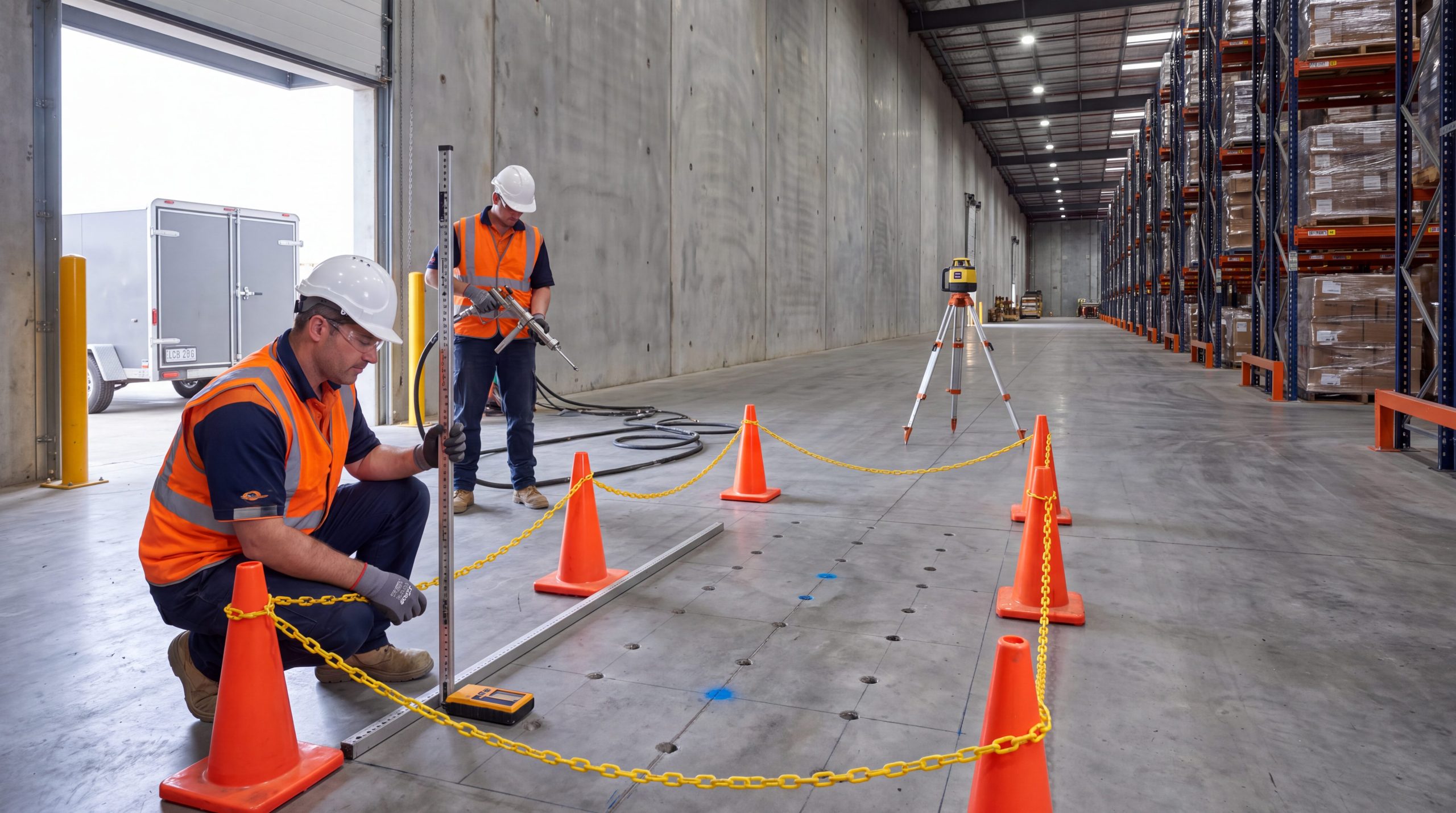
Polyurethane injection works beneath a foundation slab by filling the void first, then using controlled expansion to raise the slab while elevations are tracked.

Every step should leave a record the owner and the engineer of record can check later. The table below summarizes the general sequence for polyurethane injection beneath a commercial foundation slab.
| Step | What happens | What it leaves on record |
|---|---|---|
| 1. Survey | Elevations are taken across the settled area and fixed reference points; cracks and joints are mapped | Baseline elevations and a marked plan |
| 2. Port layout | Small ports, typically 5/8 inch, are drilled in a pattern set by void extent, joints and column lines | Port locations on the plan |
| 3. Void fill | Foam fills open space beneath the slab before any lift is attempted | Port by port injection log |
| 4. Monitored lift | Further injection raises the slab in small increments under lift monitoring | Lift readings during injection |
| 5. Patch | Ports are patched and the floor surface is cleaned | Patch completion |
| 6. Verify | Post-lift elevations are checked against the targets set in the scope | Post-lift elevation verification |
Filling voids comes before lifting for a reason. As the foam expands, it first takes up open space in the soil beneath the slab, and only once that space is full does further injection start to raise the concrete. Injecting small amounts through holes drilled in a planned order keeps that expansion controlled.
Lift monitoring is the continuous measurement of slab movement during injection, usually with a rotating laser level and receivers on grade rods. It matters more inside a building, where a floor slab meets walls, column pads, equipment bases and utility penetrations that should not be pushed out of position.
The material figures below are general method facts about polyurethane injection, not site data for any particular building:
The plan for a specific plant floor, including how much lift is appropriate, comes out of the site assessment and the owner's engineering review.
At Superior PolyLift, every injection is documented with field logs, material batch traceability and post-lift elevation verification, so the owner can compare the floor's elevation later with its elevation at closeout.
Deep soil stabilization injects slow-reacting polyurethane into weak soil below the slab zone, binding loose material before the foam expands, rather than filling a void directly under the concrete.
The difference from slab lifting is depth and timing. A slow-reacting polyurethane is injected at roughly 6 to 20 feet, where it has time to travel through loose or poorly compacted soil and bind it before it expands, firming up the layer that keeps allowing the slab to move.
It tends to come up where a slab settled again after an earlier repair, where a building sits on poorly compacted fill, or where probing during assessment finds loose material well below the slab.
It improves the soil supporting the slab; it does not repair piles, caissons or other deep foundation elements, and it does not stop an active sinkhole. Whether a site needs it, and at what depth, depends on the investigation and the owner's engineering review.
Foam foundation repair stops where the problem is no longer lost support beneath sound concrete, which is why engineering review must come before any injection on a building.

The limits are the most useful part of the scope, because they keep an owner from paying for a repair that cannot address the actual condition. Polyurethane injection is outside its range in these cases:
Superior PolyLift does not provide design or engineering services. The owner's licensed engineer of record decides whether distress comes from slab-zone settlement or something deeper. A site assessment contributes field evidence: measured elevations, observed voids, crack patterns, drainage findings and whether the slab appears to be a foam candidate. The table below shows who typically owns each decision.
| Decision | Typically owned by |
|---|---|
| Cause of building distress and structural adequacy | Owner's licensed engineer of record |
| Whether slab-zone injection is appropriate | Engineer of record, informed by the site assessment |
| Lift targets and acceptance tolerance | Engineer of record and the scope of work |
| Injection sequence, port layout and monitoring | The injection contractor, within the scope |
| Drainage and leak correction | Owner, through the appropriate trade |
| Closeout records | The injection contractor, delivered to the owner |
Outcomes on any specific building depend on that assessment and on engineering review. A foam proposal that skips this step, or promises a structural result, answers a question the method was never meant to answer.
Foam and traditional foundation repair address different layers of a building: foam restores support in the slab zone, while traditional methods such as piering or underpinning transfer loads to deeper soil.
For commercial sites the comparison is usually a sorting question, not a contest. If the slab is sound and lost support near the surface explains the settlement, polyurethane foam injection may be the proportionate repair. If the engineer finds that the building's load path needs to reach deeper, competent soil, through push piers, drilled piers or other underpinning or pier installation, that is a different scope and a different trade, and it usually involves excavation at the foundation.
| Factor | Polyurethane injection (slab zone) | Traditional deep repair (piers, underpinning) |
|---|---|---|
| Layer addressed | Slab and the soil beneath it | Load transfer to deeper soil or rock |
| Typical trigger | Voids or soft soil under sound concrete | Foundation elements that cannot carry their loads |
| Access needed | Small ports through the slab, typically 5/8 inch | Excavation or larger openings at the foundation |
| Operations impact | Work can be phased around operating hours | Depends on excavation and access |
| Who scopes it | Engineer of record, with injection contractor input | Engineer of record, with the specialty trade |
Superior PolyLift does not install piers or underpinning, so this comparison is context for specifiers rather than a sales argument.
Houston soils matter because the reason a slab lost support usually decides whether foam is appropriate, and local clay and water conditions are common causes.
Much of the Houston area sits on expansive clay soils, including the Houston Black clay series, a Vertisol that shrinks as it dries and swells as it takes on water. Those shrink-swell cycles can open voids beneath a slab in dry periods and soften the subgrade in wet ones, while sandy soils and fill near drainage paths are more prone to soil erosion. On large buildings, a geotechnical report from construction, where one exists, is a useful starting point for the assessment. High water tables and coastal subsidence add their own movement, and wet seasons load perimeter drainage.
A perimeter slab that settled after a wet season may point to runoff softening the subgrade; interior settlement along a utility corridor may point to consolidating backfill or a leak. Each pattern suggests different related work: regrading, downspout extensions, leak repair or deep soil stabilization.
None of those patterns is a diagnosis on its own, and regional subsidence differs from local slab settlement. Sorting causes is part of the site assessment and engineering review, and it keeps a lift from being undone by the condition that caused the settlement.
Before injection, owners and specifying engineers should settle the cause, the scope boundaries, the lift targets, the operating constraints and the closeout records, in writing.
A clear pre-work agreement stops a low proposal from quietly dropping monitoring or records, and gives the contractor a defined stopping point if the assessment finds a condition outside the foam scope. It is a starting point, not a substitute for the engineer of record's judgment.
Actionable Tip
Before the site assessment, mark every settled area on a floor plan and note the measured drop, nearby downspouts or drain lines, equipment or racking on the slab, and the hours each area can be closed. Hand that sheet to your engineer of record and the injection contractor so cause, scope boundaries and phasing start from the same field data.
On municipal and federal facilities, the same list feeds procurement documents, so proposals can be compared on equal terms.
Longevity depends mainly on whether the cause of settlement was corrected. Cured polyurethane foam is a rigid closed-cell material, but if a leak, poor drainage or weak soil below the slab zone keeps removing support, the slab can move again. That is why the scope should name the cause and the related work, and why service life for a specific building is a question for site assessment and engineering review.
It works on commercial and industrial buildings where the floor or foundation slab is sound and settlement comes from lost support in the soil beneath it. Warehouse floors, plant slabs and slabs inside municipal buildings are typical application types. It does not address structurally failed concrete or problems in piles and caissons. Whether a specific building fits is decided by site assessment and the owner's engineering review.
Polyurethane injection restores support and elevation to sound concrete in the slab zone. It does not repair structurally failed concrete, fix deep foundation failure in piles or caissons, or stop an active sinkhole. It also cannot keep a slab in place if an active leak or drainage problem continues to wash out or soften the soil, so that problem must be corrected alongside the repair.
Cost is driven by the extent and depth of voids, the area to be lifted, the need for deep soil stabilization, access inside an operating building, phasing requirements such as night or weekend work, monitoring and the closeout records required. Related work, such as drainage or leak correction, is usually scoped separately. Because those drivers vary from site to site, cost is set after a site assessment rather than from a general figure.
Polyurethane injection restores support beneath a slab, but load performance depends on slab thickness, subgrade condition, void extent and the loads involved, from forklift traffic to racking and equipment bases. Lifting foams are typically 4 to 8 lb/ft³, which keeps added weight on the subgrade low. Whether a specific industrial floor suits the method under its loads is a question for site assessment and the owner's engineering review.
No. Foam foundation repair works in the slab zone, filling voids and lifting or stabilizing soil beneath a sound slab. Underpinning and piering transfer building loads to deeper soil through added structural elements. They answer different problems, and an engineer of record decides which one a building needs. Superior PolyLift performs polyurethane injection only and does not install piers or underpinning.
Foam foundation repair earns its place on a commercial site when the scope is clear: sound concrete, lost support in the slab zone, a named cause and an engineer who has agreed the boundaries. Superior PolyLift works only on commercial, industrial, municipal and federal infrastructure, and our team reviews each foundation slab against those boundaries before injection is proposed. For more on the service, see our page on foundation repair with polyurethane foam. When you send a message through our contact page, include a floor plan of the settled areas, the loads they carry and any drainage history so our team can judge whether each area is inside the foam scope.
Call (866) 912-3281 to review where your foundation slab sits against these scope limits, or Request a site assessment for the settled floor areas.
Explore how our expertise can benefit your project. Reach out to our team for a consultation and discover the best solutions for your needs.

At Superior PolyLift™, integrity and reliability are the core of our ethos. Our expert team crafts custom solutions that guarantee quality and durability for every project. Choose us for geotechnical excellence that endures.
Copyright © All rights reserved. 2024 • Terms of Use and Privacy Policy • Internet Marketing by Authority Solutions®